Pick your cat up. Feel the weight of it. Notice how it sits — whether it sprawls wide or folds itself neatly. Watch it move across the room. Is it long and fluid, almost snaking across the floor? Or does it move like a solid little tank, compact and deliberate?
Most people trying to figure out their cat's breed go straight to the coat. That's a reasonable instinct — coat is the most visible feature. But experienced breeders, show judges, and veterinarians typically start somewhere else entirely. They start with the body.
A cat's skeletal structure, muscle mass, limb proportions, and overall silhouette are shaped by genetics in ways that persist even in mixed-breed cats. A cat that carries Maine Coon ancestry several generations back may not have the full coat — but the frame often remains. Long-bodied, heavy-boned, wide-chested. The body remembers what the coat sometimes forgets.
This guide breaks down the main feline body types, what each one signals about breed heritage, and how to assess your own cat's build accurately.
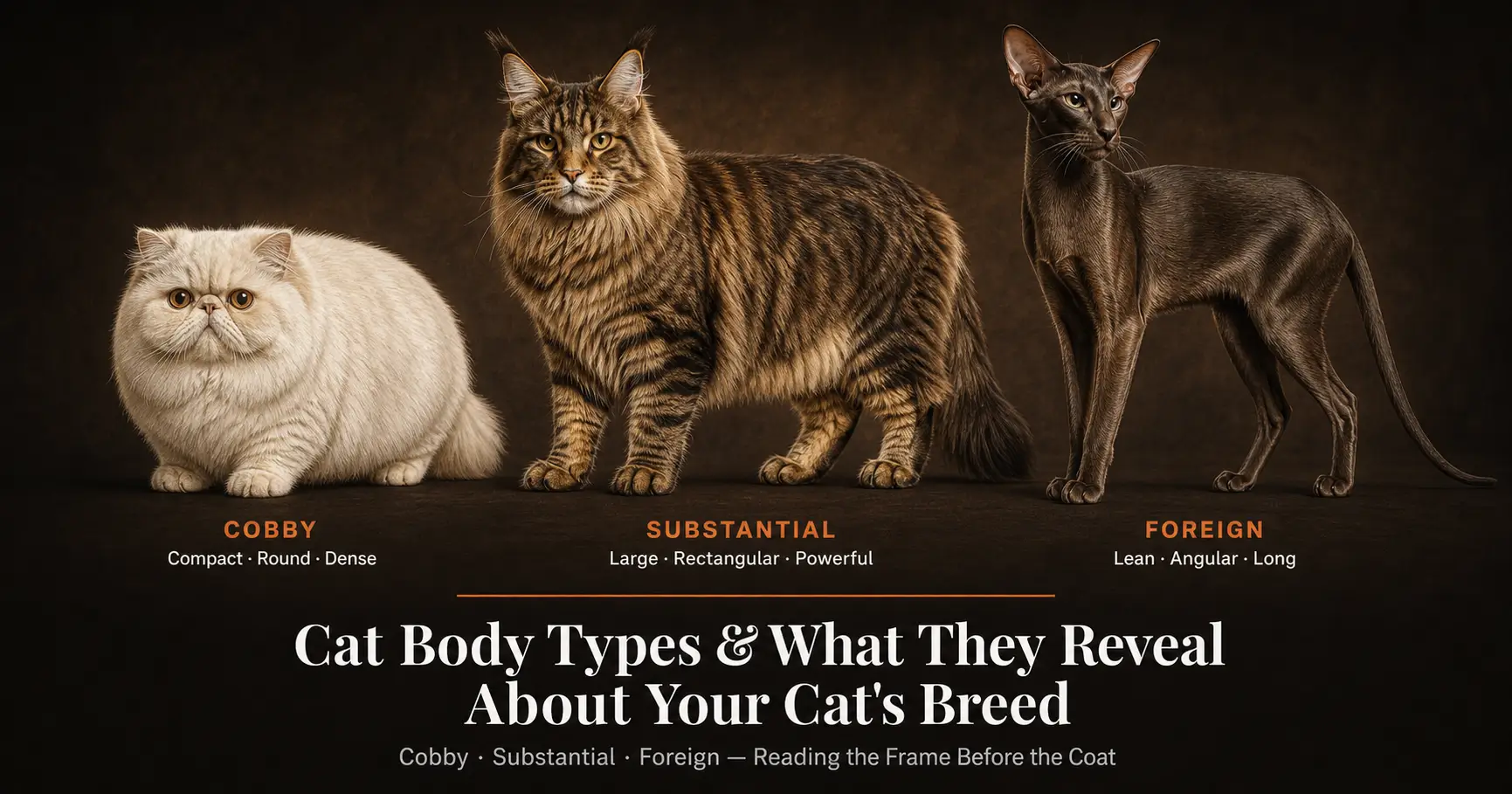
Why Body Type Holds Up Better Than Coat in Mixed Breeds
Coat color and pattern can shift dramatically across generations. A single recessive gene can suppress a distinctive pattern entirely — producing a cat that looks completely ordinary on the surface while carrying significant breed genetics underneath.
Body conformation is harder to dilute. Bone structure, chest width, leg-to-body ratio, and tail thickness are polygenic traits — controlled by multiple genes working together. That complexity actually makes them more stable across generations, not less. A mixed-breed cat with a cobby great-grandparent will often still show a wider chest and shorter legs than a purely foreign-type lineage would produce.
This is exactly why body type belongs at the beginning of any breed identification process — not at the end. Start with the frame. Everything else builds on it.
For a broader look at how body, coat, face, and eyes work together as an identification system, this guide covers the full picture.
The Three Core Body Types
Cat registries and breeders use a concept called conformation to describe a cat's physical structure relative to its breed standard. While classification systems vary slightly between organizations, three broad body type categories are recognized across virtually all of them.
The Cobby Type
Cobby cats are built low and wide. Think of the word "cobby" as meaning compact, dense, and rounded — like a rugby player rather than a sprinter.
The key characteristics:
- Short legs relative to the body — the belly sits close to the ground
- Wide, barrel-shaped chest — noticeably broader than a foreign-type cat
- Rounded head — broad skull, full cheeks, short muzzle
- Short, thick neck — minimal length between head and shoulders
- Dense, substantial feel when held — cobby cats feel heavier than they look
If you put a cobby cat on a flat surface and look at it from the side, the body appears almost as wide as it is tall. The silhouette is round and full — almost bear-like.
Breeds with a cobby build:
The Persian is the most extreme cobby — so compact and low that its belly nearly touches the ground in a relaxed sitting position. The British Shorthair is the other classic example: round-headed, wide-chested, and solidly built without being fat. The Scottish Fold and Exotic Shorthair also fall clearly into this category.
One thing worth noting about cobby cats: their weight can surprise people. A British Shorthair male that looks medium-sized often tips the scale at 12–16 lbs because of bone density and chest width. If you pick up your cat expecting something light and find it surprisingly heavy for its visual size, cobby genetics are almost certainly involved.
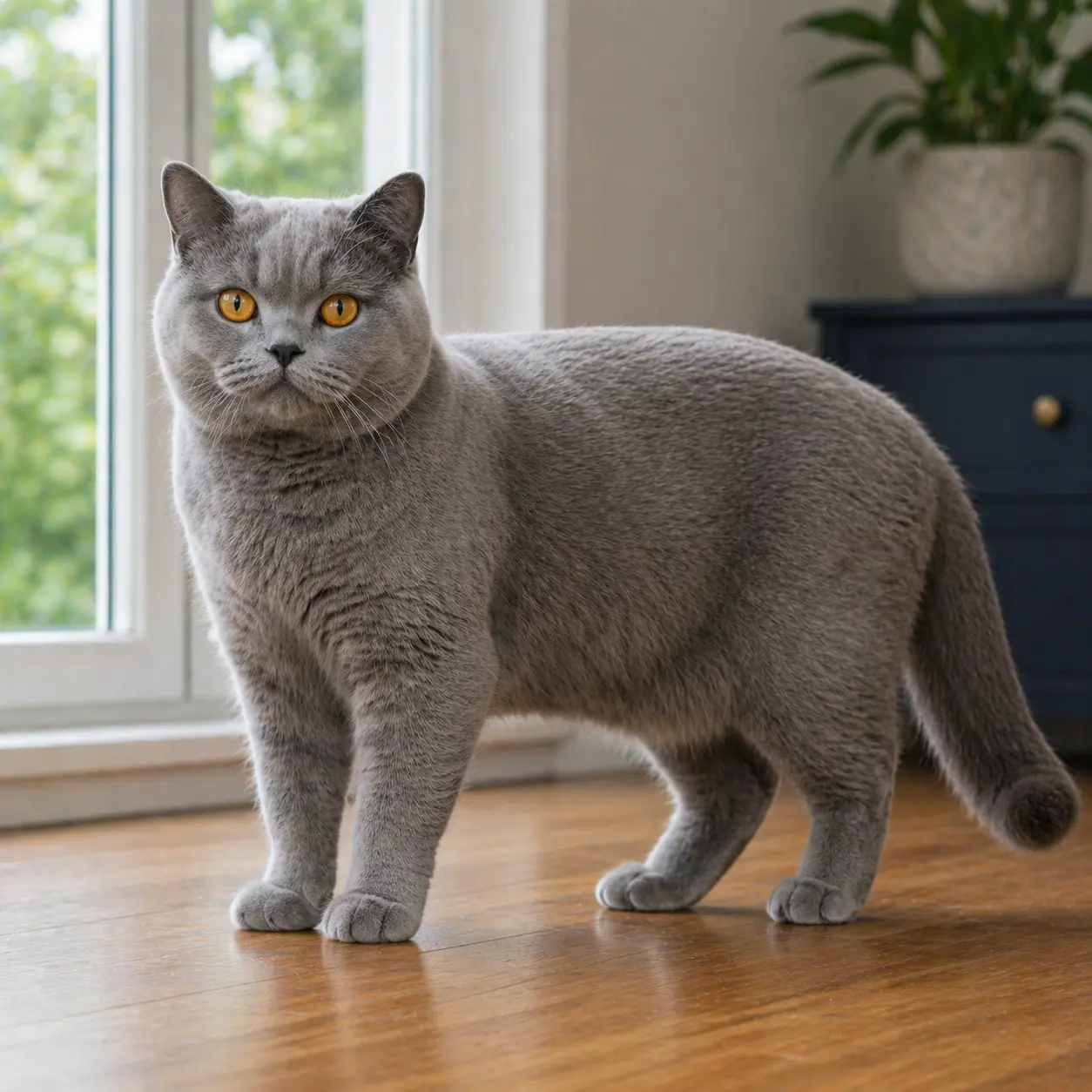 Caption: The British Shorthair is a textbook cobby cat — round, wide, dense, and built closer to the ground than its size suggests.
The Foreign and Oriental Type
At the opposite end of the spectrum: the foreign type. Where cobby cats are round and wide, foreign-type cats are long, lean, and angular. Everything about them points outward — long limbs, long neck, long tail, elongated head.
Characteristics of the foreign type:
- Long, slender legs — the body sits high off the ground
- Narrow, wedge-shaped or triangular head — tapering from large-set ears to a pointed muzzle
- Lean, tubular body — almost no width to the chest when viewed head-on
- Long, whip-thin tail — often as long as or longer than the body
- Lighter than they appear — the frame looks substantial but weighs less than cobby cats of similar height
These cats move differently too. They are fluid and fast, with a gait that looks almost mechanical in its precision. Watching a Siamese move across a room is genuinely different from watching a British Shorthair cover the same distance.
Breeds with a foreign build:
The Siamese is the reference point for the foreign type — long, angular, and unmistakably narrow. The Oriental Shorthair and Balinese share the same underlying structure. The Abyssinian is classified as semi-foreign — sharing the leanness and length without the extreme wedge head and angular angularity of a true Siamese. The Cornish Rex and Sphynx are also built on a foreign or semi-foreign frame.
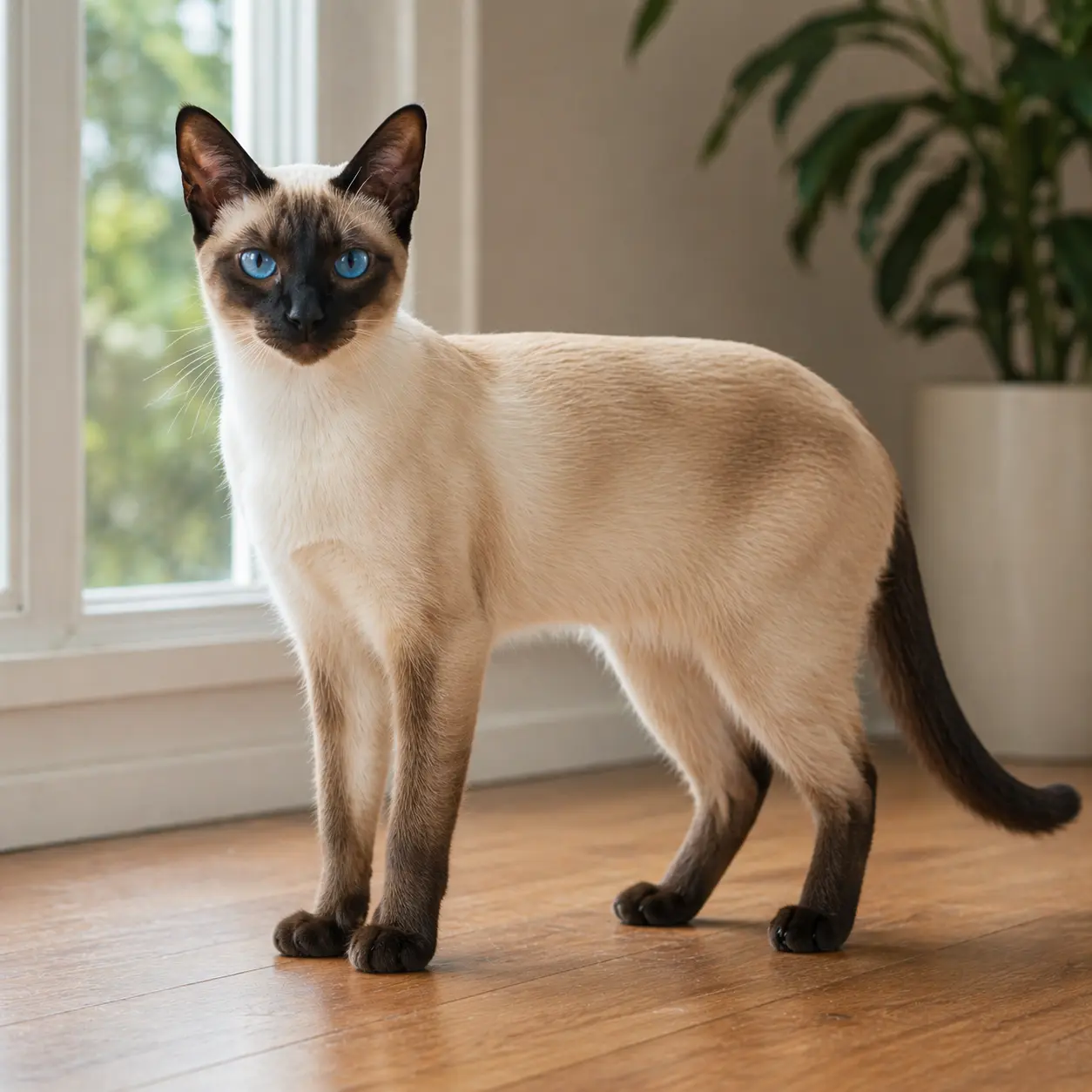 Caption: The Siamese exemplifies the foreign body type — lean, long, angular, and built entirely differently from the cobby breeds.
The Substantial or Semi-Foreign Type
Between the extremes sits the largest and most varied category: cats that are neither compact nor extreme, but large-framed and powerfully built. Sometimes called "substantial," "semi-foreign," or simply "moderate" depending on the classification system used.
These cats are:
- Large to very large — the biggest recognized breeds all fall here
- Rectangular rather than round — the body is longer than it is wide, with a broad chest that isn't cobby
- Heavy-boned — thick legs, wide paws, solid jaw
- Long, well-developed tails — often as remarkable as the rest of the cat
- Slow to mature — most large-framed breeds don't reach full size until age 3–5
Breeds in this category:
The Maine Coon and Norwegian Forest Cat are the most prominent examples — both large, heavily boned, and rectangular in frame. The Ragdoll falls here too, combining size with a semi-cobby softness. The Siberian and Turkish Van also belong in this group.
These are the breeds people are thinking of when they describe a cat as "the size of a small dog." A fully mature Maine Coon male has a chest width and leg thickness that genuinely resembles a scaled-down version of a large domestic dog more than a typical cat.
Caption: The Maine Coon's rectangular, heavy-boned frame is the defining feature of the substantial body type — breed recognition often starts with size and bone structure before anything else.
A Closer Look: What Specific Structural Features Tell You
Body type categories are useful as a starting point. But within each category, specific structural details carry additional breed signals. Here is what to look for when you go beyond the broad classification.
Leg Length and Proportion
Leg length relative to body length is one of the most readable breed signals in domestic cats. Measure it visually: when your cat stands, how much clearance is there between the belly and the floor?
A cobby cat's belly nearly grazes the ground. A foreign-type cat stands notably high — the legs are long enough that the body appears suspended. Substantial-type cats fall between these extremes but are often broader and heavier rather than tall.
One notable exception: Munchkin cats have a natural genetic mutation that dramatically shortens the leg bones while leaving everything else intact. A Munchkin has a normal-length body on legs that are roughly half the expected height. This is distinctive enough that it is almost immediately recognizable — though the mutation can appear in mixed-breed cats when Munchkin genetics are present.
Chest Width and Depth
Stand behind your cat and look at it from the back as it sits. How wide is the shoulder-to-shoulder span?
A cobby chest appears wide even from behind — the shoulders are set far apart. A foreign-type chest is narrow — from behind, the cat almost looks two-dimensional. A substantial chest is wide and deep, with visible muscle mass across the shoulders.
This single observation — the width of the chest when viewed from behind — often eliminates half the breed possibilities immediately.
Tail Characteristics
Tail length, thickness, and texture are underappreciated body type signals.
| Tail Type | Description | Associated Breeds |
|---|---|---|
| Long, plumed | Full length with thick, flowing hair — often as long as the body | Maine Coon, Norwegian Forest Cat, Ragdoll |
| Long, whip-thin | Full length but very fine — tapers sharply to the tip | Siamese, Oriental Shorthair, Abyssinian |
| Medium, thick | Moderate length, good substance, rounds slightly at tip | British Shorthair, American Shorthair, Russian Blue |
| Naturally bobbed | Significantly shortened — a stump or pom-pom shape | Manx, Japanese Bobtail, American Bobtail |
| Kinked | Full length with a visible bend or kink near the tip | Some Siamese lines, Thai cats, random-bred cats |
A naturally bobbed tail is particularly diagnostic because it results from a specific genetic mutation — it doesn't appear by coincidence or dilution. If your cat has a noticeably short tail without any injury history, a natural bobtail gene is almost certainly present somewhere in its ancestry.
Paw Size and Shape
Paws are often overlooked entirely in breed identification. They shouldn't be.
Large, round, tufted paws — where tufts of hair grow between the toes and the paw spreads wide — are characteristic of cold-weather large-breed cats. Maine Coons famously have paws that look almost snowshoe-like. Norwegian Forest Cats share this trait. The tufting between the toes is a functional adaptation to walking on snow that was preserved through selective breeding.
Oval, elegant paws with clean lines and no tufting appear on foreign-type cats — Siamese, Abyssinian, Oriental. Compact, round, unadorned paws belong to cobby breeds.
Polydactyl cats — those with extra toes — deserve a mention here. Extra toes result from a dominant genetic mutation that appears in certain Maine Coon lines, Pixie-Bobs, and some random-bred populations. A polydactyl cat carries at least one copy of the Pd gene. This trait is impossible to confuse with anything else once you see it.
Neck and Shoulder Structure
A short, thick neck connecting directly to wide shoulders is cobby. A long, elegant neck that rises clearly from the shoulders before curving to the head is foreign-type. A substantial, muscular neck that is moderate in length but heavy in mass is typical of large-framed breeds.
This structural detail is most visible when the cat is alert — head raised, ears forward. At rest, neck length is harder to assess because cats compress themselves.
Body Type in Mixed Breed Cats
The majority of cats in homes worldwide are mixed breeds of unknown ancestry. Understanding body type in this context requires some adjustment in expectations.
Mixed-breed cats rarely fit perfectly into one category. What you typically see is a combination of structural features from multiple breed lines — expressed at varying intensities depending on which genes dominated in each generation.
Some combinations appear frequently:
Large frame + lean build — a cat that is tall and long-legged but not cobby and not as angular as a true foreign type. This often suggests a mix of substantial and foreign ancestry — for example, a Maine Coon/Siamese background might produce a cat that is large and long without being either heavy-boned or narrow-chested.
Medium frame + wide chest — common in cats with British Shorthair or American Shorthair in the background mixed with something less extreme. The cobby tendency shows in chest width without producing the full compactness of a purebred cobby cat.
Small, neat body + large ears — often suggests Abyssinian or Oriental influence mixed with a smaller domestic breed. The foreign-type ears persist even when the body frame is smaller than a purebred would produce.
The most important thing to remember: body type in a mixed-breed cat is directional evidence, not a confirmed answer. It tells you what to investigate, not what to conclude. Our mixed breed identification guide covers how to build a case from multiple physical clues — including body type as one layer of a larger picture.
The Body Type Comparison Table
| Body Type | Build | Legs | Chest | Head Shape | Typical Weight | Key Breeds |
|---|---|---|---|---|---|---|
| Cobby | Compact, round, low | Short | Wide, barrel | Round, full-cheeked | 7–16 lbs | Persian, British SH, Scottish Fold, Exotic SH |
| Semi-Cobby | Compact but taller | Medium-short | Broad | Round to modified wedge | 8–15 lbs | Ragdoll, American SH, Burmese |
| Semi-Foreign | Athletic, balanced | Medium | Moderate | Modified wedge | 6–12 lbs | Abyssinian, Russian Blue, Devon Rex |
| Foreign / Oriental | Long, lean, angular | Long | Narrow, tubular | Wedge, triangular | 5–10 lbs | Siamese, Sphynx, Oriental SH, Cornish Rex |
| Substantial | Large, rectangular, powerful | Medium-long, thick | Very broad, deep | Square muzzle or broad wedge | 10–20+ lbs | Maine Coon, Norwegian FC, Siberian, Turkish Van |
| Munchkin (dwarf) | Normal length body, very short legs | Very short (mutation) | Normal | Normal, rounded | 5–9 lbs | Munchkin, Lambkin, Minuet |
Reading Your Own Cat's Body Type: A Practical Method
Assessing your cat's body type is easier than it sounds — you don't need calipers or a breed chart. Here is a straightforward process that takes about five minutes.
Observe from the side first. Stand level with your cat while it is standing still on a flat surface. Look at the relationship between leg length and body depth. Is the body much deeper than the legs are long (cobby)? Or do the legs extend significantly below the belly (foreign)?
Then look from behind. Stand at the cat's tail end and look down the length of its back toward the head. This angle shows chest width clearly. A wide cobby chest appears like a broad V from this angle. A foreign-type chest is narrow — almost like looking down a tube.
Assess the head-to-body proportion. In cobby cats, the head is large relative to the body — a round head on a round body. In foreign types, the head appears small and angular relative to the lean body. Substantial-type cats have heads that are proportionally moderate — large in absolute terms but not oversized for the frame.
Check the tail. Lay the tail flat against the body and note its length. Does it reach the shoulder blade? The base of the neck? Does it extend beyond the body length entirely?
Weigh if possible. If you have a way to weigh your cat, the number is informative. Anything over 12 lbs in an adult cat that isn't visibly overweight strongly suggests substantial-type genetics. A cat under 8 lbs with long legs is almost certainly foreign-type.
Once you have a body type assessment, you have the foundation for a breed hypothesis. The coat pattern, facial features, and ear shape then layer on top of that foundation. If you want to skip the manual process entirely, the What is My Cat Breed Quiz works through these physical features as questions — including body type — and returns a breed result at the end.
How Body Type Connects to Behavior and Health
Body type is not purely aesthetic. It has real implications for how a cat moves, what health conditions it may face, and even how it tends to behave.
Cobby cats — particularly extreme cobby breeds like the Persian — often have brachycephalic (flat-faced) features alongside their compact frames. This combination creates respiratory considerations: shorter nasal passages, potential for breathing difficulty, and sensitivity to heat. Cobby cats also tend toward sedentary behavior. They are not lazy — they are built for stillness. A Persian or British Shorthair conserves energy in a way a Siamese never would.
Foreign-type cats are metabolically active. Their lean frames need adequate caloric intake and regular physical engagement. These breeds tend toward higher stress responses if under-stimulated and can develop behavioral issues — excessive vocalization, destructive behavior, anxiety — when their exercise and mental stimulation needs go unmet.
Substantial cats — particularly large-framed breeds — mature slowly and need joint health monitoring as they age. The sheer mass of a fully grown Maine Coon places more stress on joints than a 7 lb Abyssinian. Large-breed cats also benefit from larger litter boxes, sturdier cat furniture, and feeding approaches that support slow growth rather than rapid weight gain in kittenhood.
For a fuller picture of how body type connects to temperament and care needs, the overview of common domestic breeds covers personality and care alongside physical traits for each major breed family.
Feline body conformation is also discussed in broader context in the Wikipedia article on cat anatomy, which covers skeletal structure and musculature in detail for readers who want the biology behind what they're observing.
When Body Type Gives Conflicting Signals
Body type assessment sometimes produces genuinely contradictory results — a cat with a cobby chest but long legs, or a large frame with a narrow, foreign-type head. This is not a failure of the method. It is accurate data about a mixed-breed cat's genetics.
What contradictory signals usually mean:
-
The cat carries genetics from more than one body type family — the most common explanation. A cat with one cobby parent and one foreign-type parent may land somewhere in between on every measurement, or may express cobby features in some areas and foreign features in others.
-
One trait was dominant enough to show clearly while the other was diluted — you might see a foreign-type head on a semi-cobby body, because the head-shape gene was more dominant in that particular genetic combination.
-
The cat is overweight — excess weight can make a naturally lean cat look wider and shorter. Assess body type on a cat at its healthy weight, not on a cat that is visibly overweight.
When body type signals conflict, don't force a conclusion. Note the mixed signals, weight each feature appropriately, and use coat pattern and facial structure — covered in our cat coat patterns guide — to add further layers to the analysis.
We have put together a visual infographic that summarizes all the major cat body types, their key structural features, and their breed associations in one easy-to-read reference. It covers everything in this article in a format you can save and refer back to whenever you need it.

Frequently Asked Questions
How do I know if my cat is cobby or foreign type?
The quickest method is the side-view test. Place your cat on a flat surface and observe it from the side while it stands. If the belly sits close to the ground with short visible leg length, the build is cobby. If the legs are clearly long and the belly sits high, the build is foreign. Chest width from behind is the confirming view — wide for cobby, narrow for foreign. Most cats fall clearly into one category within a few seconds of observation.
Can a mixed-breed cat have a cobby body but a foreign-type head?
Yes — and this is actually fairly common in mixed-breed cats. Body structure and head shape are controlled by different gene sets. A cat can inherit a wide, heavy-boned chest from one parent and a narrow, angular head from the other. This kind of structural mixing is one of the clearest signs of mixed heritage, and it can help narrow down which breed families are likely present.
Does my cat's body type affect its health?
It does, in meaningful ways. Cobby cats — especially flat-faced varieties — can have breathing and dental issues related to their compressed skull structure. Large, heavy-boned cats face greater joint stress as they age and are more prone to obesity-related problems. Lean foreign-type cats need more calories for their activity level and can develop stress-related conditions if under-stimulated. Understanding body type helps you anticipate and manage these risks proactively.
What body type do most domestic mixed-breed cats have?
Most random-bred domestic cats fall into a moderate middle range — not extreme cobby and not extreme foreign. They tend toward a medium frame with moderate leg length and a head that is neither fully round nor fully wedge-shaped. This is sometimes called the "moderate" or "balanced" type. It reflects the averaging effect of mixing multiple different genetic lines over generations — extreme traits from either direction tend to soften toward the middle in mixed populations.
Is a large cat automatically a Maine Coon mix?
Not automatically — but large size is one of the stronger signals of Maine Coon or similar large-breed ancestry, especially when combined with other structural clues like ear tufts, a broad chest, tufted paws, and a heavy tail. Size alone doesn't confirm it. An overweight cat of any breed can appear large. The combination of genuine skeletal heaviness, large paw size, and characteristic ear tufts is much more diagnostic than weight on its own. You can find out more at www.whatismycatbreed.com by uploading a photo for an instant visual breed analysis.