Every domestic cat alive today traces its ancestry to a single wild species: Felis silvestris lybica — the Near Eastern wildcat. One origination point. And yet we ended up with the massive cold-weather Maine Coon, the sleek heat-adapted Abyssinian, the water-resistant Norwegian Forest Cat, and the flat-faced Persian. All looking and functioning completely differently from each other.
That transformation didn't happen in a breeding programme. It happened across thousands of years of geographic isolation, climate pressure, and trade routes. Cat breeds by country of origin reflect something concrete and physical — cats in Scandinavian winters developed different coats, frames, and faces than cats in Southeast Asian courts or North African port cities. That divergence was driven entirely by survival, not aesthetics.
This is not just cat history. It has direct practical value for breed identification. Climate and geography shaped coat density, body mass, leg length, and facial structure in consistent, predictable ways. A cat's region of origin tells you what to expect physically — before you have looked at a single breed profile.
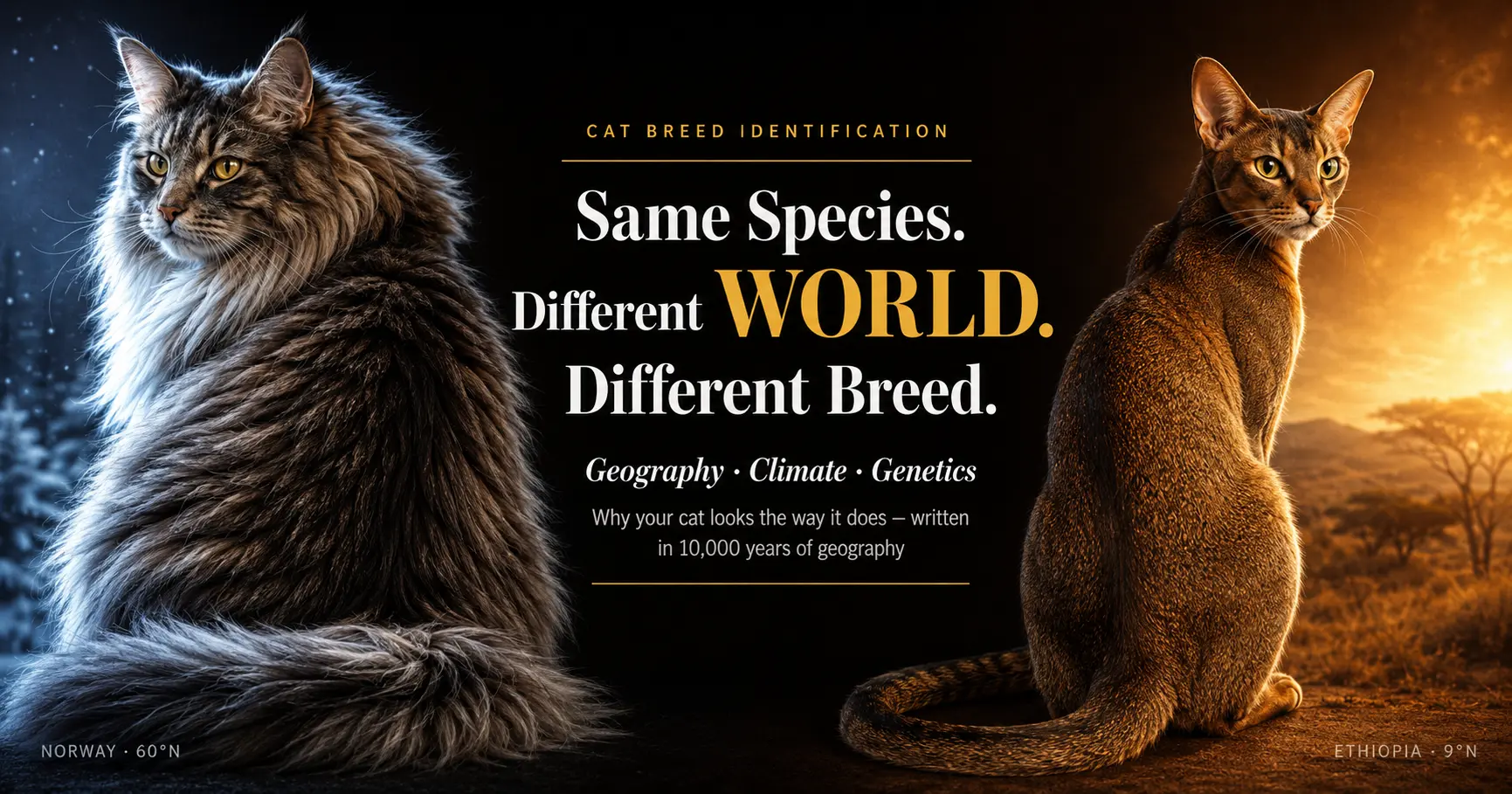
Cat Breed Origins: What Geography Actually Did to Feline Genetics
Domestic cat domestication began approximately 10,000 years ago in the Fertile Crescent — the agricultural region spanning modern Turkey, Syria, and Iraq. Wildcats moved toward early human settlements because grain stores attracted rodents. Humans tolerated the cats. A working relationship developed without deliberate human selection.
From that origination point, cats spread in waves. They followed trade routes into Egypt and then across the Mediterranean. They moved with Viking longships into Scandinavia. Merchant vessels carried them into Southeast Asia and Japan. Each population that became geographically isolated began to diverge — slowly, driven by climate and natural selection rather than human breeding programmes.
Natural breeds — sometimes called landraces — emerged from this process. The Norwegian Forest Cat, the Turkish Van, the Siberian, the Abyssinian, and the Japanese Bobtail all developed without deliberate human intervention. The specific physical traits these breeds carry today reflect the environments their ancestors occupied for hundreds or thousands of years. Dense double coats in cold climates. Fine single coats in hot ones. Heavy frames in northern populations. Lean, long-legged frames in populations that evolved near the equator.
Selective breeding — where humans deliberately crossed cats to fix specific traits — is comparatively recent. Most modern breed standards date to the late 19th century. The Cat Fanciers' Association, founded in 1906, formalised many Western breed standards that had already existed in regional populations for centuries before any registry recorded them.
I have found this geographic framework more useful than any breed chart for making a first-pass identification on an unfamiliar cat. If you know which climate the likely ancestors came from, the coat and body type follow logically. The geography does most of the sorting for you.
Cold Climates and Heavy Coats: The Northern Breeds
The most visually dramatic effect of geographic origin on cat appearance is the coat response to cold climate. Northern breeds developed substantial insulating coats as a direct survival adaptation — and those coats are immediately identifiable today.
The Norwegian Forest Cat evolved along Norway's western fjord coast, where winters are harsh and wet. Its coat reflects this precisely: a dense, water-resistant outer layer of guard hairs sits over a thick insulating undercoat. The fur lies relatively flat, repelling water rather than trapping it. The prominent ear tufts and inner furnishings protect the ear canal from wind and cold. The strong, wide-chested body reflects the physical demands of outdoor survival in a coastal Norwegian winter.
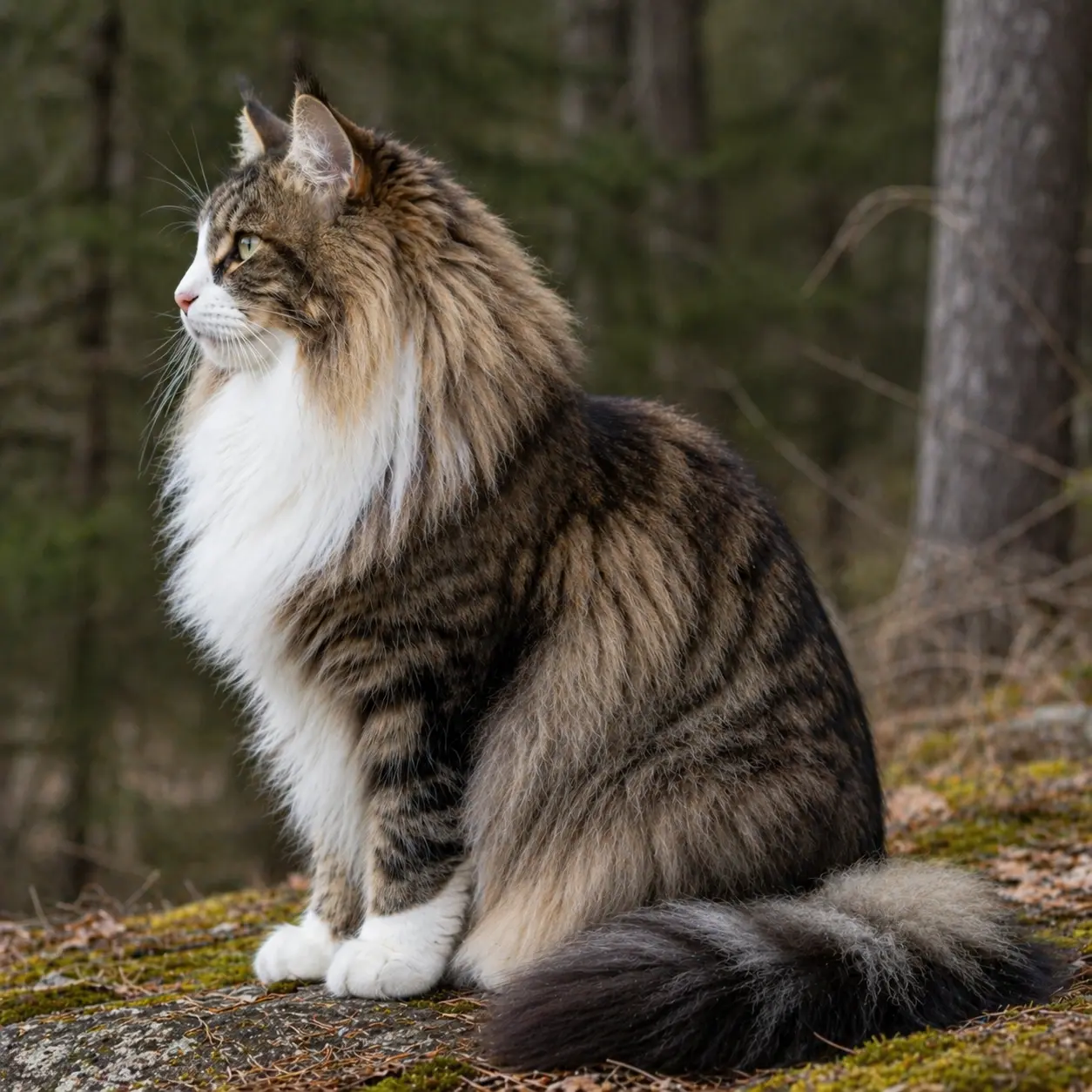
The Siberian developed across Russia's vast cold interior — a more extreme climate than Norway. It carries a similarly dense triple coat with a thick ruff around the neck, heavy ear tufts, and a substantial barrel-chested frame. Siberians run noticeably heavier than Norwegian Forest Cats of the same sex. The greater cold demanded greater body mass for heat retention — and that mass remained after millennia of natural selection fixed it in the population.
The Maine Coon developed along the northeastern coast of North America — cold winters and variable coastal conditions. Its shaggy, layered coat is water-resistant without being as uniform as the Norwegian Forest Cat's — it varies in length across the body, longest on the ruff, belly, and tail. The large, wide, tufted paws functioned as natural snowshoes. The heavy, muscular frame and rectangular skull reflect functional utility rather than aesthetic selection.
Cold-climate breeds share three consistent traits: dense multi-layered coats, substantial body mass, and pronounced ear furnishings. When you see all three together, you are looking at northern hemisphere genetics — regardless of which specific breed is involved.
The Russian Blue developed in the port city of Arkhangelsk in northern Russia. Unlike the longhaired northern breeds, it carries a dense plush double coat that lies close to the body — exceptionally warm despite its short length. The blue-grey coat colour became fixed in an isolated northern population where camouflage in low-light, snowy environments offered genuine survival advantage.
The Middle East and Africa: Where Domestic Cats Began
The Middle East and North Africa hold the deepest cat genetics of any region. Cats in this zone were not shaped by cold or isolation — they were shaped by heat, open terrain, and thousands of years of proximity to human agricultural settlements.
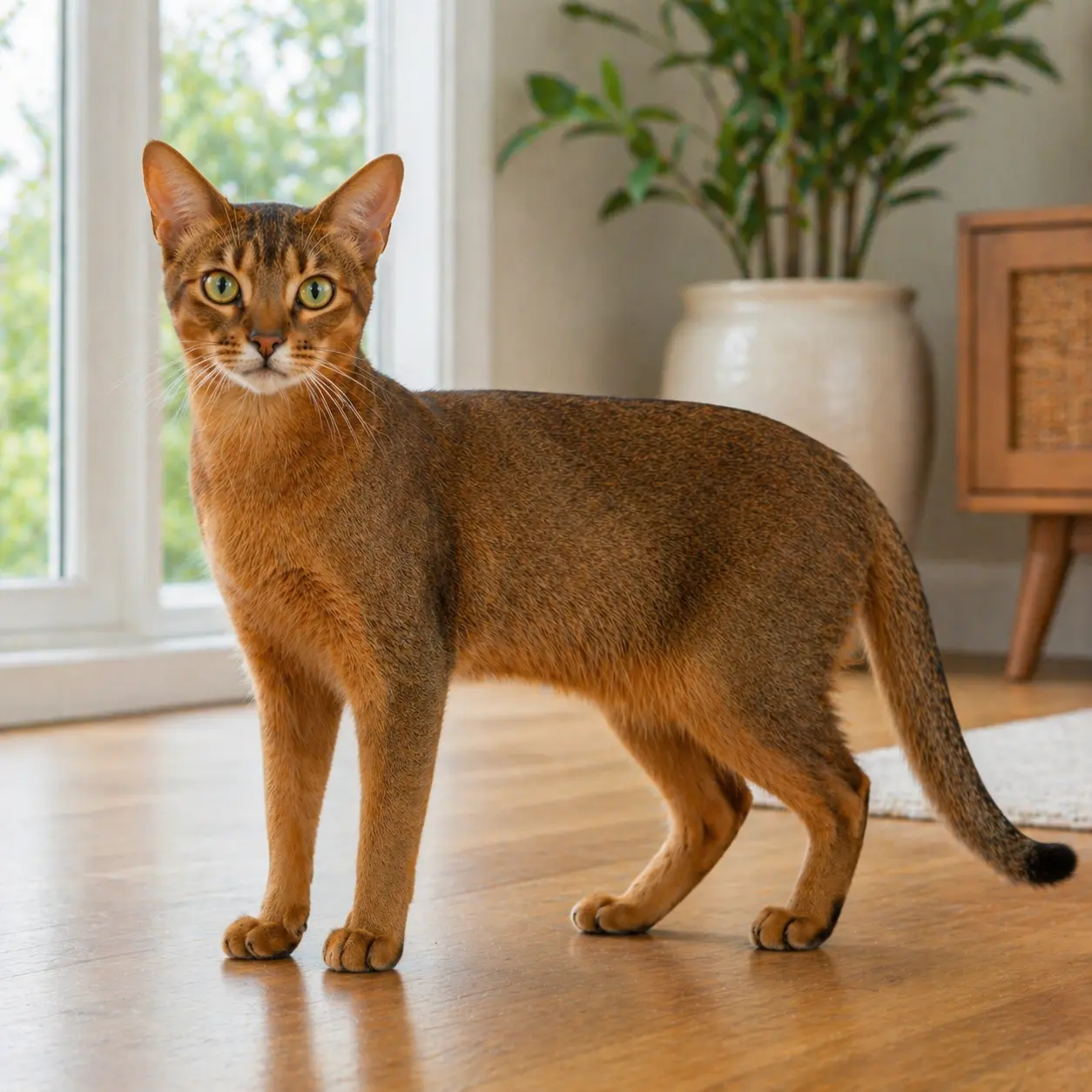
The Abyssinian traces its origin to the Ethiopian highlands — the region surrounding the ancient kingdom of Abyssinia, modern Ethiopia. Its ticked coat — where each individual hair carries alternating dark and light bands — is the closest pattern to the wildcat ancestor's agouti coat that exists in any domestic breed. The lean, fine-boned frame, long legs, and large ears all reflect adaptation to hot open environments where agility and heat dissipation mattered more than insulation.
The Egyptian Mau is the only naturally spotted domestic cat breed — its spots are not a product of selective breeding but of a genuine genetic mutation that stabilised in a North African population over centuries. Ancient Egyptian artwork from 1550 BCE depicts spotted cats closely resembling the modern Mau. The breed carries unusually fast running speed for a domestic cat — a trait that served a functional purpose in its original open-terrain environment.
The Turkish Angora and Turkish Van both developed in Anatolia — the central plateau of modern Turkey. Both carry different coats despite sharing the same geographic origin. The Turkish Angora's long, fine, silky coat lacks any dense undercoat — it is a warm-climate longhair, fine rather than insulating. The Turkish Van carries a semi-long cashmere-like single coat that doesn't mat — adapted for hot, dry Anatolian summers rather than cold winters.
Smithsonian Magazine's coverage of a landmark cat domestication genomics study confirmed the Near Eastern wildcat as the sole wild ancestor of all domestic cats, with early domestication centred in the Fertile Crescent region. The spread from that original population across trading routes into Africa, Europe, and Asia explains why Middle Eastern and North African breeds carry the greatest genetic diversity — they represent the oldest domestic populations on earth.
The Persian is often assumed to originate from Persia (modern Iran). Its actual breed history is more complex. Long-coated cats imported to Europe from the Middle East in the 1600s were significantly modified through European selective breeding. The modern Persian's extreme flat face and dense coat are the product of 150-plus years of Western breeding programmes — not the original imported cats.
Breed Origins by Region — The Complete Reference Table
| Breed | Country / Region | Origin type | Climate | Key physical adaptation |
|---|---|---|---|---|
| Norwegian Forest Cat | Norway | Natural landrace | Cold, wet coastal | Water-resistant double coat |
| Siberian | Russia | Natural landrace | Extreme cold interior | Triple coat, heavy barrel chest |
| Maine Coon | USA (Northeast) | Natural landrace | Cold, variable coastal | Shaggy layered coat, tufted paws |
| Russian Blue | Russia (Arkhangelsk) | Natural landrace | Cold northern port | Dense plush short double coat |
| British Shorthair | United Kingdom | Natural + selective | Cool, temperate maritime | Dense plush short coat, cobby frame |
| Scottish Fold | Scotland | Mutation + selective | Cool, temperate | Folded ear cartilage mutation |
| Devon Rex | England (Devon) | Mutation + selective | Temperate | Rippled sparse coat mutation |
| Cornish Rex | England (Cornwall) | Mutation + selective | Temperate | Wavy coat — no guard hairs |
| Manx | Isle of Man, UK | Mutation + island isolation | Cool, maritime island | Tail-loss mutation fixed by isolation |
| Abyssinian | Ethiopia (East Africa) | Natural landrace | Hot, dry highland | Ticked agouti coat, lean frame |
| Egyptian Mau | Egypt (North Africa) | Natural landrace | Hot, arid | Natural spotted pattern |
| Turkish Angora | Turkey (Anatolia) | Natural landrace | Hot, dry plateau | Fine single-layer longhair, no undercoat |
| Turkish Van | Turkey (Lake Van region) | Natural landrace | Hot, arid highland | Semi-long cashmere single coat |
| Siamese | Thailand (formerly Siam) | Natural + selective | Hot, humid tropical | Fine single coat, colorpoint pattern |
| Burmese | Myanmar (Burma) | Natural + selective | Hot, humid tropical | Short satiny coat, compact muscular frame |
| Japanese Bobtail | Japan | Natural mutation + isolation | Temperate island | Bobbed tail fixed by island isolation |
| American Shorthair | USA | Natural + selective | Variable continental | Sturdy medium frame, adaptable coat |
| Ragdoll | USA (California) | Fully selective — no natural origin | N/A — developed indoors | Large frame, deliberately bred temperament |
Asian Breeds: Court Cats and Trading Route Genetics
Southeast and East Asian breeds carry a distinct genetic signature that differs from both Northern European and Middle Eastern lines. They developed in hot, humid tropical climates — and the physical adaptations to that climate are immediately visible.
The Siamese is the most recognised Asian breed globally. It developed in the royal courts of Siam — modern Thailand — where records show pale-coated, dark-pointed cats as treasured court animals as far back as the 14th century. The fine, close-lying single coat carries almost no insulating undercoat. That is a direct functional adaptation to heat. The lean, angular frame, long limbs, and narrow skull all reflect thermal efficiency requirements of a tropical environment. The colorpoint gene restricts melanin production to the cooler extremities — a pattern particularly pronounced in hot-climate breeds where the temperature differential between body core and extremities is greater.
The Burmese developed in Myanmar — a similarly hot, humid climate. It shares the Siamese's fine single coat and lean build but carries a more compact, muscular frame. Its satiny, close-lying coat has a distinctive sheen unlike any other breed. That quality remained consistent through centuries of development in the Burmese lowland climate.
The Japanese Bobtail reflects one of the clearest examples of island isolation fixing a mutation in a population. The short kinked tail mutation likely entered Japan's cat population through cats imported along 6th-century trading routes from China and Korea. Japan's geographic separation prevented gene flow from mainland populations that would have diluted the mutation back toward normal. The result: a mutation that remains rare in mainland populations became universal within the Japanese domestic cat gene pool.
Several other Asian landrace breeds reached Western registries only recently. Our guide to rare cat breeds you might already own covers breeds whose physical traits reflect their geographic origins as clearly as the established Asian breeds do — including lines from Southeast Asia and the Indian subcontinent that most Western owners have never encountered.
Island Isolation and British Breeds: Geography as a Breeding Force
The British Isles produced a disproportionate number of distinct breeds relative to their geographic size. The reason is island isolation. Cats on islands cannot mix with mainland populations. Mutations that would dilute quickly in a large continental gene pool persist and spread in an enclosed island population.
The Manx is the clearest example. The tail-loss mutation entered the Isle of Man's cat population at some point in the last several centuries. On an island with a small, isolated gene pool, the mutation spread rapidly. By the 19th century, tailless cats were the norm on the island rather than the exception. The same mutation appearing on mainland Britain would have remained a rare anomaly — surrounding populations would have continuously diluted it back toward the full-tailed baseline.
The British Shorthair developed from working cats that arrived with Roman invaders approximately 2,000 years ago. Over centuries in Britain's cool, damp, variable maritime climate, those cats developed a dense plush double coat and a substantial cobby frame. The coat's density is noticeably greater than a typical domestic shorthair's — reflecting genuine adaptation rather than selective breeding alone.
The Devon Rex and Cornish Rex both emerged from separate spontaneous mutations in the English county peninsula — within roughly thirty miles of each other, in the 1950s and 1960s. The Devon Rex mutation affects a different gene than the Cornish Rex mutation. Crossing them produces offspring with neither parent's coat type. Two distinct mutations, in the same geographic corner of the same country, within a decade of each other. Small, bounded cat populations in the same climate show higher rates of visible mutation persistence — and the English peninsula demonstrates this more clearly than almost anywhere else.
For a direct comparison of how British and European breed body structures differ from Asian and African breeds, the guide on cat body type and breed identification covers the full cobby-to-foreign body type spectrum with enough detail to make these geographic distinctions immediately applicable to real identification decisions.
Understanding whether a breed emerged naturally from geographic isolation or was deliberately created by selective breeding also affects what physical consistency to expect from individual cats. Our breakdown of what separates purebred from mixed breed cats explains how origin type — natural landrace versus registry-created breed — affects both physical predictability and what documentation actually confirms about a cat's background.
What a Cat's Country of Origin Tells You About a Cat
Geographic origin is the most underused framework in cat breed identification. Most owners approach it backwards — they identify a breed first, then look up where it came from. Working in the other direction is faster and often more accurate. Assess the physical traits, map them to a climate type, and let the geography narrow the candidate list before examining specific breed profiles.
The framework works because climate-driven selection was consistent and predictable across regions and centuries. Cold northern climates produced heavy frames, dense multi-layer coats, and ear protection. Hot tropical climates produced lean frames, fine single coats, and large ears that dissipate heat efficiently. Island isolation produced fixed mutations that would otherwise have remained rare. These patterns hold globally and they hold reliably.
The most useful physical signals for geographic origin assessment:
- Coat density and layer count — dense double or triple coat points North; fine single coat points South or East
- Body mass and frame weight — heavy cobby frame indicates cold temperate origins; lean angular frame indicates tropical origins
- Ear size relative to skull — large prominent ears dissipate heat in tropical breeds; moderate well-furnished ears conserve it in northern breeds
- Longhair coat type — dense undercoat longhair indicates northern origin; silky no-undercoat longhair indicates Middle Eastern or Anatolian origin
National Geographic's ongoing coverage of feline genetic research has documented how the spread of domestic cats from the Near East into Europe, Asia, and the Americas left measurable genetic signatures in regional populations. Those signatures correspond directly to the physical variation we observe across breeds today — confirming that geography predicts phenotype with consistency that goes far beyond coincidence.
This geographic framework does not replace specific breed identification — the coat patterns, facial features, and body proportions covered in the most common domestic cat breeds visual guide are still necessary to land on a specific breed within a regional category. But as a first-sort filter — a way to immediately eliminate two-thirds of the breed list before examining specific features — geographic origin assessment is fast, logical, and consistently reliable.
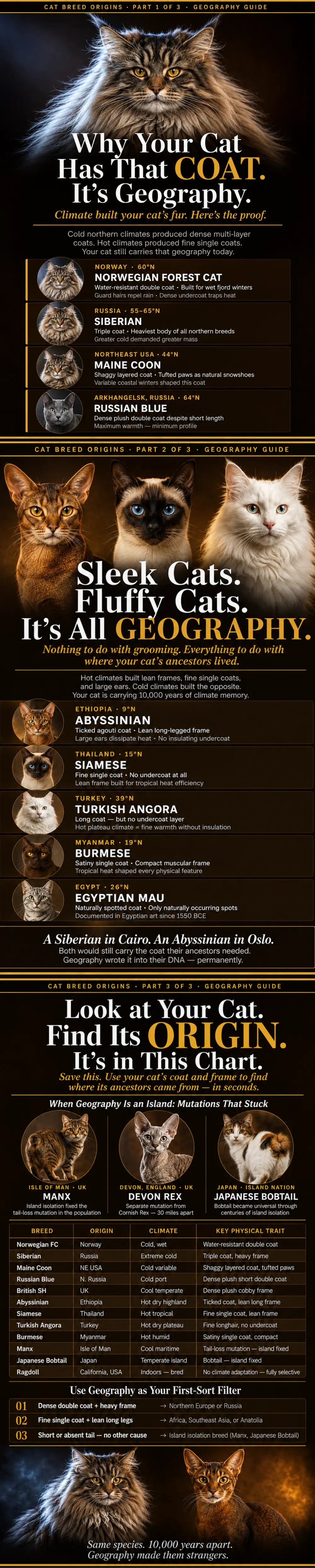
We have put together a visual infographic summarising cat breed origins by country and region — covering cold-climate northern breeds, ancient Middle Eastern and African lines, and Asian court breeds — alongside their key climate adaptations and the physical traits each climate produced, in a single reference image you can save and return to.
The climate adaptation column is the element most owners find immediately useful — it reframes breed identification from memorising breed names to reading the physical architecture that climate and geography built over thousands of years.
Frequently Asked Questions
Cat breeds by country: which region produced the most genetically distinct breeds?
The British Isles produced a disproportionately high number of distinct breeds relative to geographic size — the Manx, British Shorthair, Scottish Fold, Devon Rex, and Cornish Rex all emerged from this small region. Island isolation, geographic boundaries, and the persistence of mutations in enclosed gene pools explain the concentration. The Near East and Anatolia produced the oldest breeds in terms of domestic cat history — the Turkish Angora, Turkish Van, and the ancestor populations of most European breeds all trace to this region. In terms of raw genetic diversity, Middle Eastern and North African breeds carry the broadest gene pools because they represent the oldest continuous domestic cat populations on earth.
How does a cat's country of origin affect its physical appearance today?
Geographic origin shaped coat type, body frame, ear size, and leg length through centuries of climate-driven natural selection. Cold northern climates produced dense multi-layered coats and heavy frames. Hot tropical climates produced fine single coats and lean, long-limbed frames with prominent ears. These adaptations remain visible in modern breeds even in cats that have lived indoors for generations. Natural selection over hundreds of years leaves a more durable physical imprint than a few decades of indoor life can erase — a Siberian cat living in a heated apartment still carries the triple coat its ancestors needed to survive Russian winters.
Breed origins: are natural landrace breeds healthier than selectively bred ones?
Generally yes — but with important nuance. Natural landrace breeds that developed through geographic isolation typically carry greater genetic diversity than breeds created through tight selective breeding programmes. Greater diversity means fewer breed-specific inherited conditions. Breeds like the Siberian, Abyssinian, and Turkish Van show relatively low rates of the hereditary conditions that affect heavily selectively bred breeds such as the Persian (polycystic kidney disease) or Scottish Fold (osteochondrodysplasia). However, even natural breeds develop health concerns when modern breeding concentrates specific traits — the health of any individual cat depends on the specific practices of the breeder more than on the breed's origin type alone.
Which cat breeds are genuinely ancient versus recently developed?
The Abyssinian, Egyptian Mau, Turkish Angora, Siamese, and Japanese Bobtail all have documented or strongly evidenced histories stretching back several centuries — in some cases more than a millennium. The Egyptian Mau appears in artwork from 1550 BCE. The Siamese appears in Thai manuscripts from the 14th century. By contrast, the Ragdoll was developed in California in the 1960s, the Burmilla was created in the UK in 1981, and the Savannah emerged in the 1980s. The distinction matters practically — ancient natural breeds carry far broader gene pools and fewer breed-specific health vulnerabilities than their modern selectively bred counterparts.
Can knowing where a cat breed comes from help me identify my own cat?
Yes — and it works fastest as a first-sort filter rather than a specific identifier. Assessing coat density, body frame weight, and ear structure against the climate they reflect narrows the breed candidate list significantly before you examine specific breed profiles. A cat with a dense double coat, heavy frame, and pronounced ear furnishings points toward northern European or Russian origins — which limits candidates to a short, specific list. A cat with a fine single coat, lean angular frame, and large prominent ears points toward Southeast Asian or East African origins. That first-sort step eliminates more wrong answers more quickly than any other single approach in physical breed identification. For the specific breed profiles within each regional category, the [complete visual guide to common domestic cat breeds](https://www.whatismycatbreed.com/most-common-domestic-cat-breeds) covers each one with enough detail to complete the identification from there.