There is a specific frustration that comes from reading generic cat advice. "Cats are independent." "Cats sleep a lot." "Cats do not like being held." These statements are true for some cats and completely wrong for others — and the difference often comes down to genetics.
A Ragdoll goes limp the moment you lift it. A Siamese follows you into every room and narrates the experience. A Bengal cannot pass a closed door without attempting to open it. A Russian Blue will hide from a visitor and emerge an hour after they leave, when the house belongs to its person again.
These are not individual quirks. They are breed tendencies — behavioral patterns selected for across generations by breeders who wanted cats with specific personality traits as reliably as they wanted cats with specific coat colors. Understanding how breed shapes behavior is not about putting your cat in a box. It is about understanding the animal you actually live with.
The Science Behind Breed and Behavior
Personality in cats is not purely environmental. Research into feline behavioral genetics has established that temperament traits — including boldness, sociability, activity level, and stress reactivity — have meaningful heritable components. A 2019 study published in the journal Scientific Reports analyzed behavioral data from over 5,700 cats across 19 breeds and found significant breed differences in traits including activity level, aggression toward humans, and fearfulness of strangers.
The mechanism is the same one that produces physical traits: selective breeding within a gene pool. When breeders consistently select cats with specific behavioral tendencies for reproduction — calm cats, or vocal cats, or highly active cats — they are gradually shifting the frequency of the alleles associated with those behavioral traits in the breed's population. Over generations, this produces populations of cats that reliably express those tendencies more often than the general mixed-breed cat population would.
This does not mean every individual cat of a given breed will behave identically. Behavioral genetics is probabilistic, not deterministic. Individual variation within any breed is real and significant. A quiet Siamese exists. An inactive Bengal exists. But the breed-level tendencies are real enough to be useful — they inform expectations, care decisions, and the match between a cat and a particular owner's lifestyle.
Cat Breeds and Activity Level
Activity level is arguably the most practically significant behavioral dimension for cat owners. It shapes how you need to enrich your home, how much interactive play is necessary, and how well the cat will cope with a quieter or more demanding household.
High-Activity Breeds
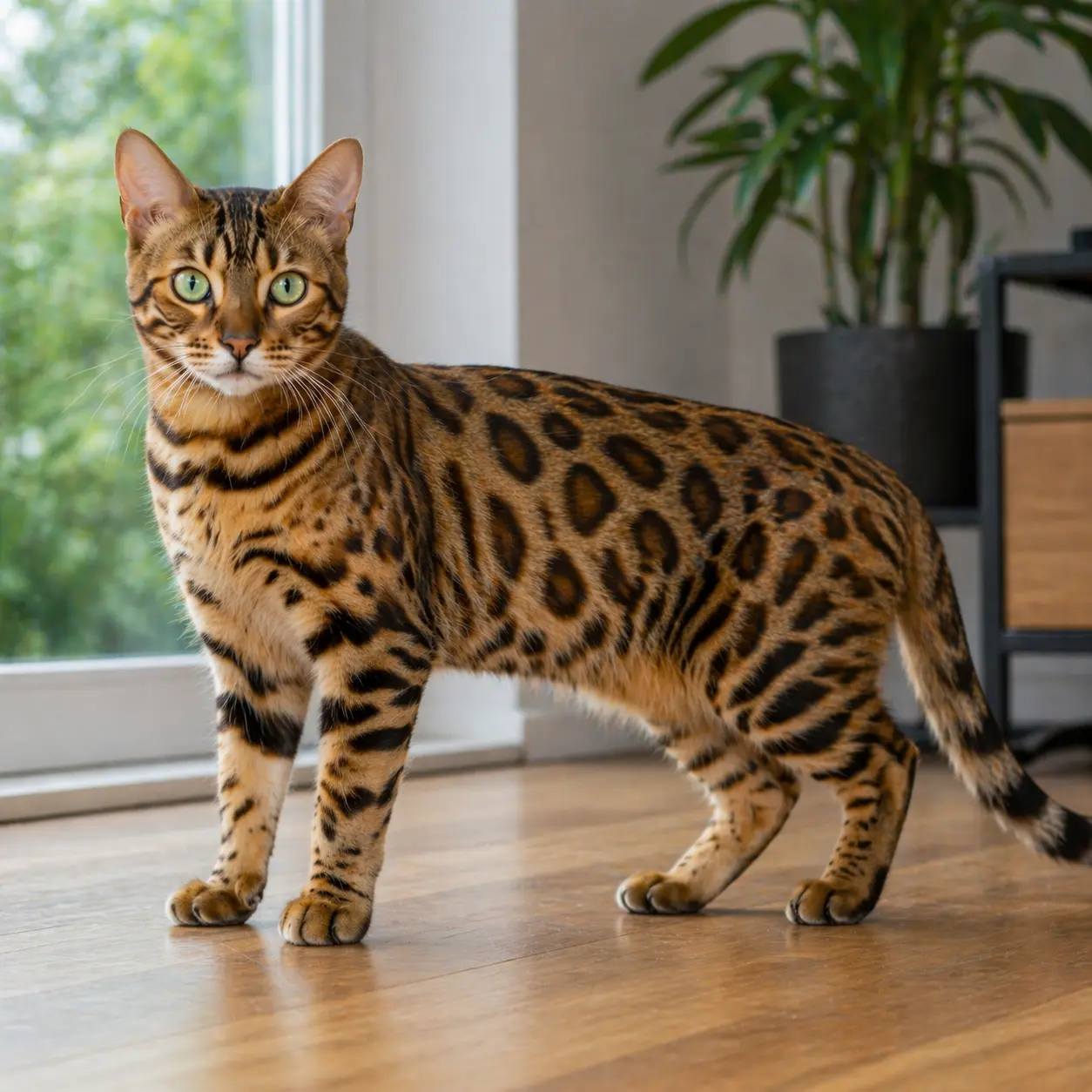
Bengal cats represent perhaps the most extreme end of the domestic cat activity spectrum. Developed through crosses with the Asian leopard cat, Bengals retained a drive and energy level that most domestic breeds simply do not share. They need daily structured play — not optional enrichment but a genuine physical requirement. Bengals that do not receive adequate stimulation redirect that energy destructively. Owners report cats that open cabinet doors, dismantle furniture, and vocalize persistently when under-stimulated. This is not behavioral dysfunction. It is a high-drive animal not getting what it needs.
Abyssinians are wired differently from Bengals but equally active. Where Bengals tend toward physical power and investigation, Abyssinians are perpetually curious and fast-moving. They are climbers. They observe everything. An Abyssinian in a small, unenriched apartment is a recipe for stress — for the cat, and eventually for the owner.
Siamese cats combine high activity with a social dimension — they are not just physically active but socially demanding. They need interaction, not just space to move. A Siamese left alone for long stretches develops anxiety that expresses through vocalization, over-grooming, or destructive behavior.
Moderate-Activity Breeds
The middle of the spectrum includes most of the commonly owned breeds. Maine Coons are active and playful but in a measured, sociable way — they engage enthusiastically when invited and settle calmly when not. Norwegian Forest Cats are similarly moderate, with outdoor or climbing enrichment satisfying much of their activity need. American Shorthairs were working cats for centuries and retain the functional energy of that heritage — active without being demanding.
Lower-Activity Breeds
Persians are the textbook low-activity breed. They move deliberately. They prefer warmth and proximity to high-energy play. A Persian that looks "lazy" is not being lethargic — it is being exactly what it was bred to be: a calm, present, decorative companion. Expecting a Persian to perform like an Abyssinian is a fundamental misread of the animal.
Ragdolls sit at an interesting intersection — they are large and calm but not completely inactive. They enjoy gentle play and will respond to interactive toys. They simply lack the intensity that characterizes the high-drive breeds at the other end of the scale.
| Breed | Activity Level | Primary Drive | Minimum Daily Play | Copes Alone For |
|---|---|---|---|---|
| Bengal | Very High | Hunting / exploration | 60+ minutes interactive | 4–6 hours max |
| Abyssinian | Very High | Curiosity / agility | 45–60 minutes | 6–8 hours with enrichment |
| Siamese | High | Social interaction | 30–45 minutes + company | 4–6 hours |
| Maine Coon | Moderate-High | Play / sociability | 20–30 minutes | 8 hours |
| American Shorthair | Moderate | Hunting games | 15–20 minutes | 8–10 hours |
| Ragdoll | Low-Moderate | Gentle interaction | 10–15 minutes | 8–10 hours |
| Persian | Low | Proximity / warmth | 5–10 minutes | 8–10 hours |
| British Shorthair | Low-Moderate | Independent observation | 10–15 minutes | 8–10 hours |
Vocalization: Breeds That Talk and Breeds That Don't
Vocalization tendency is one of the most practically noticeable behavioral differences between breeds — and one of the most heritable. The difference between the quietest and loudest breeds is not subtle. It is the difference between a cat that is essentially silent and a cat that holds conversations.
Siamese cats are the reference point for feline vocalization. Their voice is distinctive — lower and rougher than most cats, often compared to a baby crying. They vocalize to communicate, to demand, to express opinion, and apparently because they feel the situation requires comment. Owners who were not warned about this before getting a Siamese have returned them to breeders. It is that significant.
The Burmese and Oriental Shorthair share this vocal tendency at a somewhat lower intensity. Tonkinese cats are vocal but tend toward a slightly more melodic and varied register than the raw persistence of a Siamese.
At the quieter end: Russian Blues are known for being relatively silent, communicating with body language and eye contact rather than sound. Scottish Folds are generally quiet. Persians vocalize softly when they do at all. Ragdolls fall in the middle — they have a voice and use it, but it is gentle rather than demanding.
Norwegian Forest Cats and Maine Coons have a reputation for chirping, trilling, and chattering at birds — a behavioral pattern distinct from the demanding vocalization of Siamese-type breeds. It is participatory rather than demanding, which most owners find charming rather than exhausting.
Sociability and Attachment Style
How a cat relates to its people — and to strangers, to other cats, to children, to being alone — varies more by breed than most people realize. Understanding a breed's typical attachment style prevents a lot of mismatched expectations.
One-Person Cats
Some breeds form intense, exclusive bonds with a single person and are notably reserved or even hostile toward others. The Russian Blue is the clearest example — deeply loyal to its person, indifferent to strangers, and sometimes actively avoidant. This is not unfriendliness. It is a specific and selective attachment pattern. Russian Blue owners describe it as being "chosen" — the cat decided on you specifically, and that relationship is the one that matters.
Burmese cats are similarly bonded to their primary person, though they tend to express this as a following, shadowing behavior rather than aloofness toward others. Where a Russian Blue observes from across the room, a Burmese shadows from six inches.
Social Breeds
Maine Coons and Ragdolls are reliably described as the most broadly social of the common breeds — comfortable with strangers, tolerant of children, adaptable to multi-pet households, and generally presenting a Golden Retriever-style affability that surprises people expecting typical cat behavior.
The Abyssinian is social but differently — it is not a lap cat. It does not want to be held or carried. It wants to be near its people, involved in what they are doing, and preferably higher than everyone else in the room. The sociability is expressed as participation rather than physical contact.
Independent Breeds
British Shorthairs occupy a specific niche — they are loyal without being needy, affectionate without being clingy. They prefer four paws on the ground. They will settle near you reliably. They simply do not require constant interaction the way a Siamese or Burmese does. For owners who want a cat that is genuinely low-maintenance emotionally, the British Shorthair delivers this without being cold.
Norwegian Forest Cats are similar — loyal to their household, observant, gentle, but ultimately comfortable with periods of independence in a way that Siamese-type cats are not.
Cat Breed Temperament Spectrum: Boldness and Fearfulness
Beyond activity, vocalization, and attachment style, breeds vary significantly in their baseline boldness — how they respond to new situations, new people, new environments, and stress.
Boldness in cats is not the same as aggression. A bold cat investigates new objects immediately. It approaches strangers rather than hiding. It adapts quickly to new environments. It recovers from stress rapidly. The Bengal, Abyssinian, and Cornish Rex tend toward high boldness — curious, investigative, quick to engage.
Fearfulness — a higher baseline reactivity to perceived threats — is not a character flaw. It is a genetic trait that served wild ancestors well. Russian Blues, Norwegian Forest Cats, and some Sphynx lines tend toward higher baseline caution with strangers. This does not make them bad pets — it makes them cats that need patient, predictable environments and owners who understand that trust takes time.
Stress reactivity is the behavioral dimension most relevant to veterinary visits, moves, and household changes. Breeds with high stress reactivity may develop stress-related physical symptoms — over-grooming, digestive upset, hiding — in response to household disruptions that a bolder breed would simply ignore. Knowing your cat's breed tendency here prepares you to manage environmental changes appropriately.
Behavior Genetics in Mixed-Breed Cats
Most owned cats are mixed breeds, which raises a practical question: do breed-linked behavioral tendencies still apply when the ancestry is unknown or mixed?
The honest answer is: partially, and proportionally.
A cat with significant Siamese ancestry — say, one purebred Siamese parent — will very likely show elevated vocalization and social demands relative to a random-bred domestic shorthair. The behavioral genetics from that parent are real and expressed, even if the cat has no papers and looks nothing like a typical Siamese.
A cat with more diluted ancestry — a Siamese great-grandparent among many other unrelated ancestors — may show some Siamese-like behavioral tendency but more muted. The genetic contribution has been diluted by subsequent mixing. The effect is directional rather than definitive.
This is why behavioral observation is one of the tools used in mixed-breed identification — not a primary diagnostic method, but a supporting one. A cat that is persistently, specifically vocal in the low Siamese-style register, and shows the social attachment pattern characteristic of the breed, is providing behavioral evidence alongside its physical features.
Understanding how physical features and behavioral signals work together in identifying mixed ancestry is covered in the mixed breed identification guide — which walks through how to build a case from multiple signal types rather than relying on any single indicator.
Matching Breed Temperament to Your Lifestyle
The most useful application of breed behavior knowledge is upfront — before you get a cat, or when trying to understand why a recently adopted cat is behaving in ways you did not anticipate.
Some practical matching principles:
First-time owners generally do better with moderate-temperament breeds. Ragdolls, American Shorthairs, and British Shorthairs are forgiving — they are not so demanding that inexperienced owners feel overwhelmed, and not so independent that new owners feel rejected. The breeds that require the most careful matching — Bengals, Siamese, Sphynx — reward experienced owners who understand their needs but can produce real problems when placed with owners who were not prepared for them.
Busy owners who travel or work long hours need to be honest about the mismatch between their schedule and a high-social-demand breed. A Siamese or Burmese cat left alone for ten hours routinely will develop stress behaviors. A British Shorthair or Norwegian Forest Cat is far better suited to an owner whose lifestyle involves extended absences.
Households with children benefit from the naturally tolerant breeds — Maine Coon, Ragdoll, American Shorthair. Cats with higher stress reactivity and less tolerance for unpredictability — Russian Blue, Persian — can be successfully kept in households with children, but the children need to be old enough to interact respectfully. Matching a high-reactivity cat with a toddler is asking for stress on both sides.
Multi-pet households generally favor breeds known for social adaptability — Maine Coon, Ragdoll, Abyssinian. Breeds with strong single-person attachment — Russian Blue, Burmese — can coexist with other pets but tend to form a household hierarchy that centers on one human rather than becoming the family cat.
When Behavior Does Not Match the Breed
Breed tendencies are statistical patterns, not guarantees. Individual variation is real. A Persian that is unusually active, a Ragdoll that dislikes being handled, a Siamese that is quiet — all of these exist, and none of them represent a problem with the cat.
There are also situations where behavior that looks breed-atypical is actually environmentally caused. A normally social breed that suddenly becomes withdrawn is not showing breed-typical independence — it may be in pain, stressed by a household change, or responding to an underlying health issue. Behavior change is always worth veterinary attention before attributing it to breed personality.
The International Cat Care organization maintains extensive behavioral resources covering feline stress indicators, environmental enrichment needs by temperament type, and how to assess whether a cat's behavior reflects its underlying needs or a health concern. Their resources are particularly useful for owners trying to distinguish between breed-typical behavior and something that needs veterinary or behavioral intervention — accessible at icatcare.org.
For owners whose cat's behavior is confusing because its breed background is unclear, understanding the breed first is often the most useful starting point. The complete guide to the most common domestic breeds covers temperament alongside physical traits for each major breed — giving you a behavioral reference framework even before you have confirmed ancestry.
Physical identification and behavioral observation work best together. Our cat breed identification by physical features guide covers the visual side of this process, while the behavioral signals in this article add the temperament layer on top.
If you have been reading through this article and finding that your cat's behavior points toward a breed background you had not previously considered — or if you want to see what physical traits might support a behavioral hypothesis — the breed quiz works through both physical and behavioral characteristics as structured questions.
For readers who have already identified their cat's likely breed background and want to understand what the physical markers of that ancestry look like, our rare breed identification guide covers the less common breed families that sometimes show up unexpectedly.
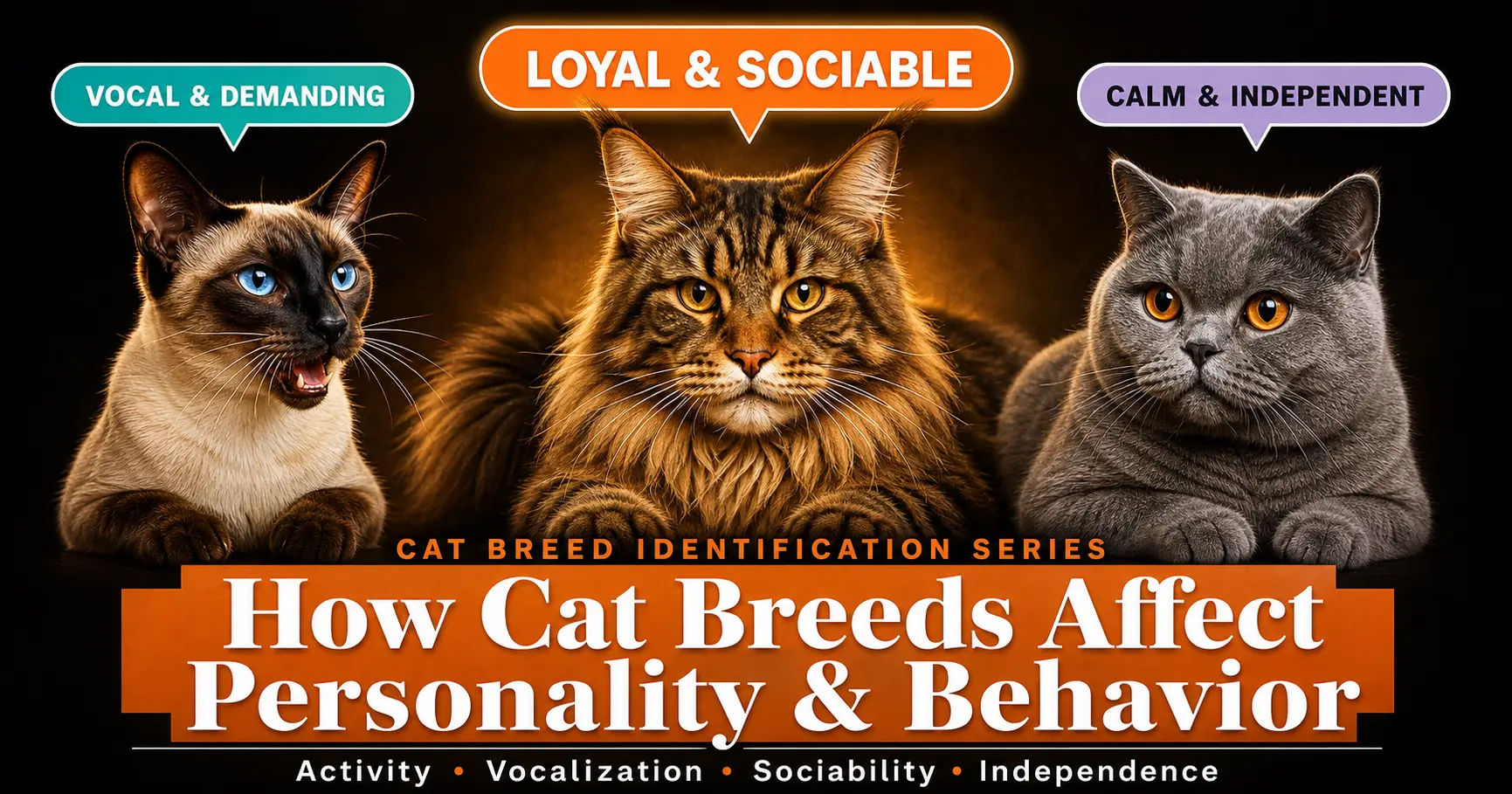
We have created a visual infographic mapping every major breed covered in this article onto a temperament spectrum — showing activity level, vocalization tendency, sociability, and independence side by side in one saveable reference chart.

Frequently Asked Questions
Cat Breed Personality: Is It Really Genetic or Just Individual?
Both — and the balance between them is more nuanced than either extreme suggests. Research into feline behavioral genetics has confirmed that traits like activity level, sociability, and fearfulness have measurable heritable components and show statistically significant differences between breeds. At the same time, individual variation within any breed is substantial. A breed's personality profile is a statistical tendency — a description of what most cats of that breed are more likely to be, not a guarantee of what any individual cat will be.
Do Mixed Breed Cats Inherit Personality From Their Breed Ancestors?
Yes, partially — and the degree depends on how close and how dominant the breed ancestry is. A cat with one purebred Siamese parent will very likely show elevated vocalization and social demands. A cat with more diluted ancestry may show milder versions of those tendencies. Mixed-breed cats often display behavioral blending — inheriting competing tendencies from different breed lines that produce something more moderate or more individual than either purebred ancestor would show.
Which Cat Breed Has the Best Temperament for Families?
There is no single answer because families vary enormously — in age of children, noise level, activity level, and presence of other pets. That said, the Maine Coon and Ragdoll consistently rank highest in owner surveys for family suitability across a wide range of household types. Both are large, tolerant, slow to stress, comfortable with children, and adaptable to multi-pet environments. The American Shorthair is a strong third option — hardy, calm, and genuinely low-maintenance in temperament.
Can You Train a Cat to Change Its Breed-Typical Behavior?
You can modify the expression of breed-typical behavior but not eliminate its underlying drive. A Bengal can learn not to knock items off counters — but the curiosity and energy that drives that behavior needs an outlet somewhere. Behavioral modification in cats works best when it redirects the existing drive rather than attempting to suppress it. A Siamese trained not to vocalize in certain contexts will still be a vocal, social cat that needs interaction. Working with a breed's tendencies rather than against them produces better outcomes for both the cat and the owner.
How Do Breed Temperament Traits Change With Age?
Most cats mellow somewhat with age — high-activity breeds become somewhat less intense, and many cats become more affectionate as they move into middle age and beyond. However, the relative differences between breeds tend to persist. A Maine Coon at ten years old is still likely more active and social than a Persian at the same age. Age moderates the intensity of breed traits but does not eliminate the fundamental behavioral differences between breeds. Senior cats also show more individual personality variation — years of experience and bonding produce an individual character that can differ significantly from breed averages.