Three-week-old kittens of almost any breed look nearly the same. A future Maine Coon, a Ragdoll, and a plain domestic shorthair share the same oversized heads, wobbly legs, and half-shut eyes at that age. The breed hasn't declared itself yet — or so it seems.
Here's what most people miss: if you want to identify kitten breed features early, the physical signals are already present. They're subtle at first. A slightly broader skull. Ears set wider than average. A coat texture that already differs from the littermates'. You won't see a complete Maine Coon at eight weeks — but the structural signals arrive well before that.
Working with a young kitten means working with less information than you'd have with an adult cat. That's honest. But less information isn't the same as no information. Breeders, shelter workers, and experienced foster carers learn to read young kittens accurately — and the process is learnable once you know which features to examine.
This post covers the earliest reliable breed signals, when they stabilize, and how to read them on a cat that's still figuring out how to land a jump.
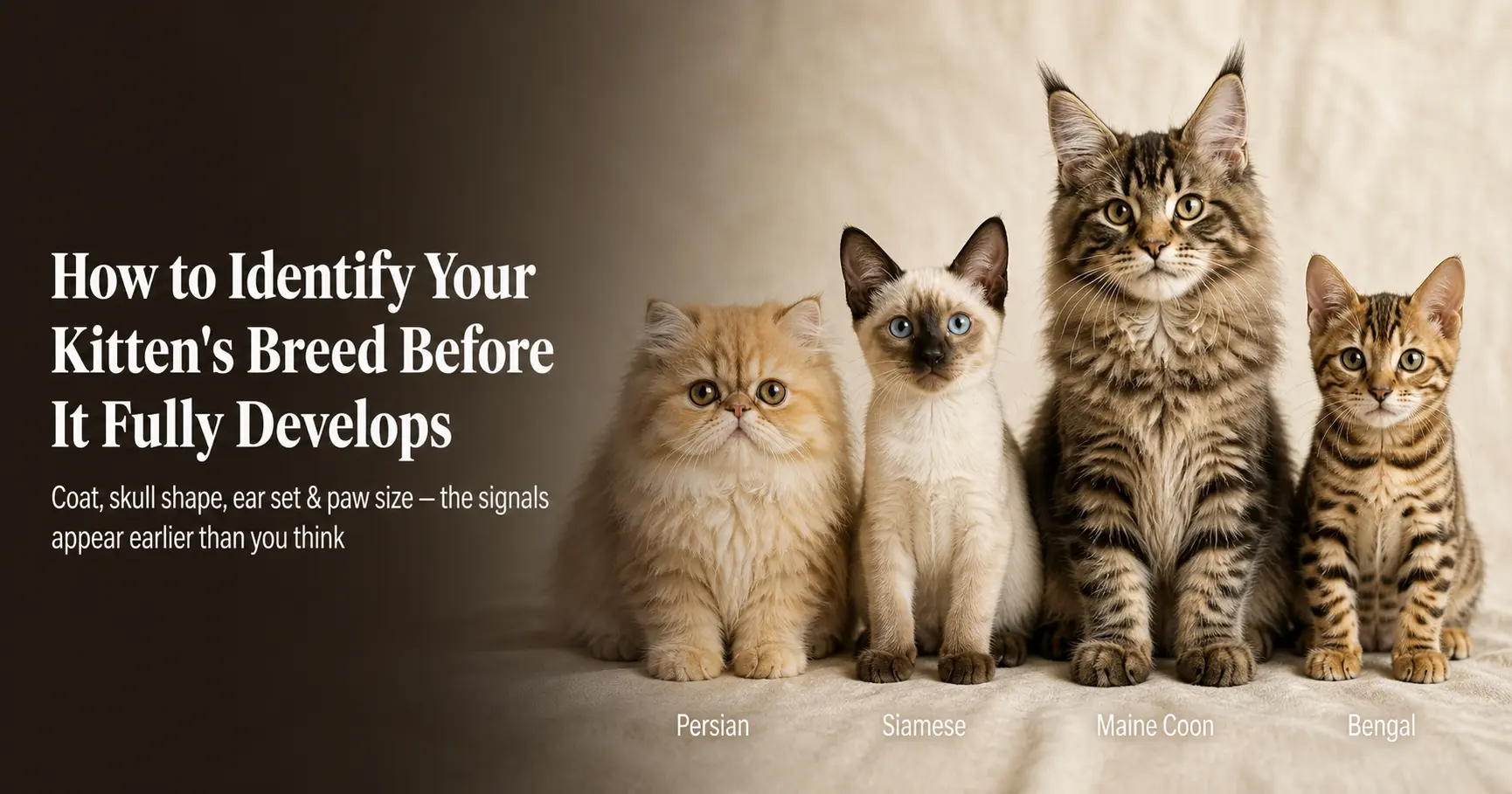
Breed Traits You Can Identify in a Kitten Before 12 Weeks
Not every breed signal waits for adulthood. Several physical features express themselves early — some within the first two to three weeks of life.
Ear set and shape emerge early and hold relatively constant. The Scottish Fold's cartilage defect shows by three to four weeks. The ears begin folding forward and downward, and that doesn't reverse. A Devon Rex shows extraordinarily large ears set wide and low on the head — unmistakable by six weeks. An Abyssinian or Oriental Shorthair displays tall, angled ears that look outsized even on a small kitten. Compare those against a British Shorthair kitten, whose ears are small, rounded, and set wide on a broad skull.
Head shape and skull structure are the most consistent early signals. Breeds with flat faces — Persians and Exotic Shorthairs — show the brachycephalic profile from the first weeks. The compressed nose, the stop sitting level with the lower eyelids, and the wide round head are all present at birth. They don't develop post-birth; they're baked into the genetics. By contrast, the long, wedge-shaped skull of a Siamese or Oriental Shorthair appears in proportion as early as four to six weeks.
Coat texture is visible early, though it shifts before adulthood. A Devon Rex kitten already shows its rippled, almost velvety coat at a few weeks old. A Siamese kitten carries a pale, close-lying base coat before the points develop. A Bengal may display faint rosette outlines or a ticked quality before twelve weeks — the contrast intensifies later, but the pattern structure is already present.
Size relative to littermates is telling when you have comparison. Maine Coon and Ragdoll kittens run noticeably heavier and longer-limbed than their littermates at the same age. I've spoken to breeders who say they can pick a Maine Coon out of a mixed litter at three weeks by paw size alone. That might sound like an exaggeration — it genuinely isn't.
The challenge is that these signals require a reference point. Comparing one isolated kitten against a mental picture of what a breed "should" look like at eight weeks is difficult. These signals become much clearer once you know which specific feature to examine in each zone of the kitten's body.
The Development Timeline: What Changes Month by Month
Kitten development doesn't happen all at once. Different features stabilize at different ages — and that directly affects how reliable any identification attempt can be.
| Age | Features becoming visible | Still changing or unreliable |
|---|---|---|
| 0–3 weeks | Head shape, ear fold (if applicable), coat texture basics, birth weight | Almost everything — eyes closed, features undifferentiated |
| 4–6 weeks | Ear shape, facial structure outline, coat pattern, limb proportions | Eye color (shifts dramatically), coat color depth |
| 8–12 weeks | Skull proportions, leg length relative to body, coat texture | Full coat length, point coloring on colorpoint breeds, body mass |
| 3–6 months | Most skeletal features, coat pattern contrast, ear tufts | Full coat on longhairs, body mass, reproductive maturity markers |
| 6–12 months | Near-final appearance for most breeds | Maine Coons and Ragdolls continue growing until age 3–4 years |
The practical takeaway: eight to twelve weeks is the best window for early identification. Most kittens come home around this age, which works in your favor — by then, enough visible features have emerged to make a meaningful read.
Eye color is the single most misleading feature at this stage. Almost every kitten starts life with blue eyes. Color begins shifting between six weeks and four months and settles into the adult tone only after that window closes. Don't lean on it. My own cat had a distinctive blue-grey tint at eight weeks that I was convinced meant something. By five months, her eyes were a completely unremarkable amber — the early color had meant nothing at all.
Reading Coat Patterns and Color in Young Kittens
Coat pattern is one of the most accessible early signals — but it requires careful interpretation, especially in the first few weeks.
Ghost tabby markings fool a lot of people. Almost all kittens show faint tabby striping in the first few weeks, including kittens that will grow into solid-colored adults. These ghost stripes exist because the tabby gene is the ancestral default in domestic cats. As melanin fills in evenly over the following months, the markings disappear. If you see striping on an eight-week-old and immediately label it tabby, hold that conclusion loosely until the coat has had time to settle.
True tabby kittens — mackerel, classic, spotted, or ticked — show stronger contrast and more defined markings earlier. A Bengal kitten displays distinct rosette outlines or horizontal striping by six to eight weeks, even if the high-contrast adult coat hasn't arrived. The pattern structure is already present; the saturation catches up later. Most first-time kitten owners assume those early Bengal markings are the same as generic tabby stripes — they're not. The shape and arrangement of the spots already differ.
Point coloring in Siamese-type breeds develops through a temperature-sensitive enzyme called tyrosinase, which restricts pigment in cooler body regions. A Siamese kitten's ears, face mask, paws, and tail are slightly cooler than the body core — so point coloring develops progressively from birth. A pale kitten with blue eyes, a subtly darker face, and noticeably darker ears at eight weeks is showing classic colorpoint signals. Not confirmation, but a strong early indicator worth noting.
White spotting patterns are reliable from birth and stay consistent. A Ragdoll's white mitted feet or bicolor pattern appears immediately. Turkish Van kittens display their distinctive colored cap and tail from day one — you won't mistake it.
Tortoiseshell and calico patterns are visible at birth and change little afterward. They also carry useful genetic information: virtually all tortoiseshell cats are female, across every breed. Finding a tortoiseshell pattern in your kitten tells you something immediately about sex — and also rules out certain breeds that don't produce that color combination.
The honest limitation here: coat pattern alone rarely confirms a specific breed. It narrows the field significantly but always needs to combine with structural features to land on a confident answer.
Cat Body Proportions: What Early Size Actually Predicts
Body proportions in young kittens are a more reliable breed signal than most owners realize — provided you know which proportions to examine and which to ignore.
Leg length relative to body length is one of the most diagnostic early features. Long, lean limbs on a young kitten point toward active, athletic breeds — Abyssinians, Bengals, and Oriental Shorthairs. Short, stocky limbs on a compact, rounded body suggest British Shorthairs or American Shorthairs. These proportional differences are visible at eight weeks, before the full adult body mass arrives. You're reading the skeleton's direction, not its final destination.
Paw size gives a preview of adult frame. Oversized paws that look disproportionate to the rest of the body consistently signal large breeds. Maine Coon and Norwegian Forest Cat kittens regularly show paws that look almost comically large for their age. That's not a defect — it's a preview of the skeleton this kitten will grow into. Watch the paws.
Tail length and thickness express breed character early. A Ragdoll shows a thick, heavy tail even as a kitten — substantial in proportion to the body. A Siamese or Abyssinian shows a long, fine, tapering tail from the first weeks. The Japanese Bobtail's shortened tail is visible immediately after birth. These features don't reverse or change direction with age.
Overall bone structure — what breeders call "type" — reads as fine, medium, or heavy even in young kittens. Fine-boned kittens with a light, angular frame grow into slender, elegant adults. Heavy-boned kittens grow into substantial cats. British Shorthairs are famously cobby even as kittens — wide, round, and thick across the chest. This is the single most underused signal in early kitten identification: most owners look at coat and face first. The bone structure underneath tells you more.
A word of honest caution: mixed-breed kittens often show body proportions that don't map cleanly to a single breed. You might see the long legs of an Abyssinian paired with the heavier frame of a domestic shorthair. That inconsistency is information in itself — it often signals a mixed background, which is worth knowing. For a thorough look at how adult body structure maps to specific breeds, the guide on cat body type and breed identification covers this in depth.
Ears, Eyes, and Facial Structure in a Growing Kitten
Facial features develop in stages, but several are reliable reads even in young kittens — especially when you examine each zone separately.
Ear position on the skull is one of the most useful early markers. High-set, large ears angling slightly outward mark Abyssinians and Oriental Shorthairs. Low-set, rounder ears on a wide skull point toward British Shorthairs or Persians. A Devon Rex shows dramatically oversized ears set low on the sides of the head — visually striking even at six weeks. If you've ever looked at a Devon Rex kitten and wondered if it was from another planet, those ears are why. Ear set doesn't shift dramatically as a kitten matures, making it one of the more stable early indicators you can rely on.
Eye shape at eight to twelve weeks already shows its adult outline in most breeds. Round eyes on a flat, wide face belong to Persian-type breeds. Almond-shaped, slightly tilted eyes develop in Oriental breeds. Ragdoll kittens show oval eyes set in a broad, flat facial plane — deep-set and wide apart, a look that's visible early even when the face is still forming.
Nose length and profile is particularly useful for ruling out entire categories quickly. A flat nose with a marked stop — where the forehead meets the nose at the level of the lower eyelids — identifies a brachycephalic breed definitively. Any kitten with a standard nose length is not from a flat-faced breed. That distinction is useful because it eliminates a large category cleanly and fast.
Muzzle shape and chin help narrow things further. The strong, square muzzle of a Maine Coon is present even in young kittens — wide, with prominent whisker pads. The softer, more pointed muzzle of a Siamese appears in the overall wedge-shaped skull at twelve weeks. These are not subtle differences once you have a side-by-side comparison in mind.
For a systematic breakdown of how each facial zone maps to specific breeds across all life stages, our guide on cat facial features and breed identification covers it in the kind of detail that makes kitten observation significantly easier.
The Tricky Cases: Breeds That Look Nearly Identical as Kittens
Some breed pairs cause genuine, consistent confusion before four to six months. Knowing which ones is useful before you spend too long staring at an eight-week-old trying to decide.
Maine Coon vs. Norwegian Forest Cat creates the most confusion. Both produce large, semi-longhaired kittens with heavy bone, prominent ear tufts, and wide chests. The earliest reliable differentiator is head shape: Maine Coons develop a more rectangular skull with a squared, prominent muzzle, while Norwegian Forest Cats tend toward a triangular head with a straight nose profile and less muzzle definition. At eight weeks, even experienced breeders sometimes struggle without pedigree papers.
Ragdoll vs. Birman vs. large domestic longhair mix — all three can produce blue-eyed, semi-longhaired, pale kittens that look strikingly similar. Ragdolls tend to run exceptionally large with notably floppy muscle tone from early on — the classic "ragdoll" quality is present from the start. Birmans show more moderate size with slightly earlier point development. A domestic longhair mix typically shows inconsistent proportions — size or coat length that doesn't quite fit either breed's standard.
British Shorthair vs. Russian Blue — both breeds produce compact, round-faced kittens with dense, close-lying coats. At eight weeks, a blue-coated British Shorthair kitten and a Russian Blue kitten look strikingly similar. The Russian Blue's coat develops a distinctive silver-tipped shimmer with maturity — but that quality is subtle before three to four months. Structural differences in head shape offer the better early read: British Shorthairs are broader and rounder; Russian Blues have a more wedge-shaped skull.
Bengal kittens vs. domestic tabby kittens — Bengal kittens go through a documented "fuzzy" stage between four and eight weeks where the coat pattern blurs and washes out. This is a recognized feature of Bengal development, not a sign the pattern has disappeared. A kitten that showed clear rosettes at three weeks but looks washed out at six is showing classic Bengal behavior. The pattern returns as the adult coat grows in.
The Cornell Feline Health Center notes that genetic mechanisms underlying coat and structural breed expression follow inheritance patterns that often can't be resolved by observation alone. When visual identification reaches its limit — and it will — DNA testing fills the gap. Our guide on cat DNA testing and breed identification explains what those tests can and cannot accurately tell you.
What Physical Evidence Can and Cannot Tell You About a Young Cat
Physical evidence works well under specific conditions — and it has honest limits that are worth stating directly.
It works well when a kitten shows strong structural markers: a flat face, a folded ear, a gene-based coat mutation, or a clearly oversized frame all point toward specific breeds with reasonable confidence. It also works well when you have background context. A kitten from a registered breeder comes with documented parentage, and physical traits serve as confirmation rather than diagnosis.
Physical evidence struggles when a kitten shows average or mixed features. Most domestic kittens — shelter rescues, offspring of stray mothers, kittens from casual litters — carry genetic combinations that produce inconsistent signals. A kitten might show the coat texture of one breed, the head shape of another, and the leg length of a third. The honest read in those cases is usually "probable mix" — not a failure of observation, but an accurate conclusion from genuinely complex genetics. Our page on identifying mixed breed cats goes deeper on what that complexity looks like in practice.
The most useful practical approach: note every feature methodically, avoid committing to a specific breed before twelve weeks, and reassess at five to six months when the adult picture has mostly arrived. If you want to assess your kitten's features now in a structured, guided way, the breed identification quiz walks through the key physical markers step by step — with the scoring adjusted to account for the uncertainty that comes with kitten age.
The most common mistake owners make is over-committing to a breed guess at eight weeks. The signals are real, but the picture is incomplete. Hold your conclusions loosely until the cat fills out — you'll get a clearer answer than any eight-week observation can give you.
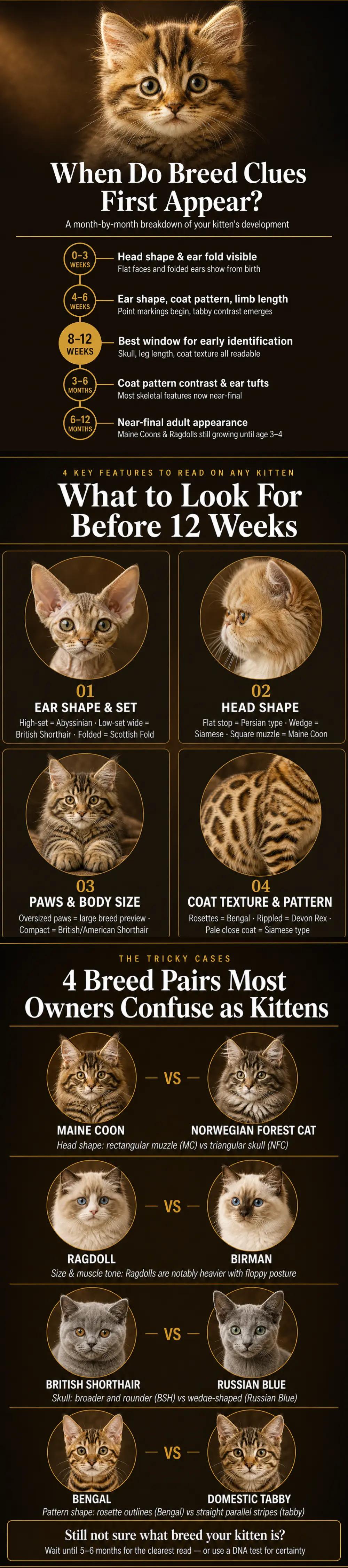
We have put together a visual infographic summarizing kitten breed identification — covering the development timeline, which features appear at which age, and the most commonly confused breed pairs — in a single reference image you can save and return to whenever you need it.
The infographic also marks which features are unreliable before twelve weeks, so you know exactly where to direct your attention and where to wait.
Frequently Asked Questions
Cat breed identification in kittens: how early is it actually reliable?
For breeds with strong structural markers — flat faces, folded ears, coat texture mutations like the Devon Rex — reliable identification is possible as early as three to four weeks. For most other breeds, eight to twelve weeks is the earliest point where physical features give a meaningful read. Full confidence generally requires waiting until four to six months, when the adult coat, body mass, and facial structure have largely settled into their final form.
Can you tell a kitten's breed from its coat color alone?
Coat color narrows the field but rarely confirms a specific breed by itself. Some color patterns associate strongly with certain breeds — colorpoint coloring with Siamese-type breeds, ticked tabby with Abyssinians, the white cap and colored tail with Turkish Vans. But most color combinations appear across dozens of breeds. Coat color works best as one input among several physical signals, never as a standalone identifier.
Breed signals in kittens: which physical traits appear earliest and hold longest?
The earliest and most stable traits are head shape, ear set, and brachycephalic facial structure — these are present at birth and don't change direction with age. Coat texture is also visible early, though it shifts before adulthood in some breeds. Eye color is the least reliable early signal; it changes significantly between six weeks and four months and should carry almost no weight in kitten breed identification during that window.
What age should I wait before using a photo-based breed identifier on my kitten?
Eight weeks is the practical minimum for photo-based tools. Before that, most kittens lack enough visual differentiation for any tool — AI or human — to make a confident read. Results between eight and twelve weeks are directionally useful but carry more uncertainty than results at six months. A good photo identifier will return a probable breed with lower confidence scores for young kittens — treat those results as starting hypotheses rather than conclusions.
How do I know if my kitten is a purebred or a mix just from looking at it?
Without documented parentage from a registered breeder, you can't confirm purebred status from physical observation alone. A purebred kitten typically shows consistent structural features across multiple traits — size, head shape, ear placement, coat texture — that all align with the same breed standard. Significant inconsistencies across those features usually indicate mixed parentage. For a closer look at how those differences express physically and genetically, the guide on purebred vs mixed breed cats covers the key distinctions directly.