Hold a Persian cat's face level with yours and look at it straight on. The nose sits at the same horizontal plane as the eyes. Not below them — level with them. In every other common domestic cat, the nose projects forward from the skull, dropping well below the eye line. In a Persian, the skull has been compressed front-to-back so completely that the nose barely protrudes from the face at all.
This is not simply a visual quirk. It is the result of a specific genetic change in skull development — one that reshapes the entire facial skeleton, repositions the eyes, compresses the nasal passages, crowds the teeth, and alters the tear ducts. Every diagnostic physical feature of the Persian cat traces back to this single underlying structural reality. Understanding that structure is the most reliable starting point when you want to identify a Persian — or when you are assessing whether a flat-faced cat from a shelter genuinely carries Persian ancestry.
The Persian is among the most visually distinctive breeds in the world and, paradoxically, among the most frequently misidentified in domestic cat populations. Part of the confusion comes from the two dramatically different head types that both legitimately carry the Persian name. Part of it comes from the Exotic Shorthair — essentially a shorthaired Persian — which carries identical skull structure but none of the coat. And part of it comes from the many mixed-breed cats in shelters that carry partial Persian genetics, expressing the flat face to varying degrees without the full coat or body type to match.
This guide covers the complete Persian identification framework: the brachycephalic skull and what it produces physically, the coat architecture and how it differs from other long-haired breeds, the two Persian head types and why they look nothing alike, the behavioral signals that support a Persian hypothesis, and how to separate a genuine Persian from the several breeds that produce superficially similar appearances.
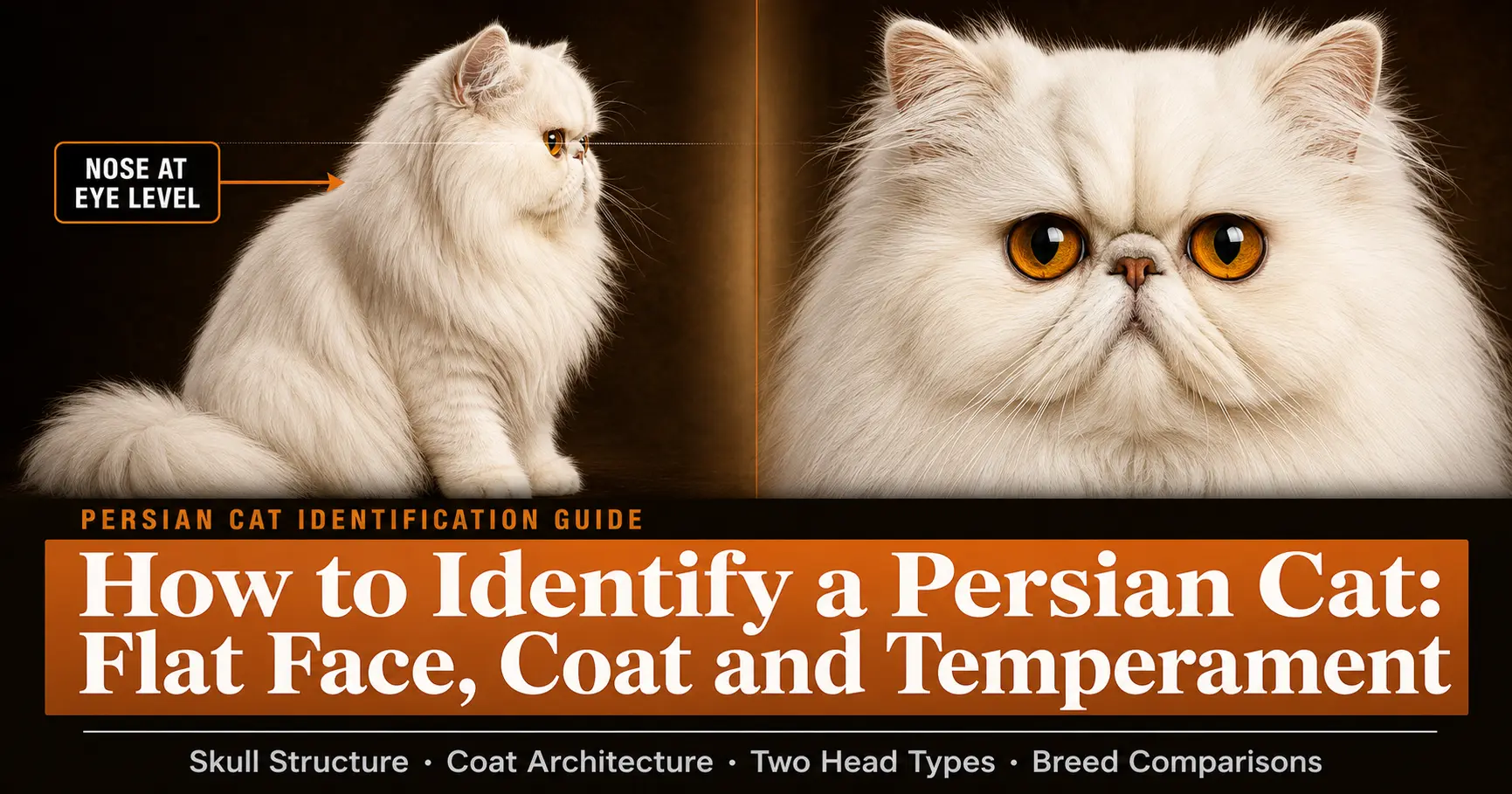
The Brachycephalic Skull: What It Is and What It Produces
The technical term for the Persian's facial structure is brachycephaly — from the Greek for "short head." The skull is shortened along the axis that runs from the nose to the back of the head. In a typical cat, this front-to-back skull depth is substantial — the muzzle projects forward, the nasal passages run full length, and the overall head profile is clearly elongated when viewed from the side. In a brachycephalic cat, that front-to-back dimension has been dramatically reduced through selective breeding.
The consequences of this structural change extend through the entire facial anatomy:
The nose repositions to the level of the lower eyelid or above, rather than projecting below the eyes as in all non-brachycephalic cats. In extreme modern Persians, the nose tip appears above the lower eye margin when viewed in side profile. The nostrils themselves are often compressed — narrowed in ways that restrict airflow.
The eyes move forward and apart as the skull widens and flattens. They appear very large relative to the face because the skull compression reduces the depth between the eye socket and the nasal structures. The eyes also sit more prominently — less recessed into the skull — which is why Persian cats are prone to corneal exposure and scratch injuries that a deeper-set eye would avoid.
The teeth are squeezed into a smaller jaw than the tooth count requires. Malocclusion — teeth meeting incorrectly or crowding each other — is near-universal in Persian cats. The lower jaw often protrudes slightly relative to the upper, creating an undershot bite.
The tear ducts follow a drainage path that has been physically compressed by the skull changes. In most cats, tears drain efficiently through the nasolacrimal duct into the nasal cavity. In many Persians, that path is kinked or compressed, causing tears to overflow onto the face instead — producing the characteristic rust-coloured tear staining that appears in the fur below the inner eye corners.
The soft palate at the back of the throat is the same length it would be in a non-brachycephalic cat — but it now sits in a compressed space. This creates the snoring, snuffling, and laboured breathing sounds that are characteristic of the breed at rest. During stress, heat, or exertion, these sounds intensify.
None of these are defects that happen to some Persians. They are structural consequences of the brachycephalic skull geometry that apply — to varying degrees — to every Persian cat.
For identification purposes, the implication is direct: these physical consequences are diagnostic. Tear staining in the fur below the inner eye corners, clearly audible nasal sounds at rest, visibly narrowed nostrils, and an undershot lower jaw — any of these in a long-haired cobby cat provide strong additional evidence of Persian ancestry beyond the flat face itself.
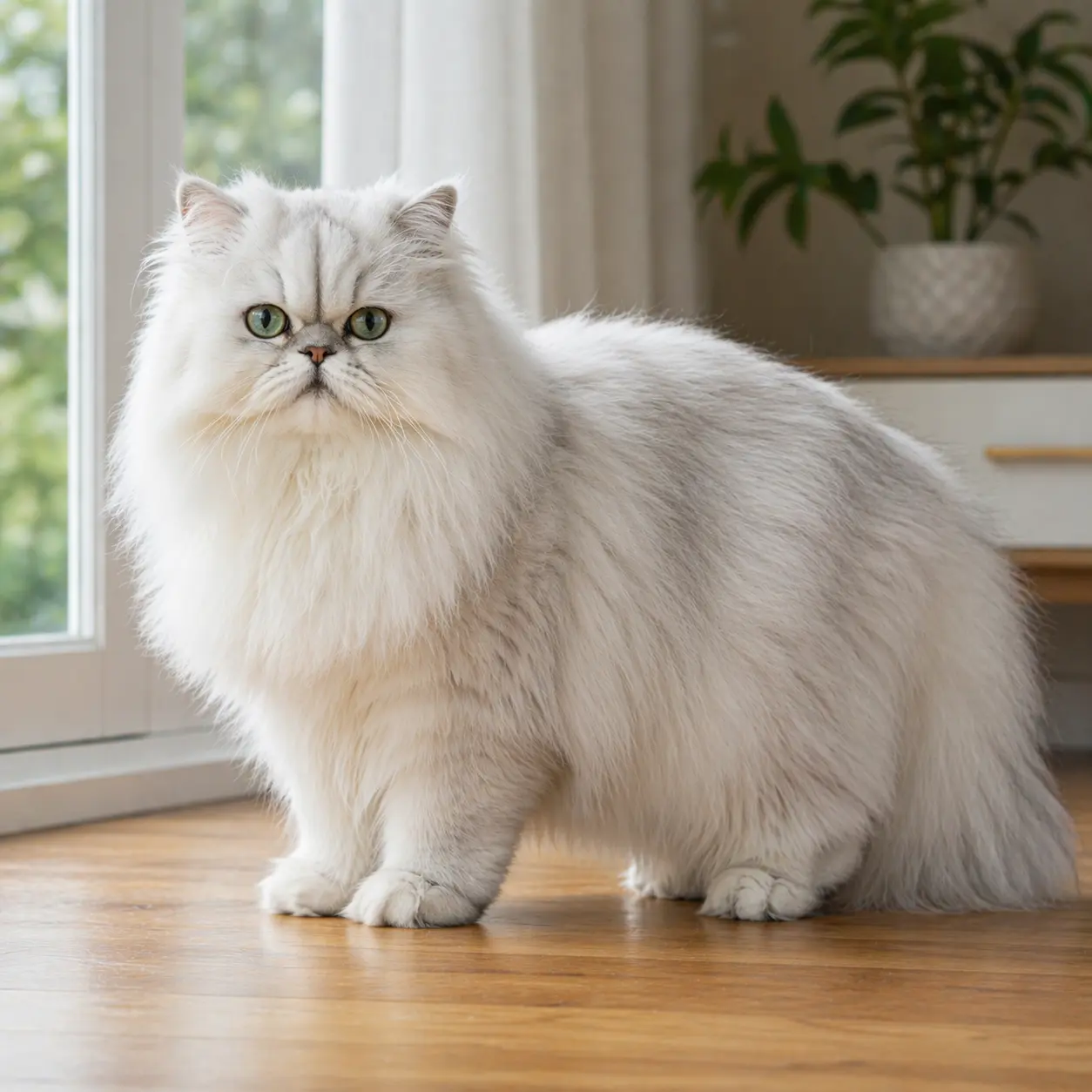
Traditional Versus Modern: Two Persian Head Types
The most significant source of identification confusion with Persians is not the coat — it is the head type. Two very different conformations both legitimately carry the Persian name, and they look genuinely different from each other.
The Traditional Persian — often called the Doll-Face Persian — carries a moderate skull with a nose that protrudes noticeably from the face, though still shorter and less prominent than a non-brachycephalic breed. The profile is gentle rather than extreme. The nose sits below the eye line. The face has clear dimensions — a visible muzzle, separated eyes, and an overall head shape that most people would recognise as broadly cat-like. Traditional Persians still carry the cobby body, the full round skull, and the long dense coat — but the facial compression is mild compared to the modern type.
This is the Persian that most cats in the general domestic population derive from when they carry Persian ancestry. Extreme flat-face genetics are concentrated in show breeding programmes, not in the random-bred population. A cat from a shelter with partial Persian ancestry will almost always show the traditional type's mild-to-moderate facial compression rather than the extreme modern type.
The Modern Persian — also called the Ultra-type or Peke-face Persian — carries extreme brachycephaly with the nose sitting at or above the eye line, almost no visible muzzle, very wide-set eyes that often appear to bulge slightly forward, and a skull so compressed from front to back that the profile is essentially flat when viewed from the side. This is the Persian that appears in show catalogues and breed books and that most people picture when they hear the name.
The distinction matters practically: if you are assessing a cat in a shelter for Persian ancestry and expecting the extreme modern type, you will walk past genuinely Persian-ancestry cats whose faces are less dramatically flat. Traditional Persian-type features — a slightly shortened muzzle, a moderate nose stop, wide-set large round eyes, a broad skull — are all that most first- or second-generation Persian mixes will show.
Cat Breed Coat Architecture: What the Persian Coat Actually Is
The Persian coat is distinctive enough to separate the breed from every other long-haired cat once you understand its specific architecture. Most people know it is long. What most people miss is that it is also architecturally different from the long coats of the Maine Coon and Norwegian Forest Cat in a way that matters for identification.
The Maine Coon and Norwegian Forest Cat carry double coats — a coarse, water-resistant outer layer of guard hairs sitting above a dense woolly undercoat. These coats have functional depth and distinct layering. Push your fingers through a Maine Coon coat and you feel two clearly different textures at different depths. The coat repels water, insulates against cold, and was shaped by centuries of outdoor life in cold climates.
The Persian coat is architecturally different. It is a single flowing layer — extraordinarily long, dense in volume, but silky in texture rather than structured in layers. There is no meaningful distinction between an outer guard coat and an inner undercoat. Every hair is approximately the same length and texture: very long, very fine, very silky. The coat flows and cascades rather than standing away from the body in the structured way a double coat does. When you part a Persian coat, it parts cleanly — the fur falls in a single layer rather than revealing a distinct underlayer.
This single-layer architecture is precisely why Persian coats mat so catastrophically without daily brushing. A double coat can mat in the undercoat while the outer guard hairs remain free — at least temporarily. A Persian's single layer mats through the entire depth of the coat simultaneously. A neglected Persian coat develops tight, skin-level mats within days.
For identification purposes: a very long-coated cat with a cobby round body whose coat parts to reveal a single silky layer, rather than two distinct coat textures, is providing strong Persian evidence that a Maine Coon's shaggy layered coat would not.
The coat also accumulates around the neck in a full ruff, flows heavily over the chest and shoulders, and extends to notable length along the belly and down the backs of the legs. In an adult Persian in full coat, the fur touching the floor as the cat walks is not unusual.
Body Type and Physical Structure
Beyond the skull and coat, the Persian body provides clear identification signals that function as cross-checks against the facial and coat evidence.
The cobby body is the reference body type for the Persian: compact, wide, and low to the ground. The chest is broad and deep. The back is short and level. The shoulders are wide. The legs are short — genuinely short, not just appearing short because of the heavy coat — set far apart by the wide chest. When you pick up a Persian, it feels denser and heavier than you expect for a cat its visual size, because the broad chest and substantial bone add mass that the compact silhouette doesn't suggest.
The head-to-body proportion is distinctive. The Persian's head is large relative to the body — a broad, domed skull sitting on a short, thick neck. From the front, the head appears to be almost as wide as the shoulders in some Persians. The overall impression is of a round head on a round body: spherical, uniform, and impressively dense.
The tail is short relative to body length and heavily furred — carried low rather than raised. A Persian tail does not whip or extend in the graceful arc of a Siamese tail or the dramatic plume of a Maine Coon tail. It is a moderate, dense, heavily coated appendage that completes the compact silhouette without adding length.
Weight range for adult Persians runs from approximately 7 to 12 pounds for both sexes — moderate compared to the Maine Coon's potential 18 pounds, but heavier than their compact appearance often suggests because of the bone density and chest width that the cobby structure produces.
Point Colour Variations: The Himalayan Connection
The Persian appears in an extraordinary range of coat colours and patterns — over 80 accepted colour and pattern combinations exist across major registries. Most of these are variations of the standard Persian type. One variation, however, deserves specific mention because it creates its own identification confusion.
The Himalayan is a Persian with the colorpoint pattern — the same temperature-sensitive coloration that produces the Siamese's dark points on a pale body. The Himalayan was developed by crossing Persians with Siamese cats, introducing the colorpoint gene into the Persian gene pool. The result is a cat that looks, in coat and body type, entirely like a Persian — flat face, cobby body, flowing long coat — but with Siamese-style colouring: a pale body with dark seal, blue, chocolate, lilac, flame, or tortoiseshell points.
The Himalayan is recognised as a Persian colour variety by some registries and as a distinct breed by others. The Cat Fanciers' Association registers it separately as a Himalayan. The International Cat Association and many other bodies consider it a colourpoint Persian.
For identification purposes: a flat-faced, cobby-bodied, long-coated cat with colorpoint colouring is almost certainly a Himalayan — Persian genetics carrying the colorpoint gene. Its identification follows the Persian framework entirely, with the added layer that its point colouring confirms Siamese ancestry somewhere in its lineage.
Behavioural Signals That Support Persian Identification
The Persian's behaviour is as distinctive as its appearance, and consistent enough to support an identification hypothesis when physical features are moderately expressed rather than dramatic.
Persians are calm by design, not by accident. Centuries of selective breeding for a specific companion role produced a cat whose default state is stillness. They do not pace. They do not climb furniture. They do not attempt to open doors. They find a warm surface, settle into it, and remain there with a quality of repose that most cats never approach. First-time Persian owners sometimes call a veterinarian concerned that their new cat seems ill — before learning that the cat is simply a Persian.
This is categorically different from the stillness of a Russian Blue, which is quiet and reserved but watchful. A Persian at rest looks genuinely comfortable with immobility in a way that reads as warmth and presence rather than wariness.
Vocalisation is soft and infrequent. Persians do have a voice — they use it when hungry, occasionally when seeking attention — but they do not hold ongoing conversations the way Siamese cats do, and they do not produce the insistent demand-vocalisation of a Burmese. A very quiet cat that nevertheless seeks proximity and warmth, and that expresses contentment through purring rather than meowing, is behaving consistently with Persian genetics.
Handling tolerance is high. Persians are among the cat breeds most consistently described as tolerant of being held, carried, and groomed. This handling tolerance is not passive — it reflects genuine comfort with close human contact that was selected for through generations of breeding for a lap-companion role. A cat with Persian-type physical features that also tolerates extended handling with contentment is adding a useful behavioural confirmation to the physical evidence.
Separating Persian from Similar Breeds
Several breeds create genuine identification confusion with Persians. The distinguishing details are specific enough to resolve most cases efficiently.
Persian versus Exotic Shorthair: The Exotic Shorthair carries the Persian's brachycephalic skull, cobby body, round head, and wide-set eyes — with a short, dense, plush coat instead of the Persian's flowing long coat. If you see a flat-faced cat with all the Persian skull features but a short coat, Exotic Shorthair is the first candidate. The Exotic Shorthair coat is dense and plush — noticeably more texture than a Domestic Shorthair — and stands slightly away from the body rather than lying flat.
Persian versus Ragdoll: Both can appear as large, long-haired cats with gentle temperaments and blue eyes in the Himalayan variation. The skull structure separates them immediately. A Ragdoll has a normal nose projection — the nose sits below the eyes in a typical cat profile. A Persian's nose sits at or near eye level. Additionally, the Ragdoll is substantially larger (10 to 20 pounds versus 7 to 12 pounds for the Persian), has a modified wedge rather than round head, and carries a semi-long silky coat rather than the Persian's full-length single-layer coat.
Persian versus British Longhair: The British Longhair is a longhaired version of the British Shorthair — a cobby cat with a round head and dense coat. Unlike the Persian, the British Longhair has a normal nose projection with no brachycephalic compression. Its coat is dense and double-layered rather than the Persian's single-layer silky flow. The two look broadly similar to untrained eyes, but the nose profile in side view separates them within seconds: Persian nose at eye level, British Longhair nose well below it.
Persian versus domestic longhair: A domestic longhair with Persian ancestry typically shows partial brachycephaly — a slightly shorter muzzle, a slightly wider skull, slightly larger eyes — rather than the full Persian facial compression. The coat may be long but often lacks the extreme length and silky uniformity of a purebred Persian coat. These cats are best described as Persian-influenced domestic longhairs: carrying some Persian genetics without meeting the full breed standard.
When Physical Features Give Mixed Signals
The most common identification challenge is not the obvious Persian — it is the cat that shows some Persian features but not all. A slightly flat face, a moderately long but not extremely silky coat, a body that is somewhat cobby but not dramatically so. These cats are almost always Persian mixes: domestic cats carrying one or two generations of Persian ancestry that has partially diluted through subsequent mixing.
Understanding how Persian features dilute across generations helps interpret these cases honestly. The brachycephalic skull traits are polygenic — controlled by multiple genes rather than a single dominant gene. They dilute across generations more gradually than a single-gene trait would. A cat that is 50% Persian (one purebred parent) typically shows moderate brachycephaly — a clearly shortened muzzle, somewhat wide-set eyes, some degree of tear staining — without the extreme compression of a purebred. A cat that is 25% Persian shows milder compression again, sometimes so mild it is not reliably distinguishable from natural muzzle variation in domestic cats.
The coat length gene, by contrast, is a recessive single gene — which means a Persian mix may carry the long-coat gene without expressing it if it inherited only one copy from the Persian parent. A first-generation Persian cross (50% Persian) with a short-haired partner produces entirely short-haired kittens — all of whom carry the long-coat gene silently.
These patterns mean that a flat-faced cat in a shelter almost certainly has closer Persian ancestry than a normal-faced long-haired cat might — because the brachycephalic features require a stronger genetic contribution to express than coat length alone.
For a comprehensive breakdown of how body type classifications like the cobby Persian build connect to specific breed families, the cat body type and breed guide covers the full conformation spectrum and what each structure tells you about likely ancestry.
The Winn Feline Foundation — a non-profit organisation dedicated exclusively to feline health research — has conducted and funded studies on polycystic kidney disease (PKD) in Persians and Persian-derived breeds, including the development of genetic tests that identified PKD as an autosomal dominant condition in the breed. Their research findings on Persian health conditions are directly relevant to any owner who has identified Persian ancestry in their cat, since PKD testing is the most actionable health step following Persian identification.
When physical features and behavioral signals leave genuine uncertainty, cat DNA testing provides the most definitive answer available — specifically identifying Persian ancestry percentages and, in comprehensive health panels, screening for the PKD genetic variant that is prevalent in Persian lines.
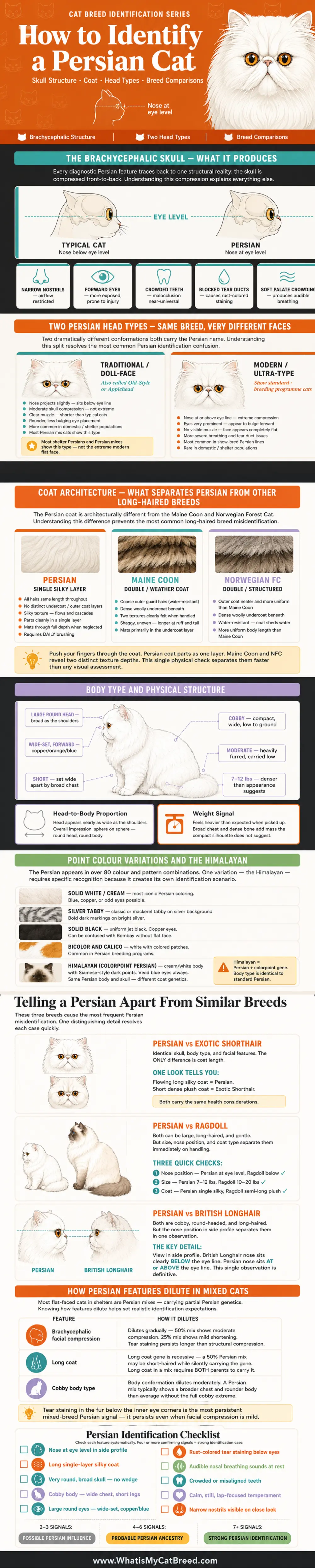
We have created an infographic covering the complete Persian identification framework — the brachycephalic skull structure and what it produces, both Persian head types compared side by side, the coat architecture compared against other long-haired breeds, and the main breeds most commonly confused with the Persian — in a single reference image you can save and consult alongside your own assessment.
The Traditional versus Modern head type comparison is the section most owners find immediately useful — it answers why a flat-faced cat from a shelter may look quite different from the breed-standard Persian, and what that means for identification confidence.
Frequently Asked Questions
How to tell if your cat is Persian: what is the single most reliable signal?
The nose position in side profile is the single most reliable starting signal. In a Persian, the nose tip sits at or near the level of the lower eyelid — a position no non-brachycephalic cat shares. In every other common domestic cat breed, the nose sits well below the eye line. You do not need to know anything else about Persian anatomy to make that first assessment: look at the cat's face from the side and note where the nose tip falls relative to the eye. If it sits at eye level, you are looking at a brachycephalic skull and Persian ancestry becomes the primary hypothesis to investigate. Combined with a cobby body, round wide-set eyes, and a very long flowing silky coat, that profile reaches genuine identification confidence.
Persian cat traits: does a flat face always mean Persian ancestry?
No — but it strongly suggests it. Persian genetics are responsible for most brachycephalic facial compression in the domestic cat population, because the Persian has been by far the most numerous brachycephalic cat breed for well over a century and its genetics have entered the mixed-breed population through decades of unplanned breeding. The Exotic Shorthair, Scottish Fold (which sometimes shows mild brachycephaly alongside the ear fold), and a few less common breeds also carry some degree of facial compression. The combination of a flat face with a very long silky single-layer coat and a cobby low-slung body is, in practical terms, diagnostic for Persian ancestry.
Can a Persian mix have a shorter or more normal-looking face?
Yes — and this is the most common scenario in the general domestic cat population. Brachycephalic facial features are controlled by multiple genes and dilute progressively across generations of mixing with non-Persian cats. A first-generation Persian mix (one purebred Persian parent) typically shows moderate brachycephaly — a visibly shortened muzzle and wide-set eyes without the extreme nose-at-eye-level compression. A second or third-generation mix may show very mild compression that requires specific attention to identify. Tear staining in the fur below the inner eye corners persists longer across generations than the structural compression itself, making it a useful supporting signal in cats where the facial compression is ambiguous.
Why does my Persian-looking cat have breathing sounds?
The snoring, snuffling, and open-mouth breathing sounds that many Persian and Persian-mix cats produce at rest come directly from the brachycephalic skull structure. The nasal passages are physically compressed, the soft palate is the same length it would be in a non-brachycephalic cat but now sits in a reduced space, and the nostrils are often narrowed. These structural features restrict airflow in ways that produce audible breathing sounds even in a healthy, unstressed Persian. In warm weather, during play, or under any physical or emotional stress, these sounds intensify. If the breathing sounds become laboured, involve open-mouth breathing at rest, or are accompanied by reduced exercise tolerance, veterinary assessment is warranted — the underlying structural causes can sometimes be surgically improved.
How do I tell a Persian from an Exotic Shorthair at a glance?
Coat length is the single fastest differentiator. The Exotic Shorthair carries identical skull structure, body type, and facial features to the Persian — it was developed specifically as a shorthaired Persian — but its coat is short, dense, and plush rather than long and flowing. The Exotic Shorthair coat stands slightly away from the body and has a teddy-bear quality; the Persian coat flows to the floor. If the face is flat and the body is cobby but the coat is short and dense, you are looking at an Exotic Shorthair or Exotic Shorthair mix rather than a Persian. For a complete breakdown of how [the most common domestic breeds](https://www.whatismycatbreed.com/most-common-domestic-cat-breeds) compare physically across all major features, the full breed comparison covers the Persian and Exotic Shorthair side by side with all distinguishing details.