Something interesting happens when an experienced veterinarian walks into an exam room with a cat they have never seen before. Before the owner finishes their first sentence, the vet has already formed a working hypothesis about the cat's breed background. Not a certainty — a hypothesis. But a structured, informed one based on a rapid visual assessment that happens almost automatically after enough clinical exposure.
It is not magic. It is pattern recognition built on anatomy, genetics, and the accumulated memory of thousands of cats examined over years of practice. And the framework vets use is learnable. Not to the level of clinical certainty — that takes years of hands-on examination — but well enough to conduct a meaningful self-assessment of your own cat using the same categories a vet would work through.
This article breaks down the veterinary approach to breed identification: what vets actually look at, in what order, how they weight different features, and where the limits of visual assessment sit even for trained professionals.
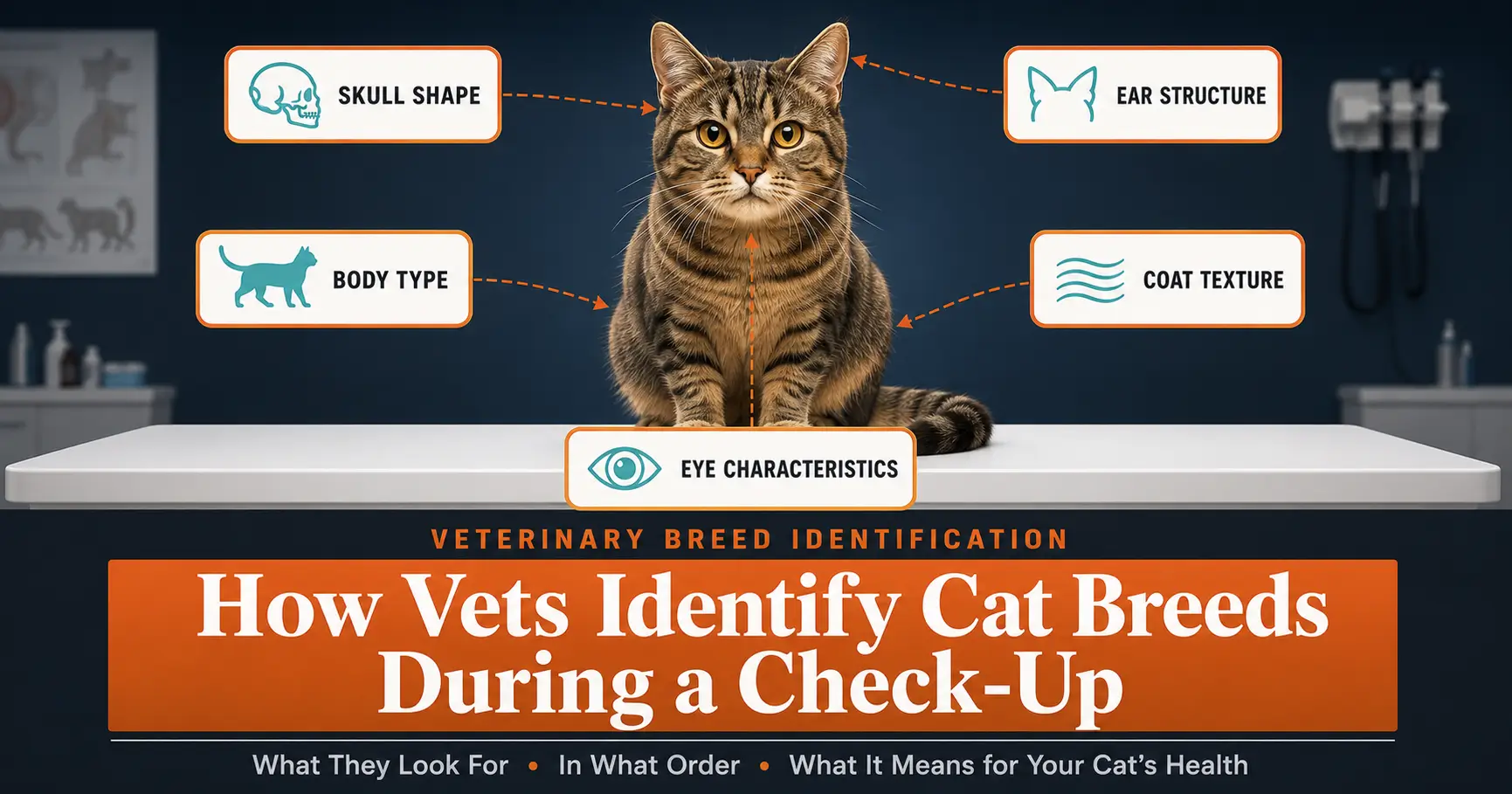
Why Veterinary Breed Assessment Matters
Before getting into the method, it is worth understanding why breed identification is clinically relevant — not just satisfying to cat owners.
Veterinarians need at least a working breed hypothesis for several concrete clinical reasons:
Health screening priorities. Certain breeds carry significantly elevated risk for specific heritable conditions. A cat that presents as probable Maine Coon warrants cardiac monitoring for hypertrophic cardiomyopathy. A cat with clear Persian or Exotic Shorthair features prompts attention to respiratory function, dental crowding, and tear duct drainage. A Scottish Fold — identifiable immediately by the folded ear cartilage — requires joint health monitoring throughout its life. These are not precautions applied to all cats equally; they are targeted because the breed signal justifies them.
Anesthetic risk assessment. Brachycephalic cats — those with flat, compressed facial structures — carry elevated anesthetic risk due to their airway anatomy. Identifying a cat as likely brachycephalic before sedation allows the veterinary team to prepare appropriate airway management protocols.
Behavioral context. A cat presenting with what its owner describes as "aggression" is assessed differently depending on whether it appears to be a Russian Blue (high stress reactivity, defensive response to strangers is breed-typical) versus a Bengal (high-drive behavior that may need environmental intervention) versus a random-bred domestic cat.
Medication dosing. Some breed-specific genetic variants affect drug metabolism. Certain mutations common in specific cat lines influence how the liver processes particular drugs — information relevant to any cat suspected of carrying those genetics.
How Vets Conduct a Breed Visual Assessment
A clinical breed assessment is not a single act of recognition. It is a sequential evaluation of multiple anatomical features, working from the most observable to the most specific. Most experienced veterinarians do this in roughly the same order.
Cat Breed Skull and Facial Structure Assessment
The skull is where veterinary breed assessment typically starts — because it is the feature with the most clinical implications and the greatest degree of breed-specific variation.
A vet assessing skull structure looks at three things simultaneously:
Facial compression — is there any degree of brachycephaly? Even mild compression — a slightly shortened muzzle, wider-than-average skull, eyes positioned slightly more forward than typical — is relevant. True brachycephalic cats (Persian, Exotic Shorthair, Himalayan) are identifiable immediately. But partial brachycephaly in a mixed-breed cat still informs the respiratory and dental assessment.
Skull width-to-length ratio — the relationship between how wide the skull is from ear to ear versus how long it is from nose tip to occiput (the back of the skull). A cobby-type cat (British Shorthair, Scottish Fold) has a wide, round skull with roughly equal width and length. A foreign-type cat (Siamese, Abyssinian) has a skull markedly longer than wide, with distinct lateral planes.
Muzzle profile — assessed specifically in lateral (side) view. Is the nose stop pronounced, moderate, slight, or absent? This single measurement has significant breed-family correlation. No stop at all (straight forehead-to-nose profile) signals Siamese-family anatomy. A deep stop with the nose at eye level signals Persian-type anatomy.
Conformation and Body Structure
After the skull, a vet moves to body assessment — typically by observation first, palpation second.
Observation captures body length-to-height ratio, chest width, limb proportion, and overall silhouette. A trained eye registers the cobby/moderate/foreign/substantial body type categories almost instantly after sufficient clinical exposure. These categories correspond to breed families in ways that have real clinical implications — large-framed cats need joint monitoring as they age; cobby cats need weight monitoring because their build predisposes to obesity; foreign-type cats need caloric monitoring because their lean mass needs adequate nutrition.
Palpation adds what observation cannot fully capture: bone density and thickness, muscle mass relative to body size, and the feel of the coat from underneath rather than on the surface. A vet running a hand along a cat's spine and feeling through the coat simultaneously assesses coat texture (plush/dense versus close-lying versus layered double coat) and body condition. The combination of what they feel and what they see produces a more accurate assessment than either alone.
Tail — length, thickness, and texture. A dramatically plumed, thick tail in proportion to a large-framed cat strongly suggests Maine Coon or Norwegian Forest Cat. A naturally bobbed tail of any length is immediately noted — it indicates a specific dominant genetic mutation regardless of what the rest of the cat looks like.
Ear Assessment
Ear examination during a routine check-up serves both clinical and breed-identification purposes simultaneously.
For breed identification, ear structure provides some of the most genetically specific signals available. A folded-forward ear is an immediate and near-certain marker of Scottish Fold genetics — the cartilage mutation is dominant and appears in mixed-breed cats carrying it from one parent. A backward-curled ear signals American Curl genetics. Lynx ear tufts (hair extending visibly beyond the ear tip) point toward Maine Coon or Norwegian Forest Cat in a large-framed cat.
Ear size and placement are assessed relative to skull type. Very large ears set high on a narrow wedge skull fit the Siamese-family profile. Small ears set wide and low on a round skull fit the cobby-breed profile.
For clinical purposes, the vet examines the ear canal, checks for signs of infection, and assesses the cartilage health — particularly important in Scottish Fold cats where the mutation affecting the ear cartilage also affects cartilage throughout the body.
Coat Examination
Coat assessment at a veterinary check-up goes beyond what most owners do at home. A vet physically separates the coat to assess:
Coat structure — whether there is a distinct undercoat separate from the guard hairs (double coat), a single layer of uniform length, or an absence of distinct layering. A Maine Coon or Norwegian Forest Cat coat has a textural transition between the outer and inner coat that is physically distinct under the fingers. A Persian coat has an unusually silky, non-layered quality at great length. A Russian Blue coat has a dense, plush undercoat that visually separates from the guard hairs.
Coat texture at the skin level — particularly relevant for rex-coated breeds (Devon Rex, Cornish Rex, Selkirk Rex) where the coat may appear normal until the vet parts it and finds the characteristic wavy or curled structure at the base.
Coat condition — separate from breed assessment but relevant to overall health picture. A cat whose coat quality has declined significantly may be showing signs of illness, nutritional deficiency, or hormonal condition rather than expressing its breed-typical coat.
What Vets Cannot Determine From Visual Examination Alone
Experienced veterinarians are honest about the limits of clinical breed assessment. Most will give a confident breed hypothesis when the features clearly converge — and a deliberately hedged response when they do not.
Mixed-breed cats with partial feature expression are genuinely difficult. A cat with a slightly elevated rump posture, fairly large paws, and a somewhat spotty tabby coat might reflect Bengal ancestry — or might simply be a domestic shorthair that happened to develop these features through ordinary genetic variation. A vet will flag the possibility without asserting it.
Generation distance from purebred ancestry cannot be determined visually. A cat that is 25% Maine Coon (one purebred grandparent) and a cat that is 6.25% Maine Coon (one purebred great-great-grandparent) may be visually indistinguishable. Their clinical risk profiles are meaningfully different. Visual assessment cannot make this distinction — DNA testing can.
Coat quality under abnormal conditions — a cat that has been shaved, a cat with stress-related coat changes, a kitten whose adult coat has not developed — all present visual assessment challenges that a vet will explicitly note in their assessment.
Rare breeds present challenges even for experienced veterinarians simply because most clinicians see them rarely. A Chartreux may be confidently assessed as a Russian Blue or a gray domestic shorthair. A Havana Brown may pass entirely unrecognized. Clinical breed exposure is weighted toward common breeds, which means uncommon breeds are underrepresented in the pattern recognition library of most practitioners.
The Veterinary Breed Assessment Process in Order
To summarize the clinical approach as a practical sequence:
1. Initial visual impression — the vet forms a rapid working hypothesis from body size, coat, and overall silhouette as the cat enters or is placed on the exam table. This is the "first read" — useful as a starting hypothesis, held lightly.
2. Skull and facial assessment — the most clinically weighted visual feature. Brachycephaly, skull shape, muzzle profile, and eye placement all assessed before hands-on examination begins.
3. Ear assessment — for breed-specific mutations (fold, curl) and for size/placement signals relative to skull type.
4. Hands-on body palpation — bone density, muscle mass, coat texture through the coat, tail characteristics.
5. Eye color and shape — noted specifically when paired with coat color (vivid green on a blue-gray coat; blue eyes on a non-white cat; unusual eye shape for the skull type observed).
6. Behavioral observation — how the cat responds during examination. High stress reactivity in a cat with Russian Blue features. Persistent vocalization in a Siamese-featured cat. Unusual water-seeking noted in owner history. Behavioral signals are assessed as supporting or complicating the visual hypothesis.
7. Owner history — where the cat came from, what the owner knows or believes about its background, any prior veterinary records. This does not replace anatomical assessment but provides context that helps interpret ambiguous signals.
8. Synthesis — the vet integrates all of the above into a breed-family hypothesis or a note that features are too mixed to support a confident assessment. The clinical record typically notes something like "suspected Maine Coon mix" or "consistent with Persian/domestic SH cross" rather than claiming confirmed breed identity.
How Your Own Assessment Can Mirror the Veterinary Approach
The vet's sequential framework is entirely applicable to a self-assessment at home — with the obvious caveat that clinical training produces faster pattern recognition and more confident conclusions than a first-time effort.
Work through the same sequence: skull shape and facial compression first, then body type and palpation, then ears, then coat texture, then eye color in combination with other features. Resist the impulse to jump to a conclusion from any single feature. The vet does not decide "Maine Coon" because the cat is large. They decide "probable Maine Coon mix" when the cat is large, has ear tufts, a square muzzle, a heavy rectangular frame, tufted paws, and an unusually plumed tail — with multiple independent features pointing the same direction.
Our physical features guide at whatismycatbreed.com/identify-cat-breed-by-physical-features follows this same layered approach — walking through each anatomical feature in sequence before synthesis. It is designed as a structured self-assessment tool that mirrors the clinical method.
For the body conformation component — the part of the veterinary assessment that is hardest to conduct by eye alone — the detailed breakdown at whatismycatbreed.com/cat-body-type-and-breed covers how to assess body type, leg proportion, chest width, and tail characteristics systematically.
When physical assessment reaches its limits — which it does for every mixed-breed cat with diluted or ambiguous ancestry — the options are an AI-based photo analysis or a DNA test. The DNA testing guide at whatismycatbreed.com/cat-dna-testing covers how genetic testing complements rather than replaces visual assessment, and what the results actually mean in clinical terms.
The American Association of Feline Practitioners (AAFP) — the primary professional organization for veterinarians specializing in feline medicine — publishes clinical guidelines that inform how veterinarians approach breed-related health considerations during routine wellness examinations. Their feline life stage guidelines are publicly available and include breed-specific health monitoring considerations that are directly relevant to the clinical breed assessment process described in this article.
We have put together a visual infographic summarizing the complete veterinary breed assessment sequence — from initial visual impression through skull assessment, ears, coat, body type, and behavioral signals — in a single reference chart you can save and use when assessing your own cat.

Frequently Asked Questions
How Accurate Is a Vet's Breed Identification?
For cats with clear, convergent breed features — particularly purebreds or first-generation mixes — an experienced veterinarian's breed assessment is highly accurate. For multi-generation mixed-breed cats where features are diluted and divergent, even experienced clinicians give hedged assessments rather than confident conclusions. The accuracy of visual breed identification is always proportional to how clearly and consistently the breed features express in the individual cat.
Do Vets Use DNA Tests to Identify Cat Breeds?
Not routinely in standard wellness practice, but increasingly when breed identification has direct health management implications. A veterinarian may recommend a DNA test for a cat that presents with features suggesting a breed known for specific heritable conditions — particularly when the owner needs genetic information to make decisions about health monitoring or, in the case of breeders, reproduction. For most pet owners, a vet's clinical assessment alongside physical self-assessment is sufficient.
Cat Breed Identification at the Vet: Should I Bring Records?
Any documentation you have about your cat's background is worth bringing to the first veterinary appointment — shelter intake forms, adoption paperwork, any prior veterinary records, and if available, information about the parents or litter. Even partial information helps the vet calibrate their visual assessment. A shelter note saying "found as stray with litter of kittens, all orange tabbies" has less diagnostic value than a note saying "surrendered by owner who stated cat is from a Maine Coon breeder's waiting list cat." Neither confirms breed — but both provide context.
Can a Vet Tell If My Cat Is Purebred Just by Looking?
No — and a responsible veterinarian will say so directly. Visual appearance does not confirm purebred status. A cat can carry the complete visual expression of a specific breed — including every expected physical feature — without being a registered purebred. Conversely, a registered purebred cat may express some features more mildly than the breed standard predicts. Purebred status requires documentation, not appearance. The clinical value of the vet's breed assessment is not about confirming registration — it is about informing health monitoring priorities.
Why Does Breed Matter for Veterinary Care?
Because breed-linked genetic conditions create concrete, actionable differences in preventive care. A Maine Coon or Maine Coon mix benefits from cardiac ultrasound screening that would be unnecessary for a random-bred domestic shorthair of the same age and apparent health. A brachycephalic cat needs airway assessment before any procedure involving sedation. A Scottish Fold needs joint health monitoring that a non-folded breed of the same age does not. These differences in care protocol have real health outcomes — which is why breed identification at the veterinary level is a clinical exercise rather than a cosmetic one.