The Asian leopard cat weighs about eight pounds. It hunts fish. It does not, under ordinary circumstances, share a sofa with anyone. And yet, in the 1960s and 1970s, geneticist Jean Mill began crossing it with domestic cats — deliberately, systematically — with the goal of creating a cat that carried the wild leopard's appearance without the wild leopard's disposition.
The result is the Bengal. And fifty years later, it remains one of the most visually striking, behaviorally demanding, and widely misidentified cats in ordinary household settings.
Bengals are misidentified in two directions. Some owners look at a boldly spotted tabby and assume Bengal. Some owners look at a true Bengal and assume it is just a particularly athletic-looking tabby. Both mistakes are understandable — and both are correctable once you know what to actually look for.
This guide works through every reliable identification marker for the Bengal cat: coat pattern, coat texture, body structure, head geometry, eye characteristics, and behavioral signals. By the end, you will be able to distinguish a genuine Bengal from a Bengal-influenced mix and from the spotted tabbies that are frequently mistaken for Bengals.
Bengal Cats: Where They Come From and Why It Matters
Understanding the Bengal's origin is not trivia — it directly explains every distinguishing physical and behavioral feature the breed carries.
The Bengal was developed through crosses between domestic cats and the Asian leopard cat (Prionailurus bengalensis) — a small wild felid native to South and East Asia. Early-generation hybrid cats (F1, F2, F3) are largely unsociable and difficult to keep. From the fourth generation onward (F4 and beyond), the domestic temperament stabilizes enough for pet ownership — but even these later-generation cats retain behavioral patterns that trace directly to their wild ancestry.
The coat pattern, the body structure, the muscle mass, the hunting drive, the water affinity, the intelligence — all of these are not random. They are the direct expression of Asian leopard cat genetics that were retained through the selective breeding program because breeders specifically wanted them.
This matters for identification because it means the Bengal's distinctive features are not superficial. A spotted tabby can produce spots through domestic tabby genetics alone. A true Bengal's spots are structurally different — and that difference is visible once you know what to look for.
The Cat Fanciers' Association (CFA) only began accepting Bengals for championship competition in 2022 after years of classification debate. The International Cat Association (TICA) has recognized the Bengal since 1986 and maintains the most detailed breed standard currently in use.
Cat Breed Identification: The Bengal Coat Pattern
The coat is where Bengal identification starts — and where most misidentifications also start.
Rosettes vs Spots vs Stripes
The single most important distinction for Bengal identification is the difference between rosettes and ordinary spots or stripes.
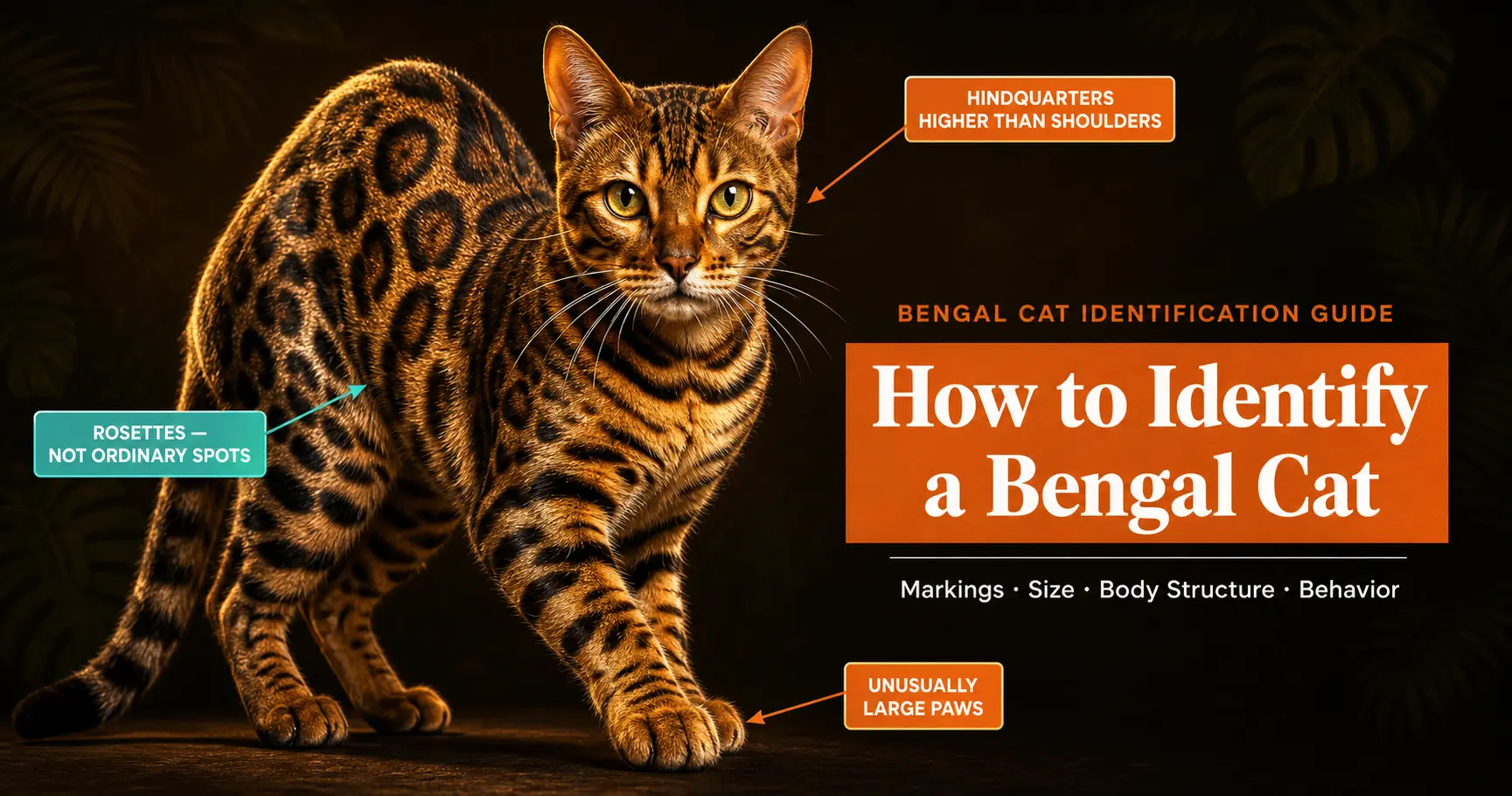
A rosette is a two-tone marking. The center of a rosette is a lighter color than its outline. This creates a spotted pattern where each mark has a ring or partial ring around a paler center — exactly like the markings of a leopard or jaguar. No other domestic cat breed produces true rosettes through normal tabby genetics. Rosettes in a domestic cat are a near-certain signal of Bengal ancestry.
Rosettes appear in several forms:
- Arrowhead rosettes — elongated shapes with a pointed leading edge, arranged in rows that suggest direction of movement
- Pawprint rosettes — open circles with dark outer marks suggesting a large paw shape
- Clouded rosettes — larger, irregular dark outlines with pale interiors, producing a dramatic graphic quality
Ordinary spotted tabbies produce solid spots — one uniform dark color throughout each mark, no lighter center, no visible outline structure. These are genetically tabby spots, produced by the break-up of mackerel stripes into disconnected dots. They can look impressive in a boldly marked cat, but they do not have the two-tone rosette structure.
Marbled Bengals are less commonly recognized but equally valid. The marble pattern is not spots at all — it is a complex, swirling blotch pattern that resembles the branching structure of a river system or marble stone when viewed from above. True Bengal marbling is distinct from the ordinary classic tabby pattern: it flows horizontally rather than in the typical bullseye swirl of a classic tabby, and the contrast between the lighter background and darker markings is typically more vivid.
The Glitter Effect
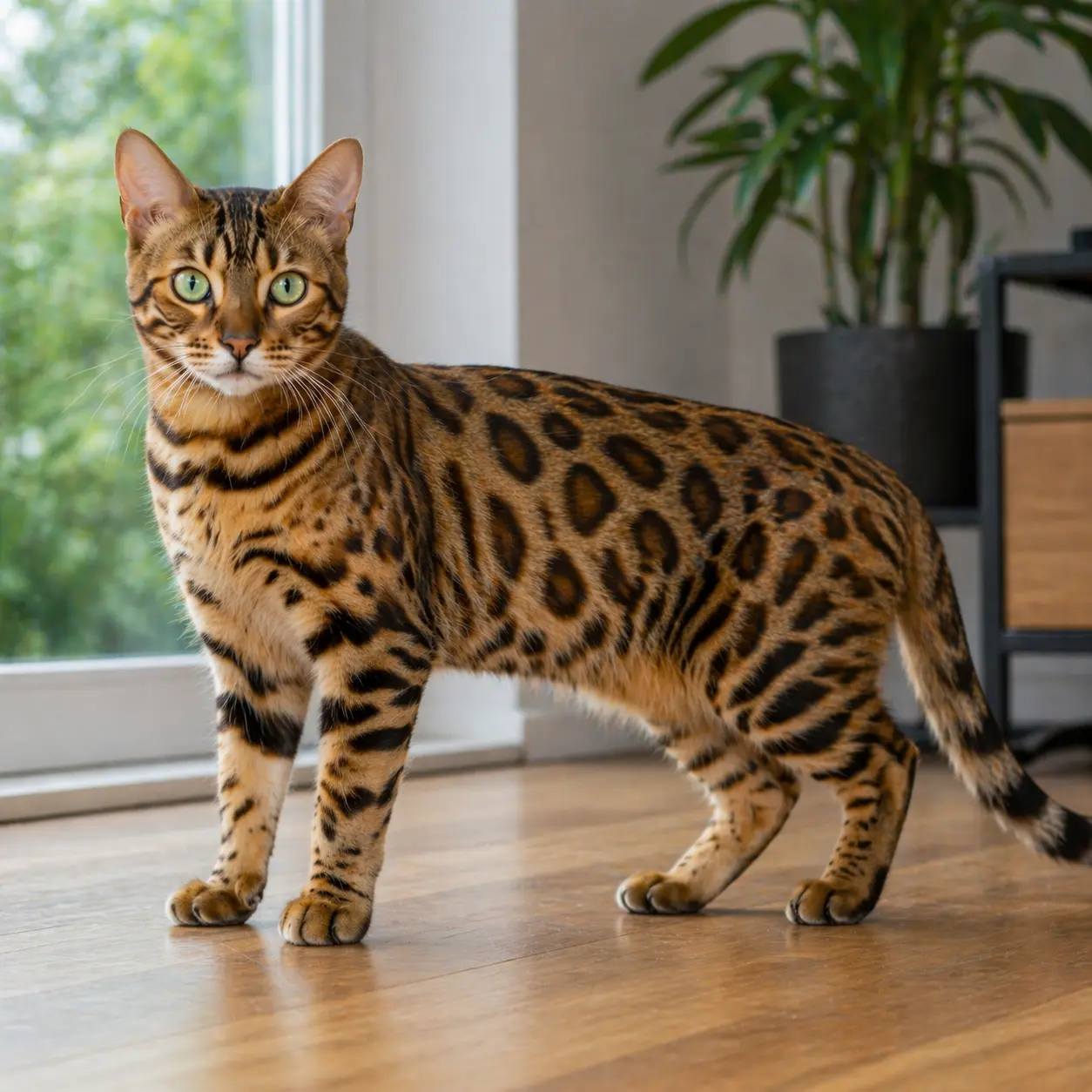
One of the Bengal's most distinctive — and most frequently overlooked — coat features is what breeders call glitter. This is a quality in the coat where individual hair shafts appear to be tipped with a light-refractive element, producing a sparkling, iridescent quality in natural light. The coat seems to catch light independently of the direction you view it from.
Glitter is not universal in Bengals — not all Bengals have it — but when present, it is essentially diagnostic. No other common domestic cat breed produces this specific light-catching quality in the coat. If you are looking at a spotted cat whose coat catches sunlight in a way that makes it appear to sparkle or shimmer independently, Bengal genetics are almost certainly present.
The glitter effect is most visible in direct sunlight or bright natural light. In artificial indoor lighting, it can be nearly invisible. Photograph the cat outside in daylight if you are assessing for this feature.
Coat Background Color
Bengal coat base colors vary, but the most common and most distinctively Bengal colors are:
- Brown tabby — a warm tawny gold to deep mahogany base with black or dark brown markings
- Silver — a bright silver-white base with dark gray to black markings — very high contrast, dramatically graphic
- Snow — three sub-variants (seal lynx point, seal mink, seal sepia) producing lighter overall cats with varying degrees of contrast
The warm golden tawny base of the brown tabby Bengal — combined with vivid rosettes — most closely approximates the Asian leopard cat's wild appearance and is the most immediately recognizable. Silver Bengals are equally valid but sometimes cause more identification confusion because the high contrast and lighter base can look less immediately "wild."
Body Structure: Reading the Bengal Frame
The Bengal's body tells you as much as its coat — and the body is harder to fake in a mixed-breed cat than the coat pattern.
Size and Weight
Bengals are medium to large cats — typically 8–15 lbs for males, 6–10 lbs for females. What distinguishes them from other cats of similar weight is muscle density. Bengals feel heavier and more solid than they look. Picking up a Bengal for the first time surprises most people — the cat is substantially denser than its size suggests.
This muscle quality comes directly from the Asian leopard cat heritage. The wild ancestor is an athlete built for hunting over rough terrain and in water. That musculature has been retained through selective breeding.
Body Shape and Proportions
The Bengal body is long and athletic — not the cobby compactness of a British Shorthair or the extreme angularity of a Siamese. It occupies a semi-foreign to foreign build, but with more muscle mass than most foreign-type breeds.
Specific proportions to look for:
The hindquarters are higher than the shoulders. This is one of the Bengal's most distinctive and least-discussed structural features. When a Bengal stands, its rear end sits visibly higher than its front — the back slopes slightly downward toward the shoulders. This gives the Bengal a crouched, ready-to-spring posture even when simply standing still. This slope is inherited from the Asian leopard cat and is not seen in other common domestic breeds.
The legs are medium-long with noticeably large paws. The feet are big relative to the cat's legs — again, a wild-cat heritage feature. This large-paw detail distinguishes the Bengal from spotted tabbies of similar body size.
The neck is long and muscular — connecting to a head that appears slightly small relative to the powerful body. This creates a distinctive neck-to-head proportion that is very different from the large-headed cobby breeds and somewhat different from the elongated-head foreign breeds.
| Feature | Bengal | Spotted Domestic Tabby | Abyssinian |
|---|---|---|---|
| Spot structure | Two-tone rosettes with pale centers | Solid one-tone spots | No spots — ticked coat only |
| Coat glitter | Present in many individuals | Absent | Absent |
| Body build | Muscular, dense, hindquarters higher | Variable — no consistent build | Lean, semi-foreign, even height |
| Head shape | Broad, rounded contours, wide nose | Variable | Modified wedge, large ears |
| Paw size | Noticeably large relative to legs | Proportional | Small, oval |
| Water behavior | Frequently seeks water voluntarily | Typical cat water avoidance | Typical |
Head Shape and Facial Features
The Bengal face is distinct from other spotted-coat cats and from other athletic-build cats. Knowing what to look for at the face level is important because it confirms or challenges the coat-based hypothesis.
Head Shape
The Bengal head is broad and rounded — with strong, full contours at the cheekbones and jawline that give the face a substantial, powerful quality. This is quite different from the wedge-shaped Siamese or the more moderate modified wedge of the Abyssinian.
The overall impression is of a face with broad planes — the space between the ears is wide, the cheekbones are high and prominent, and the muzzle, while not short, is wide and full rather than tapered or pointed.
Nose Width
The Bengal nose is noticeably wide and prominent — wider than most domestic cat breeds of comparable size. In profile, the nose extends clearly from the face with a straight, unbroken bridge. From the front, the width of the nose is immediately visible. This wide nose is a direct inheritance from the Asian leopard cat and distinguishes the Bengal's facial structure from spotted domestic tabbies, which typically have more moderate nasal width.
Eyes
Bengal eyes are oval to round, set slightly obliquely on the skull — the outer corner sits slightly higher than the inner corner. Eye size is large relative to the face. Color varies by coat type:
- Brown tabby Bengals: gold, green, or hazel eyes — all vivid and clear
- Silver Bengals: green or blue-green eyes are most common
- Snow Bengals: blue or aqua eyes depending on the specific snow variant
The eye color in Bengals tends to be vivid and saturated — not pale or washed-out versions of these colors, but intense, clear expressions of them.
Ear Size and Placement
Bengal ears are medium-sized — not large and wide-based like a Siamese, not small and rounded like a British Shorthair. They are set wide on the skull and have a slightly forward tilt. The ear tips are rounded. Ear tufts are minimal or absent — the Bengal's ear profile is clean rather than decorative.
This moderate ear size, combined with the broad skull, is part of what gives the Bengal face its distinctive powerful quality without the extreme angularity of the foreign breeds.
Bengal Behavior: The Identification Layer That Cannot Be Faked
No behavioral trait alone confirms Bengal ancestry. But the behavioral profile of a confirmed Bengal is so distinctive that consistent behavioral signals — alongside matching physical features — add meaningful weight to an identification hypothesis.
Water
The most frequently cited and most reliable behavioral signal is a voluntary, enthusiastic relationship with water. Bengals do not simply tolerate water — they seek it. They paw at running taps. They sit in wet sinks. They attempt to join their owners in the shower. Some Bengals have been documented voluntarily entering water to retrieve submerged toys.
This behavior comes directly from the Asian leopard cat, which hunts in and around water and is an accomplished swimmer. It is so consistent in Bengals — and so uncommon in most other domestic breeds — that water-seeking behavior in an otherwise unidentified spotted cat is a meaningful piece of evidence.
Intelligence and Problem-Solving
Bengals open doors. They figure out cabinet latches. They dismantle childproofing. They learn to turn lights on and off. They discover the specific time their owner typically feeds them and position themselves at the food bowl exactly four minutes before.
This intelligence level is not merely anecdotal — it is systematically observed in Bengals and widely documented by owners and breeders. It is also a source of management challenges that unprepared owners find overwhelming. A Bengal that is not mentally stimulated redirects its intelligence into behavior that owners find destructive.
Vocalization and Communication
Bengals are vocal but not in the Siamese way. The Siamese vocalizes in a demanding, persistent, conversation-seeking register. The Bengal vocalizes in a more varied, sometimes chirping or chattering register — particularly when watching birds through a window. Bengals also produce low, rolling chirps during play that are distinctive and quite different from ordinary meowing.
Activity and Hunting Drive
The Bengal's hunting drive is significantly more intense than that of most domestic breeds. They do not play — they hunt. Interactive play with a wand toy triggers a genuine predatory sequence: stalking, chasing, pouncing, catching, and carrying. The intensity of focus during this sequence is different in quality from the play behavior of most domestic cats. Owners consistently describe it as watching something switch on.
Bengal Mixes vs Purebred Bengals: What the Differences Look Like
A significant number of cats described as Bengals in shelter intake forms, online listings, and casual conversation are Bengal mixes — cats that carry some Bengal genetics without being registered purebreds. Understanding how Bengal features express in mixed cats helps set realistic expectations.
Which Features Persist in Mixes
The coat genetics that produce rosettes require specific gene combinations. True rosettes in a mixed-breed cat with Bengal ancestry may appear as:
- Full rosettes (if the mix is recent — first or second generation)
- Broken rosettes (spots that show partial two-tone structure but are less fully developed)
- Bold spots with darker outlines (a directional signal rather than a definitive marker)
- Standard solid spots (if the rosette-specific genetics were not passed on)
The glitter effect is somewhat more persistent in mixes — it appears to be heritable even when the rosette pattern has partially diluted.
The hindquarters-higher posture is one of the most persistent structural features in Bengal mixes — even several generations removed from a purebred Bengal, the slightly elevated rump posture can be visible.
The large paw size relative to leg length also persists reliably in Bengal-influenced mixes.
Behavioral traits — water affinity, intelligence, hunting intensity — are heritable and may express clearly in a cat with significant but non-purebred Bengal ancestry.
What You Cannot Conclude Without Papers
A spotted cat with glitter, large paws, a slightly elevated rump, and water-seeking behavior may well have Bengal ancestry. But calling it a Bengal without a pedigree is inaccurate. It is a cat with Bengal characteristics — which is a real and meaningful thing — but not a registered Bengal. The distinction matters for the same reasons outlined in our guide on the differences between purebred and mixed breed cats.
How to Confirm Bengal Ancestry When You Are Not Sure
When physical and behavioral assessment leaves you uncertain, two confirmation routes are available.
DNA testing can detect Bengal-specific genetic markers, including variants associated with the Asian leopard cat ancestry that distinguishes Bengals from spotted domestic tabbies. The coverage for Bengal genetics varies by testing company — check that the specific test you choose includes Bengal in its reference panel. The detailed assessment of which DNA tests cover which breeds is covered in our cat DNA testing guide.
Breeder or specialist consultation is worth pursuing if you believe you have a Bengal or near-Bengal without documentation. Bengal breed associations and experienced Bengal breeders can assess photographs and often give informed opinions that help distinguish confirmed Bengals, near-Bengals, and spotted cats without meaningful Bengal ancestry.
The International Bengal Cat Society (TIBCS) maintains educational resources about Bengal identification that are detailed, breed-specific, and significantly more granular than general cat breed guides. Their documentation on rosette types, pattern terminology, and coat quality is the most reliable specialist reference available for this breed.
Understanding where Bengal characteristics fit within the broader framework of physical cat breed identification — body type, coat, face, and ear signals working together — gives you the most complete picture when assessing a suspected Bengal.
For cats that show Bengal-like coat patterns combined with other unexpected features, the mixed breed identification guide covers how to interpret competing signals from multiple possible breed backgrounds.
If you want to explore where your specific cat's features fit across all the breed families — not just Bengal versus tabby — the breed quiz works through physical and behavioral signals as structured questions and returns a result that may give you a useful starting framework.
We have put together a visual infographic that maps all the key Bengal identification features — coat pattern types, body structure signals, facial features, and behavioral markers — in a single reference image you can save and compare directly against your cat.

Frequently Asked Questions
Bengal Cat Identification: How Do I Know If My Cat Is Really a Bengal?
Look for the combination of features rather than any single marker. True rosettes (two-tone spots with paler centers), a muscular body with hindquarters visibly higher than the shoulders, noticeably large paws, a wide broad nose, and vivid eye color together form a strong Bengal profile. Add glitter in the coat and water-seeking behavior and the case becomes very strong. A single feature — spotted coat alone, or large size alone — is not sufficient. Multiple converging signals are what distinguish genuine Bengal characteristics from a coincidentally striking domestic tabby.
Cat Breed Rosettes vs Spots: What Is the Actual Difference?
A rosette has a two-tone structure — a darker outer ring or partial ring surrounding a lighter center. Each rosette mark contains at least two visible colors: the pale interior and the darker outline. This is genetically distinct from ordinary tabby spots, which are a single solid color throughout each mark. In good natural light, the difference is visible to the naked eye once you know what to look for. Rosettes have depth — they look almost three-dimensional. Ordinary spots are flat, uniform, and one-toned.
Can a Domestic Tabby Cat Have Rosettes Without Bengal Ancestry?
Genetically, true rosettes as seen in Bengals require the specific combination of genes associated with the Asian leopard cat hybrid ancestry. An ordinary domestic tabby does not carry these genes and cannot produce true rosettes through tabby genetics alone. However, some bold spotted tabbies produce markings that have a faint two-tone quality at their edges — particularly in cats with high-contrast ticked backgrounds. These are not rosettes. They are boldly expressed tabby spots that resemble rosettes at a distance. Genuine Bengal rosettes show clear, defined pale centers with darker complete or partial outlines.
How Big Do Bengal Cats Get?
Male Bengals typically reach 10–15 lbs at a healthy adult weight. Females are smaller — usually 6–10 lbs. The size alone is not a Bengal identifier since many breeds and mixed-breed cats reach comparable weights. What is more distinctive than raw weight is the muscle density — Bengals feel heavier and more solid than their size suggests. A well-muscled 12 lb Bengal feels categorically different from a 12 lb overweight domestic shorthair. The combined signals of size, muscle mass, elevated rump posture, and large paws are more diagnostic than weight alone.
Are Bengal Cats Dangerous or Aggressive?
No — but they are high-maintenance. A Bengal that receives adequate exercise, mental stimulation, and appropriate social interaction is no more aggressive than any other domestic cat. The problems arise from mismatched expectations. An owner who expected a calm, low-energy companion and got a Bengal instead is likely to experience behavioral issues — not because the cat is dangerous but because it is frustrated and under-stimulated. The intense hunting drive, the water-seeking, the problem-solving, the constant activity — these are not behavioral problems. They are the natural expression of a cat with significant wild-cat heritage living in an environment designed for a domestic cat. Understanding that distinction is the foundation of successful Bengal ownership.