The average domestic cat carries between 18 and 23 caudal vertebrae in its tail. A Manx carries none. A Japanese Bobtail carries just a handful — fused, kinked, and unique to every individual cat in that breed. These are not minor anatomical quirks. They are genetic signatures, and they are visible from across the room.
Most owners zero in on face and coat when trying to work out their cat's breed. The tail gets almost no attention. That's a significant miss — tail morphology follows tighter genetic rules than coat color does, and it is one of the most breed-specific features a cat carries. Using the tail as a cat tail breed identifier narrows the field fast, often faster than any other single feature.
Three things about a tail tell you something meaningful: its length, its shape, and how the cat holds it. A fourth — coat texture on the tail itself — narrows things further in longhaired and curly-coated breeds. Together, these four signals form a reliable component of any breed identification process.
This post focuses entirely on the tail. What it reveals, which breeds it flags clearly, and where it reaches its limit.
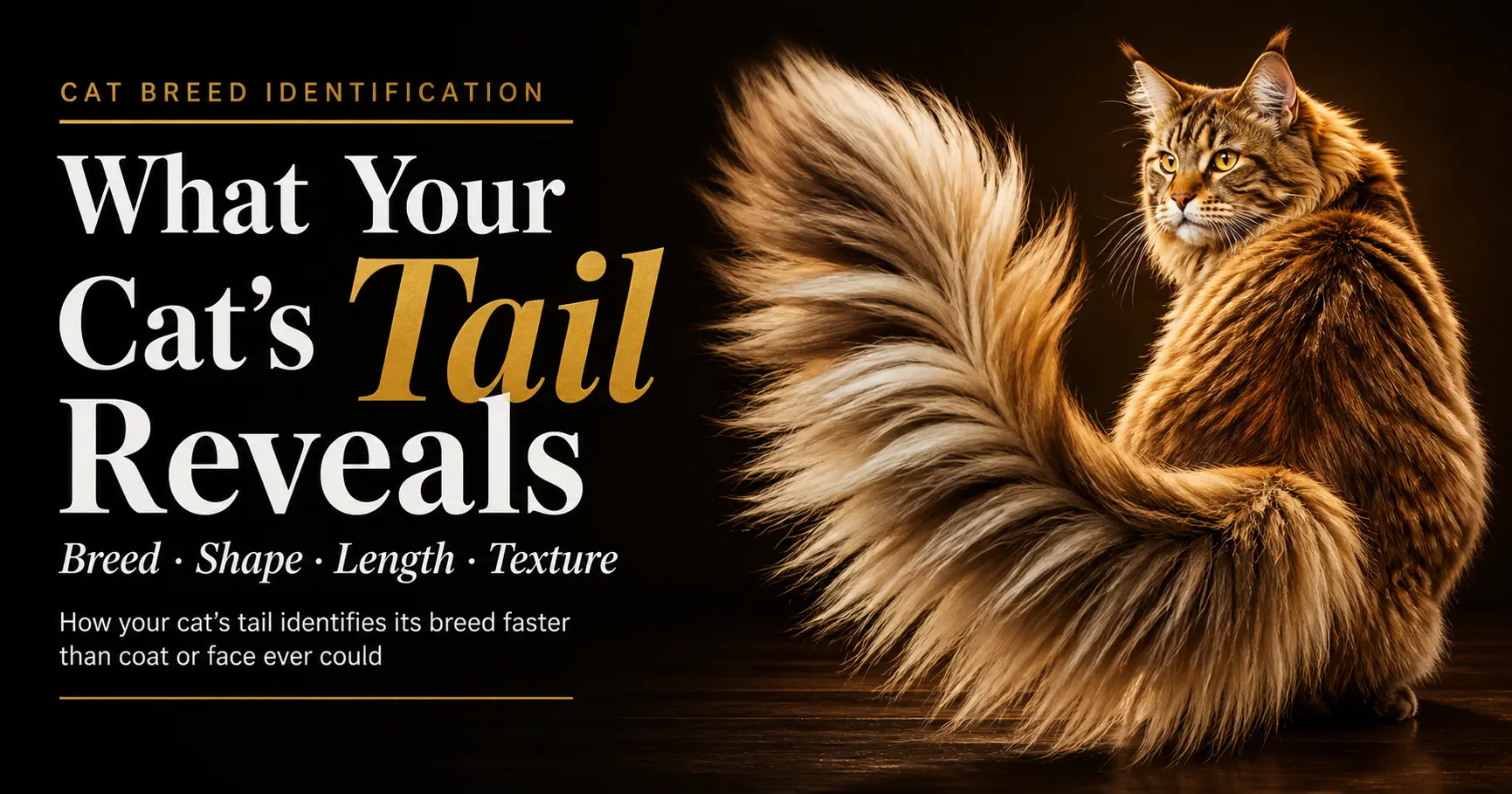
Cat Tail Anatomy: The Structure Beneath the Fur
Before breed signals make sense, the underlying anatomy helps. A cat's tail is a direct extension of the spine — the caudal vertebrae begin immediately after the sacrum and continue to the tip. Most domestic cats carry between 18 and 23 of them. Length, flexibility, and how those vertebrae fuse or truncate all determine the tail shape you observe externally.
Tail set — the point where the tail meets the body — is the first feature to assess. Some breeds carry a high tail set, where the tail base sits near the top of the rump and lifts immediately. Others carry a low set, where the tail emerges from a lower point and angles downward before rising. This feature stays consistent within breeds and distinctive across them.
Tail base width is the second structural signal, and it is more informative than most owners expect. A Maine Coon has a thick, wide tail base that tapers gradually across a long length. A Siamese has a narrow, fine base that flows into an equally fine tail throughout. You can feel this as much as see it. Run your hand from the cat's rump to the first few inches of tail and the difference between a heavy-framed breed and a fine-boned one is immediately clear.
When I do this with my own cat, her tail base feels almost like gripping the root of a thick rope — dense and solid right at the body. A friend's Siamese feels entirely different at the same point: light, almost delicate. Same action, completely different structural information.
The tail tip tells its own story in specific breeds. Some show darker tip coloring — a characteristic of Abyssinians and certain ticked domestic shorthairs. Others show coat variations at the tip: a tuft in a Maine Coon, a flowing plume in a Persian, a ringed banding pattern in a Bengal. These tip details are visible even on cats whose overall color makes the rest of the tail hard to read.
The Genetic Story Behind Short and Bobbed Tails
Short tails in cats are not accidents. They express specific genetic mutations — and the mutation varies depending on the breed. This matters enormously for identification, because the form of the shortening points directly to the breed.
The Manx carries a mutation in the T-box transcription factor gene that disrupts tail vertebrae development entirely. This mutation produces the full range of Manx tail outcomes within a single litter: completely tailless cats ("rumpies"), cats with a small rise of bone where the tail would be ("risers"), cats with a short stub ("stumpies"), and cats with near-normal but shortened tails ("longies"). A completely tailless cat with a Manx body type — cobby, heavy, rounded at the rump — points immediately to the Manx or its longhaired variant, the Cymric. No other breed produces fully tailless cats through natural breeding.
The Japanese Bobtail carries a genetically independent mutation. The vertebrae are present but shortened, kinked, and partially fused — creating a pom-pom shape that curves back toward the body. Every Japanese Bobtail's bobtail differs slightly from every other's, even within the same litter. That individual variation is a breed hallmark, not a defect. The tail is also rigid — it doesn't flex like a normal tail does. Pick it up gently and it moves as a single structure rather than as individual segments.
The American Bobtail produces a naturally shortened tail between one-third and one-half of a full tail's length. Critically, this tail is flexible. It often curves or kinks slightly but moves freely — the opposite of the Japanese Bobtail's fused structure. American Bobtails are heavier and more muscular than Japanese Bobtails, and the tail reflects this: wide at the base, substantial in feel, flexible throughout.
The Pixiebob carries a bobbed tail that ranges from fully absent to roughly two inches. The genetic mechanism differs from all three breeds above. A Pixiebob looks superficially similar to an American Bobtail at a glance — the heavily spotted coat, large frame, and short tail create a similar silhouette. But the Pixiebob's distinctly wild-looking face, heavily spotted pattern, and polydactyl feet (in many individuals) distinguish it quickly.
A short tail is a genetic marker specific to a small number of breeds. The exact form of the shortening — fused versus flexible, pom versus stub, fully absent versus partial — points clearly to which breed you are looking at.
The Kurilian Bobtail, less commonly encountered in Western countries, carries its own bobtail variant: a short, fluffy, pompom tail formed from 2–10 kinked vertebrae, similar in appearance to the Japanese Bobtail but produced by a separate mutation in a distinctly heavier-bodied cat.
Long, Plumed, and Whip-Thin: Full-Length Tail Types by Breed
For cats with full-length tails, three broad structural types emerge. They map reasonably cleanly to breed categories — which makes them useful as a first-pass filter before examining finer details.
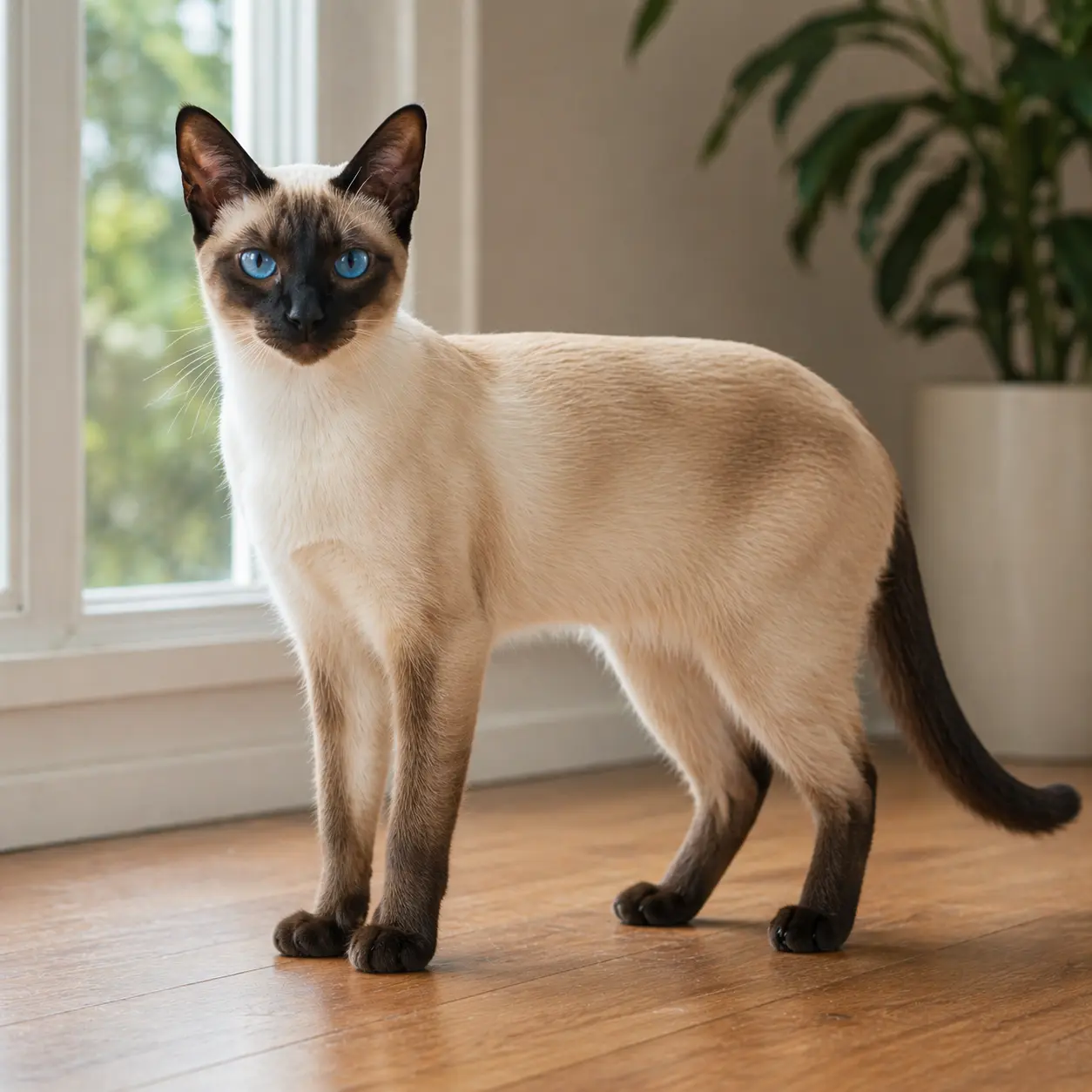
The whip tail is long, fine, and tapers to a sharp point. It is the signature of the Oriental breeds — Siamese, Oriental Shorthair, Balinese, and related lines. The tail on a Siamese is narrow from base to tip, almost stick-like in its fineness. It feels light when you lift it — uniformly fine throughout with no real taper because it starts thin and stays thin. A cat whose tail seems almost too long and too narrow for its body is showing a clear whip-tail profile, pointing toward Oriental breed ancestry.
The plumed tail is long and heavily furred — the coat fans outward and creates a flowing feather-like shape. The Persian, Norwegian Forest Cat, and Turkish Angora all carry this tail type, but each version differs in texture. A Persian's plume is dense and uniform, creating a full fan with no visible taper. A Norwegian Forest Cat's plume is similarly long but feels coarser and more resistant — designed to shed water. The Turkish Angora's plume is fine and silky rather than dense — it flows and moves with the cat rather than sitting as a solid mass. All three produce the plumed appearance, but the fur quality distinguishes them clearly if you run a hand through the tail.
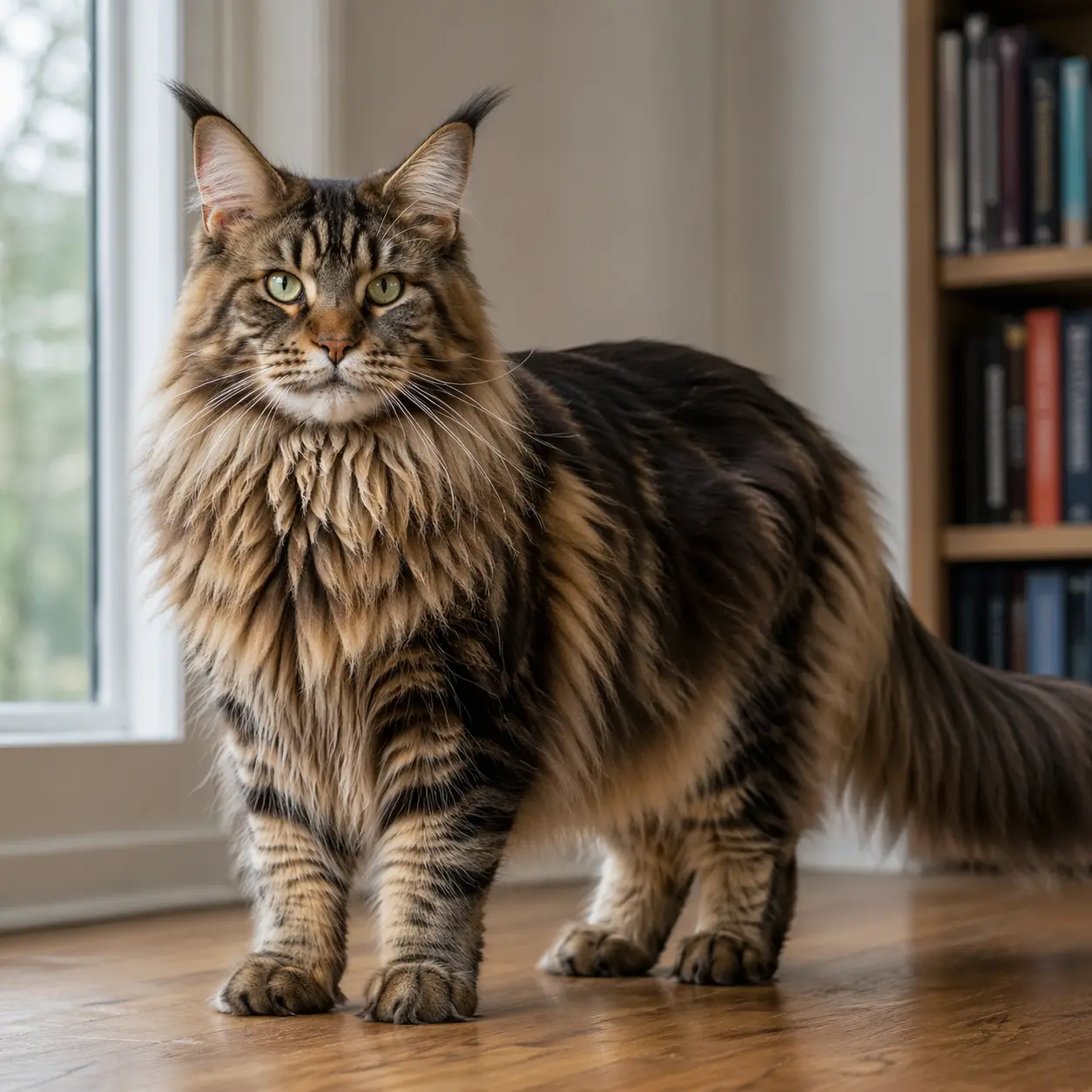
The otter tail — named directly for the river otter's characteristic tail — is thick at the base and tapers evenly toward the tip, covered in coat that lies flat rather than fanning outward. The Maine Coon is the textbook example. The tail matches the body: large, substantial, covered in shaggy layered fur that has considerable volume without the outward fan of a Persian's plume. Lift the tail on a Maine Coon and the weight is immediately obvious. This is not a delicate structure — it has real mass.
The Ragdoll and Birman both carry long, medium-thickness tails that sit between the plumed and otter types — substantial but not as extreme as a Maine Coon, flowing but not as exuberant as a Persian's plume. The Ragdoll's tail is plush and full; the Birman's is slightly less so.
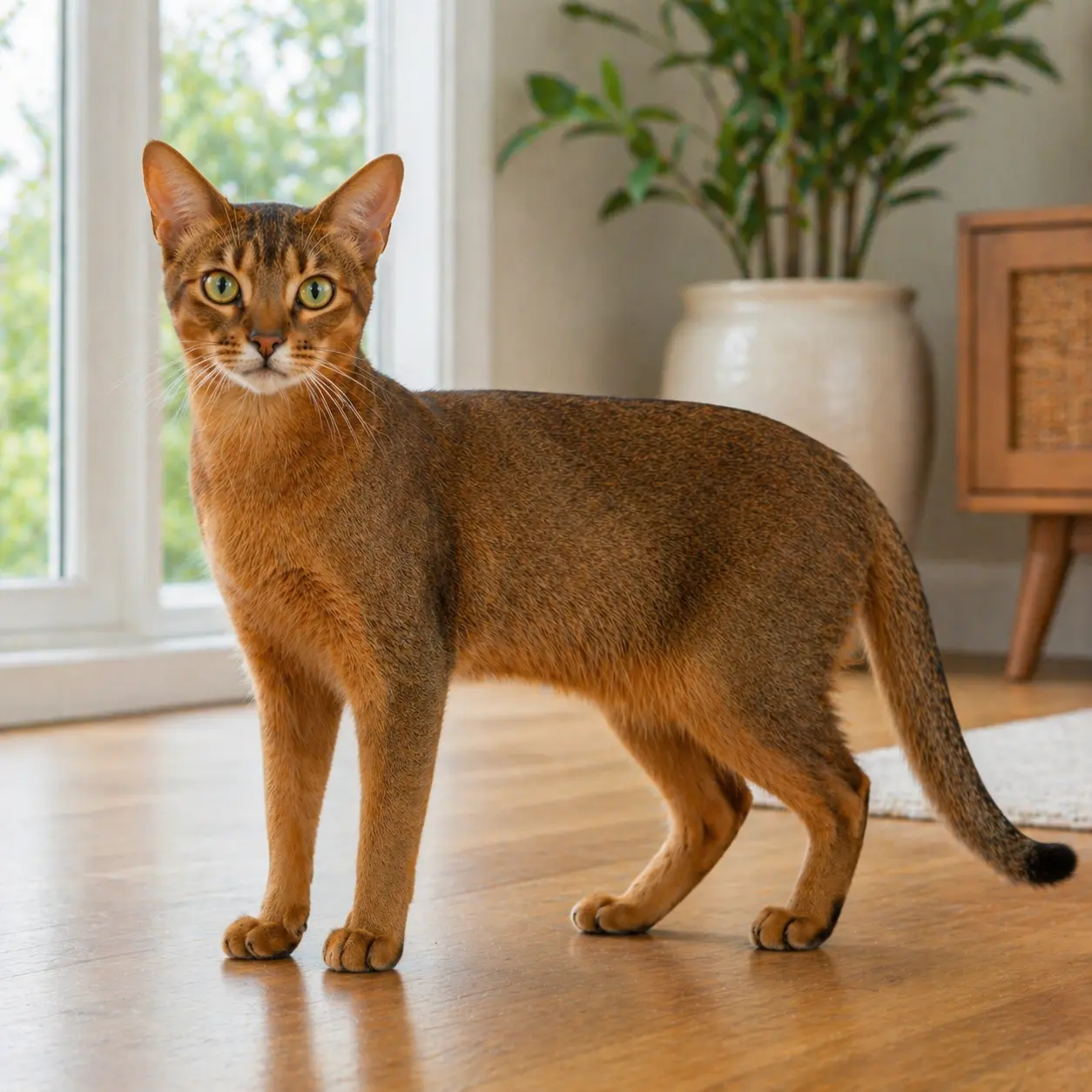
The Abyssinian and Savannah carry long, tapered tails with close-lying short coat. Neither whip nor plumed — distinctly athletic in appearance. The Abyssinian's tail often holds a slight upward curve at the tip during movement, which is one of its most recognisable behavioral signatures once you know to look for it.
Breed-by-Breed Tail Comparison
This table covers the tail profile for the most commonly encountered breeds. Use it alongside direct observation — a table can tell you what to look for; your hands and eyes tell you what is actually there.
| Breed | Length | Shape / Type | Tail coat | Typical carriage |
|---|---|---|---|---|
| Maine Coon | Long — equals body length | Otter — thick base, even taper | Dense, shaggy, layered | High or horizontal |
| Siamese | Long | Whip — fine and narrow throughout | Short, close-lying | High, sometimes curved at tip |
| Persian | Medium-long | Plumed — dense uniform fan | Very long, flowing, dense | Low — flows downward |
| Norwegian Forest Cat | Long | Plumed — coarser texture | Long, weather-resistant, dense | Carried upright, fan displayed |
| Manx | None to short stub | Absent, rise, stub, or longie | Short, dense (if present) | N/A |
| Japanese Bobtail | Very short — pom-pom | Kinked and fused — rigid | Short or semi-long | Held upright |
| American Bobtail | Short — 1/3 to 1/2 standard | Flexible, slight curve | Medium, dense | Arched upward when alert |
| Ragdoll | Long | Medium-thick, even taper | Medium-long, plush | Low or trailing |
| Abyssinian | Long | Tapered, athletic | Short, close, ticked | Low with tip curved upward |
| Bengal | Medium-long | Thick base, even taper | Short, dense, ringed banding | Low, horizontal |
| Turkish Angora | Long | Plumed — fine and silky | Long, fine, silky | Arched forward over back |
| British Shorthair | Medium — thick throughout | Blunt, rounded tip | Short, dense, plush | Low — thick and solid |
| Devon Rex | Long and slender | Fine taper | Short, rippled or sparse | Held low, flexible |
Tail Carriage, Base Width, and Coat on the Tail
How a cat holds its tail during movement carries breed information — and most people watch the face and body while the tail telegraphs something useful just behind them.
Turkish Angoras carry their tail arched forward over their back when walking. The tail fans toward the head rather than trailing. Once you have seen it, you recognise it instantly. Ask any Turkish Angora owner — the tail carriage is the breed's most theatrical physical feature, and it is consistent enough to function as a breed signal on its own when combined with the body type.
Abyssinians hold the tail relatively low with the tip curved slightly upward — a subtle hook that gives the tail a questioning look during movement. It is easy to miss if you are watching the cat's face. Watch the tail instead and the signature appears in almost every step.
Base width is the most underused tail signal in breed identification. British Shorthairs carry a noticeably thick tail base — short overall, dense and solid at the root, matching the breed's cobby body. Compare that against an Abyssinian's tail base: narrow, fine, proportional to a lean athletic frame. Both cats could theoretically carry similar coat colors. The tail base alone distinguishes them. Most people miss this entirely when they assess their cat.
Coat texture on the tail matters most where the tail coat differs from the body coat. A Persian's tail fur runs longer than its body fur in most individuals — the plume requires more coat length than the dense, uniform body coat. A Devon Rex carries the same rippled, sparse coat on its tail as on its body — distinctly different from the uniform plush of a British Shorthair's tail. A Bengal's tail shows ringed banding in most individuals regardless of body pattern — the rings appear even when the body carries rosettes rather than stripes.
Tail Shape and Texture: What They Reveal About a Cat
Taken alone, a tail confirms a breed only in specific cases. The Manx, the Japanese Bobtail, and the Turkish Angora are each identifiable from the tail alone — their tail characteristics are too specific to belong to anything else. For most other breeds, the tail narrows the field significantly but needs support from other physical features to close in on a confident answer.
The combination that works reliably: tail length plus tail base width plus coat texture plus carriage. When all four align with the same breed standard, the read becomes significantly more confident. When they conflict — a long tail with a fine base but a heavy, stocky body — you are most likely looking at a mixed-breed cat. That conclusion is useful. Ruling out a purebred background is as valuable as identifying one.
This is the single most practical use of tail assessment: not to confirm a specific breed, but to rapidly eliminate large categories. A cat with a short, fused, pom-pom tail is not a Maine Coon. A cat with a long, fine whip tail is not a British Shorthair. A cat with a full flowing plumed tail is not a Siamese. Ruling out is fast and reliable. Confirming takes more.
The UC Davis Veterinary Genetics Laboratory has documented genetically independent mutations underlying bobtail expression across different breed lines — confirming that visually similar short tails in the Manx, Japanese Bobtail, and American Bobtail arise from distinct genetic events. That distinction is practically useful: the shape, flexibility, and form of a short tail points to the specific mutation, and therefore the specific breed, when you examine it carefully rather than labelling it "short-tailed cat" and stopping there.
For cats where tail signals point toward a breed but other features seem inconsistent, our guide on reading kittens before they fully develop explains how feature consistency improves significantly at five to six months — which affects tail read accuracy as much as any other feature.
Where tail structure, body type, and coat all align toward the same breed but you want certainty rather than probability, this overview of what cat DNA tests can and cannot tell you covers the practical limits and genuine uses of genetic testing for breed ancestry.
For a complete physical assessment that combines tail signals with face shape, ear set, and body structure into one approach, the full physical feature identification guide covers how these signals work together — which is consistently more accurate than using any single feature in isolation.
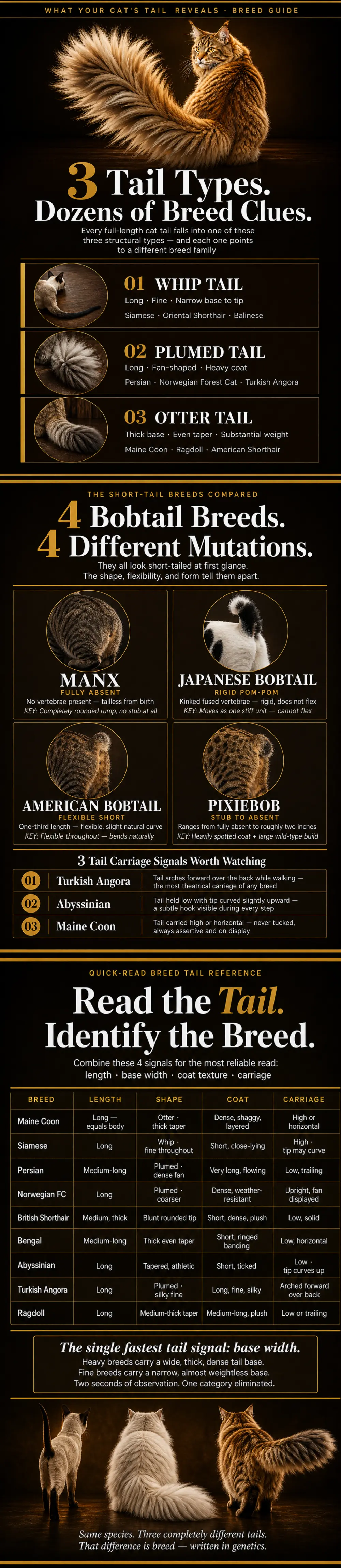
We have put together a visual infographic summarising cat tail breed identification — covering the three full-length tail types, the bobtail mutation comparison across four breeds, and the carriage signals that most owners overlook — in a single reference you can save and return to whenever you need it.
The bobtail comparison section is particularly useful if you are trying to separate a Manx from a Japanese Bobtail from an American Bobtail — three breeds that read as "short-tailed cat" at first glance but differ significantly in tail form, flexibility, and genetic origin.
Frequently Asked Questions
Cat tail length: does it actually vary significantly between breeds?
Yes — and the variation is often dramatic rather than subtle. A Maine Coon's tail typically equals its full body length and carries substantial fur volume. A Siamese tail is long but extremely fine and narrow from base to tip. A British Shorthair's tail is medium-length with a distinctly blunt, rounded tip unlike any other common breed. In most cases, tail length combined with base width and coat texture gives an immediate signal pointing clearly toward a breed category — no measuring required.
Breed identification by tail: which single tail feature is the most reliable?
Tail base width is the most underused but consistently reliable single signal. It correlates tightly with overall body type — heavy-boned breeds carry wide, thick tail bases, and fine-boned breeds carry narrow, light ones. This two-second observation rules out more incorrect breeds faster than any other tail assessment. Adding tail length and coat texture to that base width read improves accuracy significantly without requiring any specialist knowledge.
Can a cat have a naturally short tail without being a Manx or Japanese Bobtail?
Yes. The American Bobtail, Pixiebob, and Kurilian Bobtail all carry natural bobtail mutations that are genetically independent from the Manx and Japanese Bobtail mutations. Congenital tail abnormalities and old healed injuries can also produce shortened tails in cats of any breed background. A short tail alone does not confirm a bobtail breed — the shape, flexibility, and form of the shortening, combined with the cat's overall body type, points to the correct interpretation.
How do I tell a Maine Coon tail from a Norwegian Forest Cat tail?
Both breeds carry long, heavily furred tails — but coat texture is the differentiator. A Maine Coon's tail fur is shaggy, layered, and slightly coarser with a visible difference between the guard hairs and the undercoat beneath. A Norwegian Forest Cat's tail fur is similarly long but denser and more uniform — it has a weather-resistant quality with less visible layering. The head shape remains the single most reliable distinction between these two breeds, but the tail texture supports that read when you can examine it closely. Our breakdown of cat body types and what they predict covers the Maine Coon and Norwegian Forest Cat structural differences in more detail.
What does a permanently kinked or bent tail mean in a cat?
A permanent kink — where the tail bends at a fixed angle and holds that position — reflects either a genetic trait or a healed old injury. In Southeast Asian domestic cat populations, kinked tails appear naturally at high frequency due to a recessive genetic variant that spread widely through those populations historically. In Western domestic cats, a fixed rigid kink at a single point more often indicates an old fracture. A flexible kink that moves with the tail is more likely genetic in origin; a rigid, immovable bend that the cat cannot move past is more likely a healed injury. Neither significantly affects a cat's health or quality of life, but the distinction is worth noting when assessing breed background — a kinked tail in an otherwise consistent-looking breed profile does not rule out that breed.