Walk into any animal shelter in North America and mention you think your cat might be a Maine Coon mix. The staff will smile in a particular way. It is the smile of people who hear this approximately forty times per week — because "Maine Coon mix" has become the default label for any large, semi-longhaired domestic cat regardless of actual genetics.
Here is the honest version: most of those cats are not Maine Coons. A large shaggy coat and a substantial frame, while necessary, are not sufficient. The Maine Coon carries a very specific set of structural markers — skull shape, muzzle form, ear placement, tail construction — that domestic longhaired cats simply do not share. Those markers are the difference between a genuine Maine Coon identification and an enthusiastic guess.
The honest version also has a second part: genuine Maine Coon genetics are more widespread in the North American domestic cat population than most people realise. The breed developed from working farm cats along the northeastern coast before any registry existed. Its genes dispersed into the general domestic population for generations. A cat with specific, consistent Maine Coon physical markers often does carry real Maine Coon ancestry — and that ancestry is worth identifying accurately rather than dismissing because no papers exist.
This guide gives you the specific markers that separate a Maine Coon from every other big fluffy cat — and tells you exactly how confident each signal should make you.
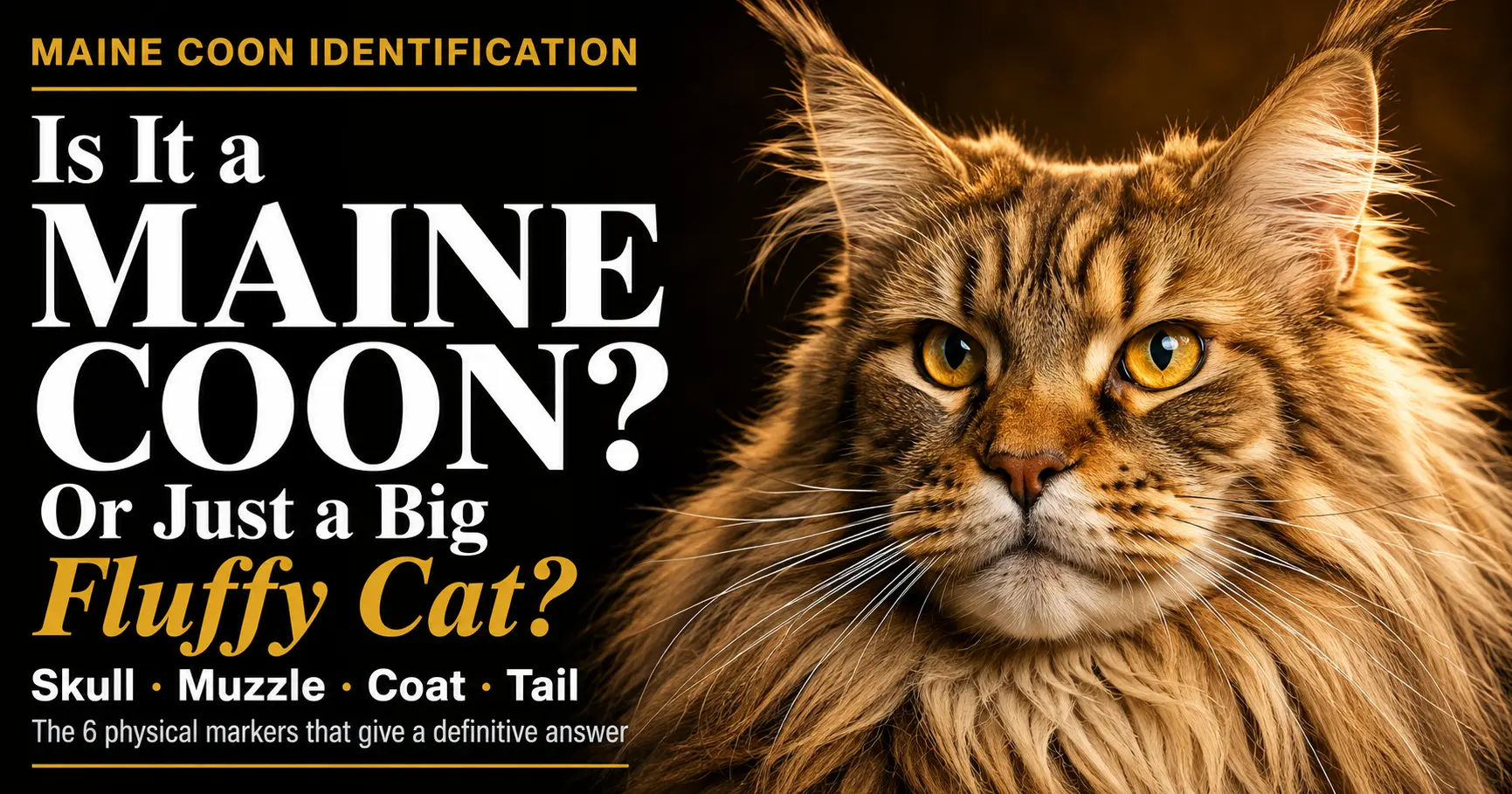
Cat Skull and Face: The Most Reliable Maine Coon Identifier
The Maine Coon's skull shape is the single most reliable breed marker available — more reliable than coat length, more reliable than size, and far more reliable than ear tufts alone. It is also the feature most consistently overlooked in favour of the more dramatic visual elements.
A Maine Coon carries a distinctly rectangular skull when viewed from the side. The forehead is relatively flat — it does not dome upward in the rounded way of a British Shorthair or Persian. The nose is medium-length with a gentle concave curve — a slight ski-jump profile when viewed in close profile. The skull's length is greater than its width when measured objectively.
From the front, the defining feature is the square, prominent muzzle. This is the detail most people miss entirely. The muzzle has visible width and angularity — it projects forward with clear definition and forms a squared shape at the whisker pads. It is not soft or tapered. It is not pointed. It is distinctly squared and wide. Place your fingers on either side of a genuine Maine Coon's muzzle and you feel four distinct corners rather than a smooth curve.
High cheekbones create a slight hollowing below them — not sunken, but defined. This gives the Maine Coon face a slightly sculpted quality that becomes more pronounced in males. Paired with the wide muzzle, it creates a face that conveys physical substance and purpose rather than softness.
The ears sit high on the skull, wide-set, with a notably wide base. The ear's outer edge follows the line of the face so closely that the skull and ears form a continuous shape. At the tips of the ears: lynx tips — tufts of fur extending above the ear tip and pointing upward. Inside the ear: dense ear furnishings that project outward and are visible from the front. Both features are present in the Norwegian Forest Cat too, but the Maine Coon's lynx tips tend to be longer and denser, and the ear base is wider relative to the skull.
The forehead M marking — a tabby M shape visible between the eyes in tabby-patterned Maine Coons — is not breed-exclusive. Any tabby cat carries it. But when I look at a Maine Coon's face in full, the M sits above a face that no other common breed replicates precisely: the combination of rectangular skull, squared muzzle, high cheekbones, and high-set wide-based ears. Individually, each feature appears elsewhere. Together, in this specific combination, they are the Maine Coon's face.
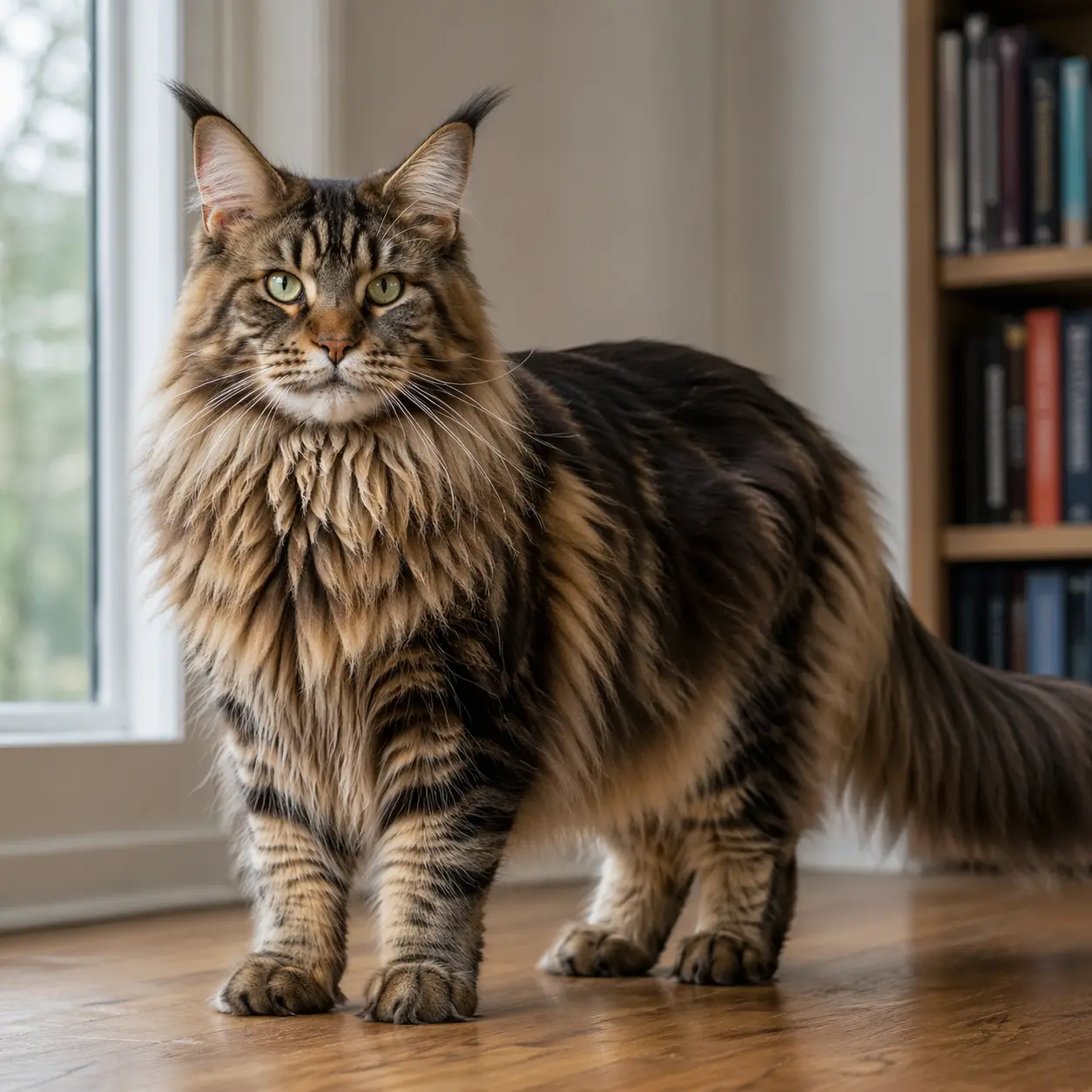
Size, Weight, and the Slow Development Schedule
The Maine Coon is the largest domestic cat breed by average weight — but size alone is not a reliable identification signal, and most owners use it incorrectly.
Adult Maine Coon males weigh between 12 and 18 lbs. Females run lighter: 8 to 14 lbs. These are substantial numbers — but many large domestic cats, Siberian males, large Ragdolls, and mixed-breed cats from heavy-framed ancestry can approach these weights without any Maine Coon genetics. A cat weighing 15 lbs is not therefore a Maine Coon. A cat weighing 15 lbs with the skull, muzzle, and coat structure described in this guide is substantially more likely to be.
The more useful signal is not peak weight but frame architecture. The Maine Coon carries a rectangular, muscular body — long from shoulder to rump, with a wide chest and substantial bone density. The legs are long relative to body length but not spindly. The paws are wide and round, often with notable inter-digital tufting — fur growing between the toe pads that was functionally useful as natural insulation in northeastern winters.
Polydactyl Maine Coons — cats with extra toes — deserve specific mention. Polydactyly (extra digits) is historically associated with Maine Coons from the northeastern coastal population, where the trait spread through the working cat population and was valued for its snowshoe effect. A polydactyl cat with Maine Coon structural features strengthens the breed identification significantly. Polydactyly appears in other breeds and random domestic cats too, so it is not conclusive — but in this combination it carries real weight.
The development timeline is perhaps the most distinctive and least known Maine Coon characteristic. Most domestic cats reach physical maturity between 12 and 18 months. The Maine Coon continues growing until three to five years of age. A Maine Coon at 18 months looks noticeably different — lighter, less full, less impressive — than the same cat at four years. If you have a young cat that seems large for its age but hasn't yet reached the full coat, mane, and body mass you associate with adult Maine Coons, that slow development is itself a breed signal worth factoring in.
A Maine Coon at 18 months is not a finished Maine Coon. If you are assessing a young cat and wondering why it doesn't quite match the dramatic adults you see in photos, wait. The cat may be exactly what you think it is — just not yet finished becoming it.
The Maine Coon Coat: What's Distinctive and What Isn't
The Maine Coon coat is shaggy, layered, and water-resistant — but "long and fluffy" describes dozens of cat types that are not Maine Coons. The specific coat characteristics worth examining are texture, layering pattern, and distribution across the body rather than simply length.
The texture is the first signal. A Maine Coon's coat is silky rather than cottony. The guard hairs have a slightly coarse, resistant quality — they do not mat easily under normal circumstances because the coat was built to repel weather rather than trap it. Run your hand against the grain: the coat springs back rather than packing flat. A domestic longhair often carries a softer, finer coat that mats more readily and lies differently when disturbed.
The layering is the second signal. The Maine Coon coat is not uniform in length across the body. It varies deliberately: shorter on the shoulders, longer on the ruff at the neck and chest, longest on the belly, flanks, and tail. The belly coat often produces a distinct skirt effect — a longer fringe that follows the lower body line. This variation in coat length across different body zones is a genuine breed characteristic. A domestic longhair typically shows more uniform coat length across the body with less pronounced variation.
The ruff at the neck and chest is the coat's most visually dramatic element in adult Maine Coons — particularly males. The ruff is a dense, longer growth of fur around the neck that suggests a lion's mane in its most developed form. The ruff continues down the chest. Young Maine Coons and females show a less developed ruff, but it is present in some form in most adults.
The tail is one of the most overlooked identification points. The Maine Coon carries an otter tail — long, wide at the base, and covered in dense shaggy fur that fans outward. The tail should be approximately as long as the cat's body. When the cat wraps the tail around itself to sleep, the tail covers the entire body with substantial coverage. A domestic longhair's tail is typically thinner at the base, less densely furred, and shorter relative to body length.
Breed Comparison: Maine Coon Versus the Three Most Common Confusions
Three specific breeds cause the majority of Maine Coon misidentification: the Norwegian Forest Cat, the Siberian, and the domestic longhair. A fourth — the Ragdoll — causes confusion specifically in coloured or patterned cats. Each requires specific distinguishing signals.
Maine Coon versus Norwegian Forest Cat is the most common expert- level confusion. Both breeds share semi-long coats, lynx tips, ear tufts, large frames, and northern-climate adaptation. The clearest separator is head shape. The Maine Coon's rectangular skull with its squared muzzle and flat forehead differs from the Norwegian Forest Cat's triangular skull with its straight nose profile and less prominent muzzle. Viewed in profile: the Maine Coon shows a slight concave curve on the nose; the Norwegian Forest Cat shows a perfectly straight nose from brow to tip. From the front: the Maine Coon's squared muzzle with four visible corners contrasts with the Norwegian Forest Cat's softer, more tapered muzzle.
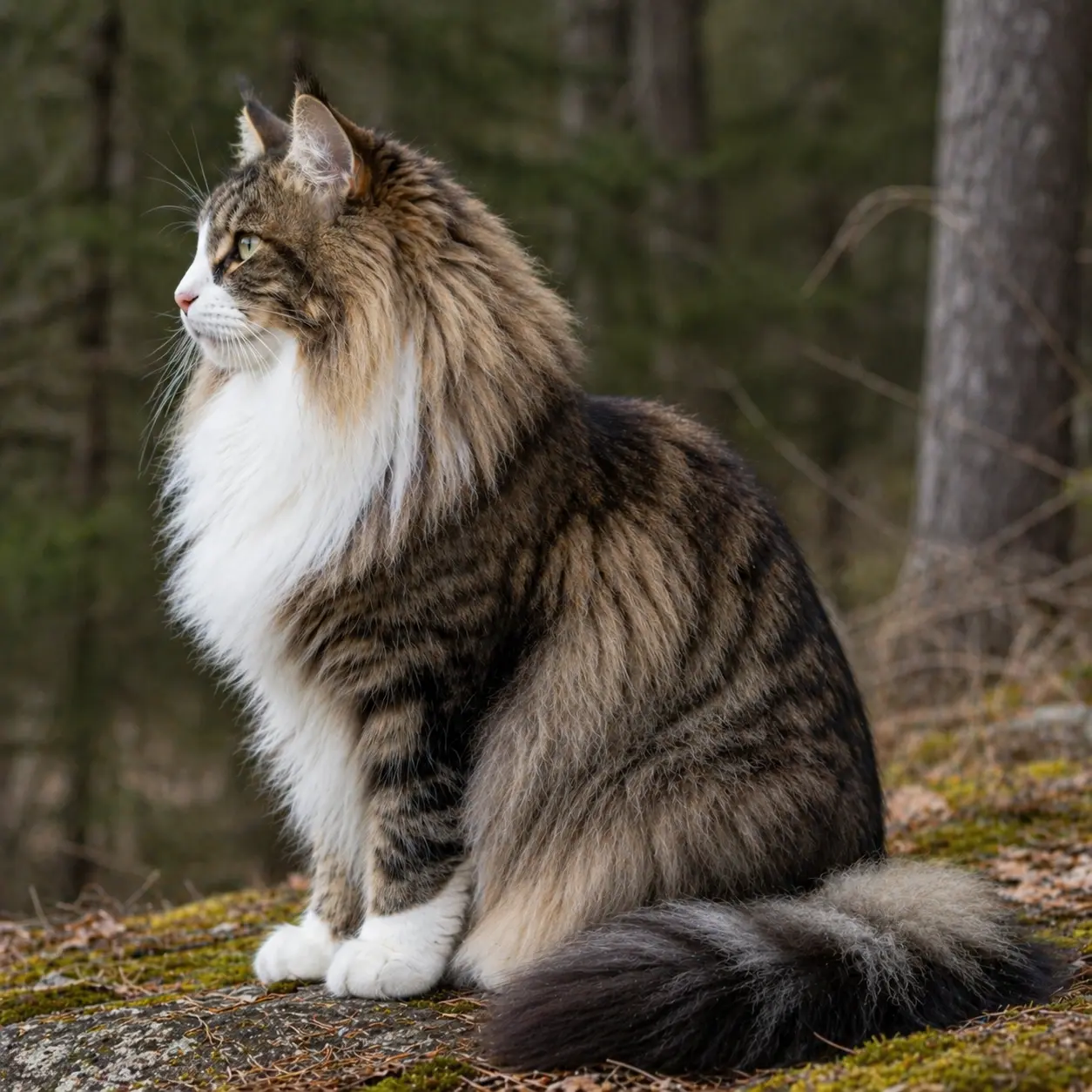
Maine Coon versus Siberian requires assessing body frame and coat texture rather than just size. Both are very large, heavy cats with dense coats. The Siberian carries a heavier, more rounded, more barrel-chested body with a slightly shorter, rounder face — less rectangular than the Maine Coon's profile. The Siberian's coat tends to have denser, more uniform undercoat. The Maine Coon's coat is more visibly layered and varied in length across the body. In Europe, where the Siberian is more prevalent, this confusion arises frequently.
Maine Coon versus domestic longhair is the most common confusion overall. The domestic longhair typically shows a more rounded, less rectangular skull. The muzzle is softer and less squared. The coat, while long, lacks the pronounced body variation and otter-tail quality of the Maine Coon. The domestic longhair's paws are usually smaller relative to body size. The lynx tips, when present in a domestic longhair, are typically shorter and less pronounced. The combination of head shape + square muzzle + otter tail + tufted paws, all in the same cat, does not typically appear by coincidence in domestic longhairs.
Maine Coon versus Ragdoll is a size-and-colour confusion in lighter-coated cats. Ragdolls reach similar weights and carry long coats, but the Ragdoll's face is distinctly different: broader and flatter with widely-set oval eyes and no muzzle squaring. The Ragdoll coat is plush and silky rather than shaggy. Most Ragdolls carry colorpoint colouring — a cat with Maine Coon structural markers but colorpoint colouring most likely carries both breeds in its background.
Maine Coon Mixes: What They Actually Look Like
The most realistic identification outcome for most cats is not "purebred Maine Coon" or "not Maine Coon" but "Maine Coon mix with varying degrees of trait expression."
A Maine Coon mix typically shows some but not all of the core structural markers. The most durable features — the ones that persist most visibly in mixed populations — are the squared muzzle, the rectangular skull shape, the wide paw size, and the otter tail structure. These persist more reliably than coat length (which the other parent's genes can significantly shorten) or ear lynx tips (which diminish in mixed lines).
A cat with a clearly squared, prominent muzzle and wide, tufted paws in a medium-length coat is likely showing Maine Coon ancestry through those structural features even when the coat length doesn't match the full Maine Coon standard. The skull does not lie — it reflects bone structure that persists across generations more reliably than coat expression.
Our breakdown of identifying mixed breed cats covers how to read physical inconsistencies as genetic data rather than identification failures — which is essential context for Maine Coon mix assessment, where the most common situation is partial trait expression rather than clean breed conformance.
Behavioural Signals That Support Physical Identification
Behaviour alone does not identify a breed — and no responsible identification rests on it. But several behavioural traits in the Maine Coon are consistent enough to function as supporting evidence when the physical picture is ambiguous.
The voice is the most distinctive. Maine Coons chirp and trill rather than producing the standard domestic cat meow. The chirp is a rapid, birdlike sound — a soft, musical trill that many owners describe as more conversational than demanding. Maine Coons use this sound to communicate location, interest, and acknowledgment. A large semi-longhaired cat with Maine Coon structural features that consistently chirps rather than meows is showing one of the breed's most consistently reported behavioural signatures.
Water fascination appears across Maine Coon owners' reports with enough consistency to note as a breed tendency. Maine Coons frequently paw at water bowls, follow owners to the bathroom, and interact with running water in ways most domestic cats avoid. The trait likely traces to the breed's working-cat origins in coastal fishing communities. It is not universal and it is not diagnostic — but when combined with physical markers it adds to the overall picture.
Dog-like following behaviour — trailing their owner from room to room, greeting at the door, learning to fetch — appears frequently in Maine Coon accounts. Ask any confirmed Maine Coon owner: this cat thinks it is a dog. The physical confirmation matters far more than any behaviour, but the combination of correct physical markers and this behavioural profile strengthens identification confidence meaningfully.
What Physical Evidence Confirms in a Cat
The Maine Coon identification hierarchy — from most to least reliable — runs as follows:
Skull shape and square muzzle: highest reliability. These structural bone features persist in mixes, do not vary with season or age past maturity, and are difficult to mistake in a well-lit examination. A cat without the squared, prominent muzzle and rectangular skull is not a Maine Coon regardless of coat length or size.
Otter tail and tufted paws: high reliability. The tail base width, dense shaggy fur distribution, and approximate tail-to-body length ratio are durable signals. Paw tufting and inter-digital fur are difficult to fake and not common in domestic longhairs.
Lynx tips and ear furnishings: moderate reliability. These appear in Norwegian Forest Cats and Siberians too. They support a Maine Coon identification but do not close it alone. Their absence does not rule out Maine Coon ancestry — they diminish in mixes.
Coat texture and layering: moderate reliability. Supports the identification when combined with structural features. Less useful in isolation because coat quality varies with nutrition, health, and seasonal cycle.
Size and weight: lowest reliability as a standalone signal. Confirms the possibility when structural features already suggest Maine Coon. Meaningless without structural support.
The Cat Fanciers' Association breed standard for the Maine Coon specifies the rectangular body shape, the squared muzzle, and the head proportions as core conformation requirements — explicitly distinguishing these structural points from the coat characteristics that most owners focus on first. That priority reflects the same identification logic: structure before coat, skull before size.
When structural signals align clearly but documentation doesn't exist, our overview of cat DNA testing covers exactly what those tests can confirm about Maine Coon ancestry — and what limitations apply to breed identification via DNA in mixed populations.
For a complete physical assessment that places Maine Coon structural features within the broader framework of body type variation across breeds, the cat body type and breed identification guide covers the full rectangular-to-cobby spectrum that makes the Maine Coon's architecture immediately distinguishable.
The guide on identifying cat breed by physical features covers how to combine skull, body, coat, and tail signals into a complete assessment — the multi-feature approach that produces the most confident results when working with cats of uncertain ancestry.
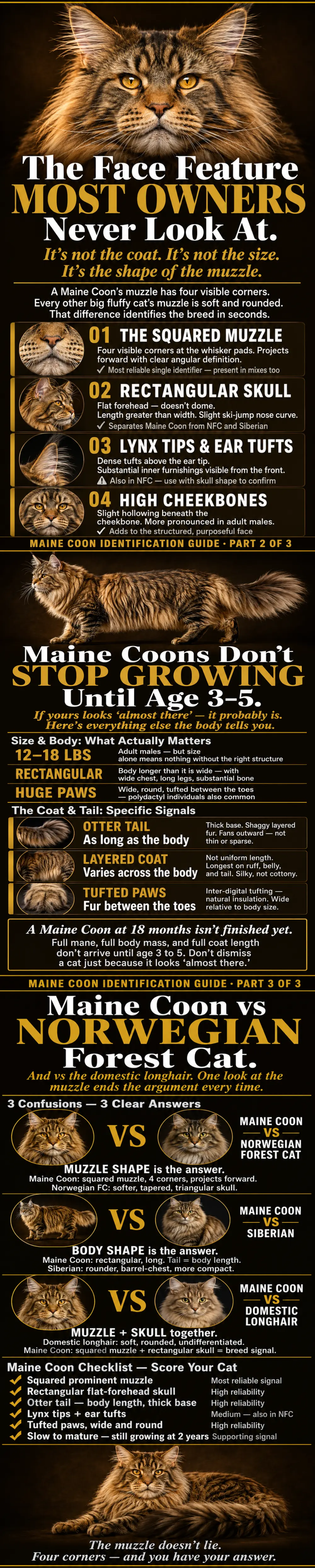
We have put together a visual infographic summarising Maine Coon identification — covering the skull and muzzle comparison against the Norwegian Forest Cat and domestic longhair, the complete coat and tail characteristic guide, and the feature reliability ranking — in a single reference image you can save and use.
The skull comparison section is the most practically useful element for anyone trying to separate a Maine Coon from a Norwegian Forest Cat — the two breeds that most reliably fool experienced cat owners and shelter workers alike.
Frequently Asked Questions
Cat breed identification: what is the single most reliable way to
tell a Maine Coon from a domestic longhair?
The squared, prominent muzzle is the most reliable single distinguishing feature. A domestic longhair carries a softer, more tapered, or more rounded muzzle. A Maine Coon's muzzle projects forward with visible width and four distinct corners at the whisker pads — you can feel the squared shape when you place a hand gently on either side. No other common longhaired breed replicates this specific muzzle shape in combination with the Maine Coon's rectangular skull and flat forehead. If the muzzle is soft and undifferentiated, the cat is most likely a domestic longhair regardless of coat length or body size.
How big does a cat have to be to be a Maine Coon?
Size alone does not identify a Maine Coon — and using weight as a primary identifier is one of the most common mistakes owners make. Genuine Maine Coon males average 12 to 18 lbs and females 8 to 14 lbs, but many large domestic cats and mixed-breed cats reach similar weights without any Maine Coon genetics. More useful than peak weight is frame architecture: the Maine Coon's rectangular, long body with wide chest, long legs, and notably large round paws distinguishes its physical structure from a simply heavy domestic cat. A cat that is large but rounded and compact rather than rectangular and long is pointing away from Maine Coon regardless of the scale reading.
Maine Coon identification: how do I tell a Maine Coon from a
Norwegian Forest Cat?
Head shape separates them most reliably. View the cat in profile: the Maine Coon shows a slight concave curve on the nose — a gentle ski-jump profile — while the Norwegian Forest Cat shows a completely straight nose from brow to tip with no concave curve. From the front: the Maine Coon's squared, prominent muzzle with four visible corners contrasts with the Norwegian Forest Cat's softer, more triangular muzzle and more triangular overall skull shape. The Maine Coon's rectangular skull and the Norwegian Forest Cat's triangular skull are consistently different once you know what to look for — but the distinction requires looking specifically at these structural zones rather than coat or size.
Can a cat have Maine Coon genetics without looking like a Maine Coon?
Yes. In a mixed-breeding background, Maine Coon genetics can be present without producing the full suite of visual markers. A cat may carry Maine Coon ancestry and show only partial trait expression — the squared muzzle but not the full coat length, or the wide paws but not the lynx tips. Coat length in particular is strongly influenced by the other parent's genetics and often does not express the full Maine Coon standard in mixed lines. The structural features — muzzle shape, skull form, paw width — persist more reliably in mixed populations than coat expression does, which is why they carry more identification weight even when the overall appearance doesn't match the dramatic adult Maine Coon photos most people use as their reference point.
My cat chirps and follows me everywhere — does that mean it's
a Maine Coon?
Behaviour alone cannot identify a breed, and this combination of traits appears in other breeds and individual domestic cats without any Maine Coon genetics. The chirping and trilling vocalization is one of the Maine Coon's most consistently reported characteristics, and the dog-like following behaviour appears frequently enough in owner accounts to note as a breed tendency. As supporting evidence alongside clear physical markers, these behavioural traits add meaningfully to an identification. As the primary basis for identification without strong physical support, they are not sufficient. If the physical markers — skull shape, muzzle, tail, paw structure — don't align with Maine Coon conformation, the behaviour reflects an individual personality rather than confirmed breed ancestry.