Look at the dark markings on a Siamese and trace where they sit: ears, face mask, lower legs, paws, and tail. Then look at where the dark colour stops — mid-leg, across the crown, and at the base of the neck. That boundary is not a random design. It is a temperature gradient. The dark pigment deposits precisely where the skin runs coolest and stops where the body core begins to warm.
No other common domestic cat breed produces colour through this exact mechanism. Understanding it is the most reliable starting point when you want to identify a Siamese cat — or assess whether a cat that came to you from a shelter or litter carries genuine Siamese ancestry.
The Siamese is among the most recognised breeds in the world and also among the most misidentified. The label "Siamese mix" gets applied loosely to any pale cat with dark points, regardless of whether the underlying genetics support it. Some of those cats genuinely carry Siamese ancestry. Others carry the colorpoint gene without any Siamese in their recent history at all. Knowing the difference requires looking beyond the visual surface of the points.
This guide covers the full identification framework: what the colorpoint pattern actually confirms, the two dramatically different head types that split Siamese appearance into nearly unrecognisable versions, the complete range of point colour variations, and how to separate a Siamese from the several breeds that produce similar colouring.
Cat Coat and Colorpoint: The First and Most Reliable Signal
The colorpoint pattern works through a temperature-sensitive enzyme called tyrosinase, which the Siamese carries in a mutated form. In most cats, tyrosinase functions at normal body temperature and distributes melanin evenly across the coat. In the Siamese, tyrosinase stops functioning above approximately 33°C — the normal temperature of the body core.
The result: melanin production shuts down in warm zones and continues in cool ones. The cat's extremities — ears, face mask, lower legs, paws, and tail — run cooler than the body core. They develop dark pigment. The body stays pale. The boundary between dark and pale follows the actual temperature gradient of the skin, which is why the demarcation is soft and gradual rather than sharply defined.
This mechanism has two direct identification implications. First, Siamese kittens are born entirely pale — sometimes pure white. The temperature differential between body and extremities doesn't develop until after birth, when the kitten begins experiencing ambient temperature. Points appear progressively over the first weeks and months. Second, a Siamese in a colder environment develops darker points than the same cat in a warmer one. I have spoken to Siamese owners who noticed their cat's points visibly lighten through summer months and darken again in winter. The mechanism is that active and that visible in daily life.
The colorpoint gene is recessive. A cat must carry two copies — one from each parent — to express the pattern visibly. A cat with only one copy appears entirely normal in coat colour but can pass the gene to offspring. This is why pointed kittens occasionally appear from two non-pointed parents — both carried a hidden copy.
Every adult cat showing a true colorpoint pattern carries the colorpoint gene in double copy. That narrows the breed candidates to a specific list: Siamese, Ragdoll, Birman, Balinese, Tonkinese, Snowshoe, Colorpoint Shorthair, the Thai cat, and many domestic mixed-breed cats carrying ancestry from any of the above. The pattern confirms the gene's presence. It does not confirm a specific breed.
Point Color Varieties: Reading the Shade of the Points
The Siamese breed produces several distinct point colours. The shade of those points reflects the underlying genetics beyond just the colorpoint gene itself — and reading the shade accurately adds another layer to any identification assessment.
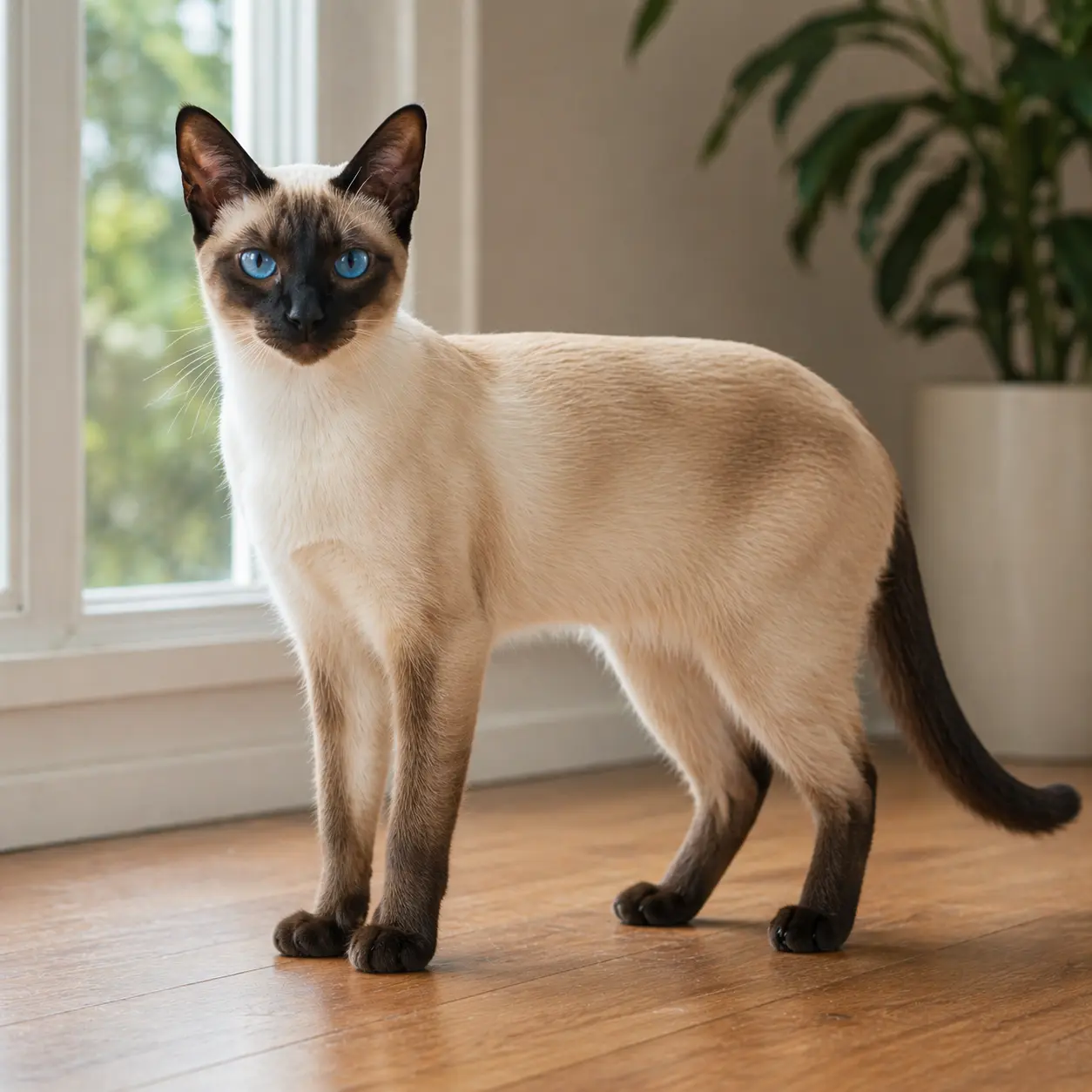
Seal point is the original and most recognised Siamese colouring. The points are very dark brown — almost black-brown — against an off-white to pale fawn body. The body tone is distinctly warm in seal points: cream to fawn rather than pure white. That body warmth is a reliable distinguishing detail for seal point genetics specifically.
Blue point produces slate-grey to steel-blue points against a pale blue-white body. The body is notably cooler and whiter than a seal point's. Blue point is the dilute version of seal — the same genetics with a dilution gene reducing the melanin intensity.
Chocolate point produces warm milk-chocolate points against a clean ivory body. The points are clearly lighter and warmer in tone than seal point's near-black. Chocolate point looks similar to seal point in many photographs, but under natural light the difference between warm milk-chocolate brown and near-black is immediately obvious. Chocolate point Siamese weren't officially recognised in the Western cat fancy until the 1950s, despite the gene being present in the breed far longer.
Lilac point — called frost point in some registries — is the palest of the four classic colours. Faded pinkish-grey points against a pure white body. Lilac is the dilute version of chocolate and requires both the dilution gene and the chocolate gene in homozygous form — making it the rarest of the four.
Beyond these four, the Colorpoint Shorthair — recognised as a distinct breed by the Cat Fanciers' Association but essentially an extended-colour Siamese by most assessments — added flame (orange-red), cream, tortoiseshell, and lynx (tabby-striped within the points) variations. The International Cat Association recognises a broader point colour range under the Siamese standard itself. For identification purposes: a cat with colorpoint colouring in flame, tortie, or tabby points shows Colorpoint Shorthair or mixed-ancestry genetics layered on top of the base colorpoint gene.
Traditional Versus Modern: Two Very Different Head Types
The most significant source of confusion when owners try to identify a Siamese is not the colour pattern — it is the head type. Two dramatically different conformations both legitimately carry the Siamese name, and they do not look like the same breed.
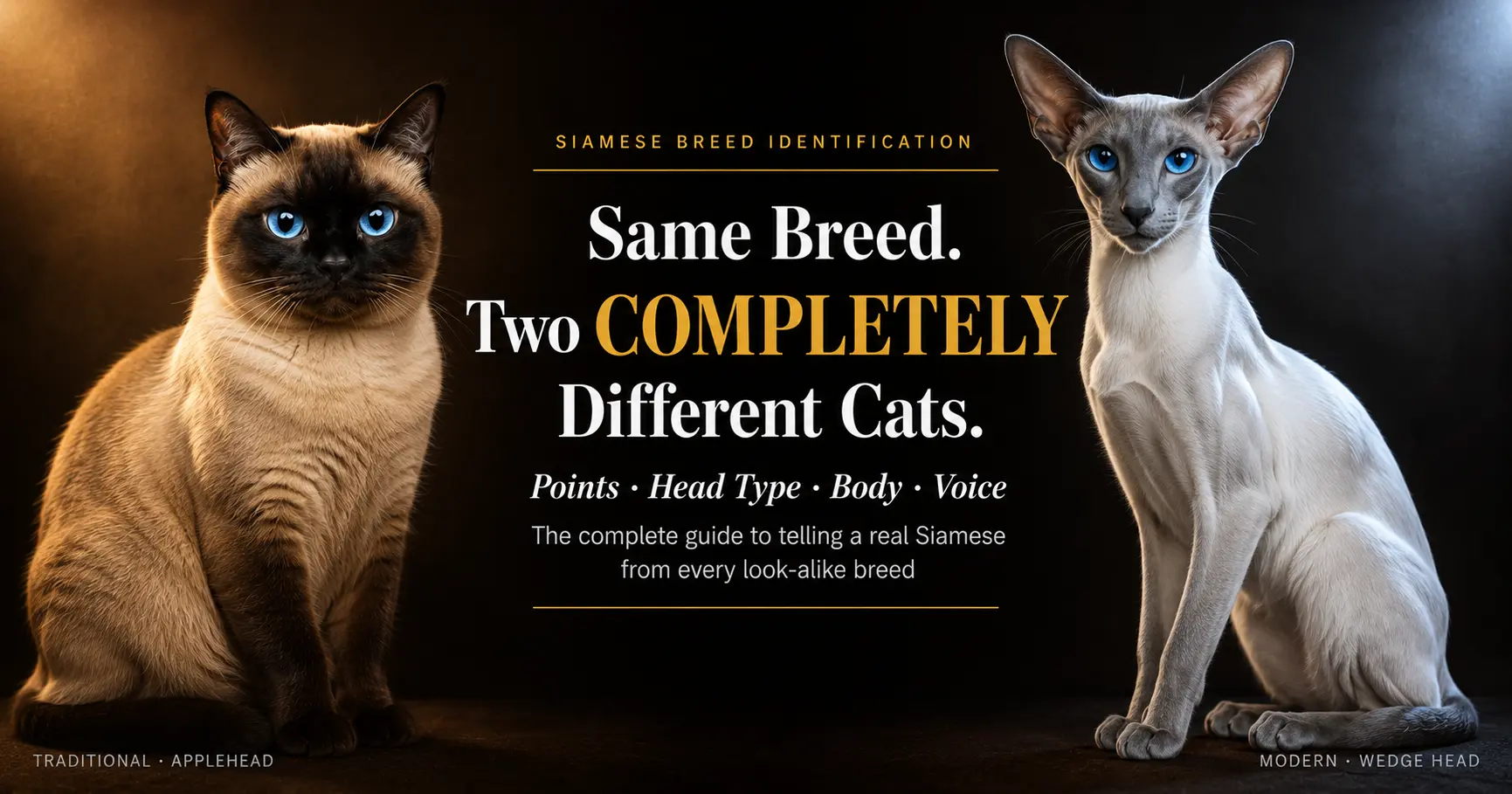
The Traditional Siamese — also called the Applehead, Old-Style, or Thai cat in some registry classifications — carries a rounder, more moderate skull. The head shape is rounded rather than sharply wedged. The muzzle is moderate rather than extreme. The nose shows a slight downward angle rather than a completely straight profile. The eyes are rounder and set more forward, with less dramatic slant than the modern type. The body is heavier and more substantial. This is the Siamese that appears in 19th-century illustrations and early photographs of the breed from Thailand.
The Modern Siamese carries an extreme wedge-shaped skull that narrows continuously from the ears to the nose in a perfectly straight line. From the front, the head forms a triangle. The ears are very large and wide-set, continuing the skull's line outward. The nose is completely straight in profile with no stop. The eyes are dramatically almond-shaped, slanted markedly upward at the outer corners. The body is extremely lean and tubular — long, angular, and fine-boned throughout. The tail is very long and whip-thin.
This divergence happened through deliberate selective breeding in the mid-to-late 20th century, as Western show breeders pushed progressively toward more extreme features. Walk into a traditional Siamese breeder's cattery and the cats look nothing like what most people picture when they say Siamese. That contrast surprises almost everyone the first time they encounter it.
If you are assessing a cat in the general domestic population for Siamese ancestry, the moderate traditional head type is far more common than the extreme modern type. A cat with colorpoint colouring and a moderately wedged head, forward-angled large ears, and slanted eyes likely carries traditional Siamese genetics — even if it looks nothing like the angular modern show animal.
Breed Variants Built on Siamese Genetics
Several established breeds carry the Siamese colorpoint gene and share significant genetic heritage with the Siamese. Identifying one of these breeds rather than a pure Siamese is a realistic outcome in any colorpoint cat identification.
The Balinese is a longhaired Siamese — the result of a natural longhair mutation appearing in Siamese litters in the 1940s and 1950s. A Balinese carries all the Siamese physical architecture: the wedge head, the slanted almond eyes, the fine tubular body. The only difference is the semi-long silky coat, which lies flat and flows rather than puffing outward. A colorpoint cat that looks Siamese but carries noticeably longer fur with a silky flat-lying quality points directly toward Balinese ancestry.
The Colorpoint Shorthair shares the modern Siamese body type and head conformation entirely. It exists to carry the expanded point colour range — flame, cream, tortie, and lynx points — that the original Siamese gene pool didn't produce. Cats showing flame or tortie points on an otherwise modern-Siamese body type most likely fall into the Colorpoint Shorthair category.
The Tonkinese is a Siamese and Burmese cross, producing three coat pattern expressions: pointed, mink (the most common Tonkinese pattern — a midpoint between pointed and solid), and solid. The Tonkinese pointed pattern looks similar to Siamese but the eye colour is aqua rather than blue — a direct result of the combined Siamese and Burmese genetics. A colorpoint cat with aqua rather than vivid blue eyes points immediately toward Tonkinese ancestry. Aqua eyes in a non-white adult cat are nearly exclusive to this breed.
The Snowshoe is a Siamese and American Shorthair cross producing colorpoint colouring with distinctive white boots on the paws. The Snowshoe carries a heavier, more substantial frame than the modern Siamese — American Shorthair genetics adds bone and mass. White paw markings on a colorpoint cat suggest Snowshoe, Birman, or mixed ancestry rather than pure Siamese.
For a thorough breakdown of how the colorpoint pattern fits within the full range of domestic cat coat patterns and what each pattern genetically confirms, the cat coat patterns and breeds guide covers the genetics of each pattern and which breeds produce them.
Body, Voice, and Behaviour as Supporting Identification Signals
The Siamese body type is as distinctive as the colorpoint pattern and functions as a reliable cross-check when assessing a pointed cat.
A Siamese carries an extremely lean, long, tubular body. The frame is fine-boned — legs long relative to body length, the neck long and elegant, and the overall silhouette angular rather than rounded. Pick up a Siamese and the cat feels surprisingly light for its apparent size. The musculature is visible and defined rather than padded by body mass. A colorpoint cat with a rounded, cobby, or heavily muscled frame almost certainly carries non-Siamese genetics — likely Ragdoll, Birman, or American Shorthair ancestry diluting the body type.
The coat on a Siamese is among the shortest and closest-lying of any domestic cat breed. It sits flat against the body with virtually no texture. Individual hairs are extremely fine. The coat produces almost no shedding and carries no meaningful undercoat. A colorpoint cat with medium-length, plusher, or thicker coat texture points toward Ragdoll, Birman, or Tonkinese heritage rather than pure Siamese.
The voice is one of the Siamese's most immediately distinctive non-visual signals. The Siamese produces a loud, low-pitched, insistent call — the "meezer" cry that many owners describe as sounding like a human infant. This vocalization is consistent enough to support identification when physical signals are ambiguous. Most people who have lived with a Siamese remember the voice at least as vividly as the appearance.
Bonding behaviour — intense attachment to one person, following their owner from room to room, and vocalising when left alone — is a behavioural marker worth noting when the physical evidence is genuinely borderline. It is not diagnostic on its own, but as a supporting detail it adds meaningfully to the overall picture.
Telling a Siamese Apart from Similar-Looking Cats
Several breeds produce colorpoint colouring and cause genuine identification confusion. The distinguishing details are specific enough to resolve most cases quickly.
Siamese versus Ragdoll: Both carry colorpoint colouring with vivid blue eyes. The differences are dramatic on closer inspection. A Ragdoll weighs 10 to 20 lbs with a very large, broad, heavily muscled body, a flat-topped medium-length head, and a plush medium- length coat with clear body and texture. A Siamese weighs 6 to 10 lbs with a wedge-shaped angular head and an extremely fine, flat, paper-thin coat. Body size and coat texture separate these two breeds quickly at first handling.
Siamese versus Birman: The Birman carries the same four classic point colours as the Siamese. The critical distinguishing feature: the Birman shows white gloves on the front paws and white gauntlets on the rear paws. Any pointed cat with white foot markings is Birman, Snowshoe, or mixed ancestry — not Siamese. The Birman also carries a longer, silkier coat and a heavier, more rounded skull than the Siamese.
Siamese versus Thai cat: The Thai cat is the officially registered name in some international registries for the Traditional/Applehead Siamese — the moderate, rounded-skull type. If your cat shows colorpoint colouring with a rounded rather than wedge-shaped head, it may fit the Thai cat standard more accurately than the modern Siamese standard. The distinction matters for registry classification but not for general identification — both carry identical colorpoint genetics.
Siamese versus domestic colorpoint mix: The most common scenario. Many domestic cats carry the colorpoint gene without any recent purebred Siamese ancestry. A domestic colorpoint mix typically shows inconsistencies across multiple features: a head that fits neither Traditional nor Modern Siamese type, a body weight or frame outside Siamese range, or a coat with more texture and length. These inconsistencies are informative. Consistent Siamese features across head shape, body type, coat texture, and eye colour indicate genuine breed ancestry. Mixed signals indicate a cat carrying the colorpoint gene within a broader mixed genetic background — which is common and perfectly valid.
VCA Animal Hospitals notes that the colorpoint gene in Siamese-type cats historically associated with two conditions that breeders have largely selected away from: convergent strabismus (crossed eyes) and a kinked tail. Both resulted from genetic linkages in the early Siamese gene pool. They occasionally appear in cats with older traditional Siamese lines and some domestic colorpoint mixes. Their presence in a colorpoint cat does not confirm Siamese ancestry — but it does confirm the colorpoint gene line extends back far enough to carry those older associations.
What Physical Features Confirm About a Cat's Siamese Heritage
The clearest confirmation of Siamese heritage combines four signals consistently: colorpoint pattern with temperature-appropriate distribution, vivid deep blue eyes, an extremely fine and flat close-lying coat, and a lean angular body type. When all four align — particularly with point colour falling within the four classic Siamese shades — the identification reaches genuine confidence.
Vivid blue eyes alone do not confirm Siamese. The colorpoint gene produces blue eyes in every breed that carries it: Ragdoll, Birman, Balinese, Snowshoe, and domestic mixes included. Blue eyes confirm the colorpoint gene is present. They do not specify which breed delivered it.
Colorpoint pattern alone does not confirm Siamese either. The same gene appears across a dozen breeds and countless domestic mixed-cats. The pattern narrows the field to colorpoint gene carriers. Body type, head shape, coat texture, and eye colour accuracy complete the case.
For cats showing colorpoint colouring with inconsistent features — a body type that seems wrong, a head matching neither Siamese type, or aqua eyes rather than blue — our guide on identifying mixed breed cats explains how to read those inconsistencies as useful data rather than treating them as identification failures.
When colorpoint pattern, body type, and coat texture all align with Siamese standards but documentation is unavailable, cat DNA testing provides the most definitive answer — and specifically identifies which colorpoint breed contributed to a cat's ancestry when the visual picture remains ambiguous.
The facial features identification guide covers the skull shape, eye axis, and muzzle structure that separate the Siamese from Ragdoll, Birman, and other colorpoint breeds at the facial level — which is the most efficient single zone for ruling out alternatives once the colorpoint pattern is confirmed.
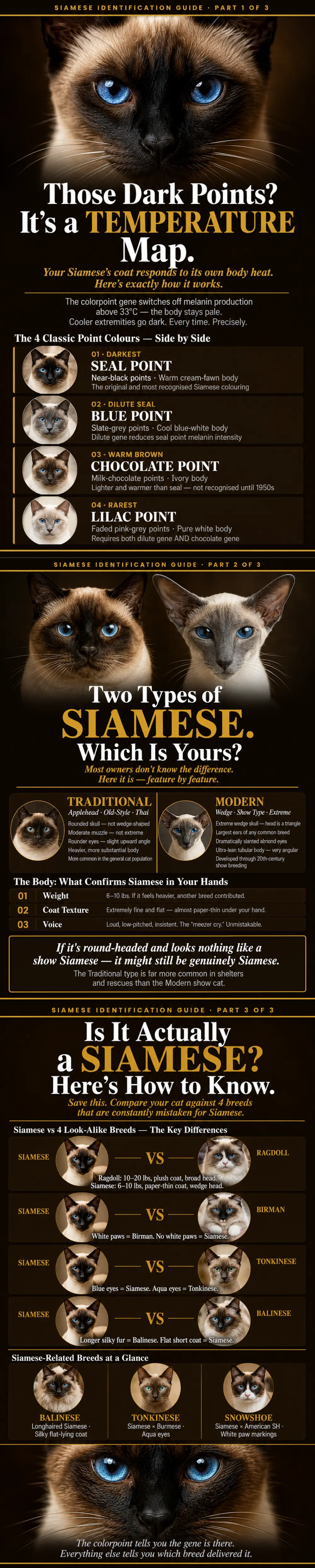
We have put together a visual infographic summarising Siamese identification — covering the colorpoint temperature mechanism, all point colour varieties side by side, both head types compared directly, and the main colorpoint breeds distinguished from each other — in a single reference image you can save and return to.
The Traditional versus Modern head type comparison is the section most owners find immediately clarifying — it answers why the Siamese they see at the shelter looks nothing like the one in the breed book, and what that actually means for identification.
Frequently Asked Questions
Cat colorpoint pattern: does it always mean Siamese ancestry?
Not necessarily. The colorpoint gene is recessive and has spread well beyond purebred Siamese lines through decades of domestic cat breeding. Many mixed-breed cats carry the colorpoint gene from a Ragdoll, Birman, Balinese, or Tonkinese ancestor rather than a Siamese one — or from a domestic mixed cat that happened to carry the gene from generations back. The pattern confirms the gene is present in double copy. It does not confirm which breed introduced it. Physical features beyond the pattern — body type, head shape, coat texture, and eye colour — provide the evidence needed to narrow the field further.
Siamese cat identification: what is the single most reliable physical signal?
The combination of colorpoint pattern, vivid deep blue eyes, and an extremely fine flat close-lying coat is the most reliable three-feature signal for Siamese identification. Each feature alone appears in other breeds. All three together — in a lean, angular-framed cat — point strongly toward genuine Siamese or Siamese-derivative ancestry. The coat texture is the most consistently overlooked signal. It is distinctly different from the Ragdoll or Birman coat, which carries more body, more length, and more texture. If the coat feels almost paper-thin when you run a hand across the body, Siamese ancestry becomes significantly more likely.
Can a cat carry Siamese genetics without showing any colorpoint pattern?
Yes. Because the colorpoint gene is recessive, a cat with only one copy shows no pointed colouring in its own coat. It appears entirely normal in colour. That cat can still pass the gene to offspring — and if paired with another carrier, produces colorpoint kittens with approximately 25% probability per kitten. Physical features other than coat colour may hint at the underlying genetics even when no points are visible: a lean angular frame, a wedge-shaped skull, large ears, and a very fine flat coat all suggest Oriental or Siamese heritage in a non-pointed cat.
What is the difference between a Traditional and Modern Siamese?
Traditional Siamese — also called Applehead or Old-Style — carries a rounded, moderate skull, a less extreme muzzle, rounder eyes with less dramatic slant, and a heavier body type. Modern Siamese carries an extreme wedge-shaped skull that narrows to the nose in a straight line, very large wide-set ears, dramatically slanted almond eyes, and an extremely lean tubular body. Both carry identical colorpoint genetics and produce the same point colours. The divergence developed through selective breeding in Western show programmes during the mid-to-late 20th century. In the general domestic cat population, the traditional moderate type is far more common than the extreme modern type — which is important when assessing a shelter or rescue cat for Siamese ancestry.
How do I tell a Siamese apart from a Ragdoll at first glance?
Body size and coat texture separate them immediately. A Ragdoll weighs 10 to 20 lbs with a very large, broad-chested, heavily muscled frame and a medium-length plush coat that carries real body and softness when handled. A Siamese weighs 6 to 10 lbs with a lean, angular frame and a coat so fine and flat that it almost disappears under your hand. Both produce colorpoint colouring with blue eyes — but if the cat is very large and feels substantial and plush when held, every signal points toward Ragdoll. If the cat is lean and angular and the coat feels extremely thin and close, every signal points toward Siamese. Body weight relative to apparent frame size is the fastest single differentiator between these two breeds. For a deeper breakdown of the facial and structural differences, the [physical features identification guide](https://www.whatismycatbreed.com/identify-cat-breed-by-physical-features) covers the full feature-by-feature comparison.