People use the words "purebred" and "mixed breed" constantly when talking about cats. But ask most cat owners what those words actually mean — not in a general sense, but specifically, genetically, in terms of what it means for the cat sitting in front of them — and the answers get vague quickly.
That vagueness matters. It affects how people think about their cat's health, behavior, and identity. It shapes decisions about adoption, veterinary care, and expectations. And it often leads to conclusions that are simply not true — like the assumption that a purebred cat is inherently healthier, or that a mixed breed cat has no identifiable genetics worth knowing about.
This article clears up the distinction properly. What separates a purebred from a mixed breed cat is both simpler and more complicated than most people realize — and understanding it fully changes how you think about your own cat.
What "Purebred" Actually Means
The word "purebred" sounds self-explanatory. It isn't.
A purebred cat is not simply a cat that looks like a specific breed. It is not a cat that has "a lot of" one breed in it. A purebred cat is a cat whose entire recorded ancestry — going back multiple generations — consists exclusively of the same breed, documented and registered with a recognized cat registry.
The two largest registries globally are The Cat Fanciers' Association (CFA) and The International Cat Association (TICA). These organizations maintain breed standards — detailed written descriptions of what each breed should look like physically, how it should be built, and what coat types are acceptable — and keep records of registered cats and their lineages.
A cat is only a purebred if it has a pedigree document from one of these registries (or a recognized equivalent). The pedigree is a family tree, usually spanning four to five generations, showing that every ancestor was the same recognized breed. Without that document, the cat is not a registered purebred — regardless of what it looks like.
This is the distinction most people miss: appearance does not determine purebred status. Documentation does.
A cat can look exactly like a Maine Coon — large, tufted ears, shaggy coat, square muzzle, twenty pounds — and not be a purebred Maine Coon. It may carry significant Maine Coon genetics. It may have had a purebred Maine Coon great-grandparent. But if that lineage was never documented and registered, the cat is a mixed breed with Maine Coon ancestry. Those are genuinely different things.
What "Mixed Breed" Actually Means
Mixed breed is the catch-all category for every cat without a documented purebred pedigree. This includes an enormous range of cats:
A cat whose parents were both random-bred domestic shorthairs with no known ancestry. A cat with one purebred Siamese parent and one random-bred parent, never registered. A cat that looks unmistakably like a specific breed but has no papers. A cat from a shelter with completely unknown history. A feral-born cat that was socialized. All of these are mixed breed cats, even though their genetic situations are dramatically different from one another.
The terms domestic shorthair and domestic longhair — the most common labels applied to mixed breed cats in shelters — are not breeds at all. They are coat-length descriptions. A domestic shorthair is simply any cat of unknown or mixed ancestry with a short coat. The term tells you nothing about the cat's genetic makeup, ancestry, or physical characteristics beyond coat length.
This is worth dwelling on because it means "mixed breed" spans an enormous spectrum. At one end: a cat that is genuinely a first-generation cross of two known purebreds, carrying 50% of each. At the other end: a cat whose ancestry is so thoroughly mixed across dozens of generations that no single breed influence is identifiable at all. Both are mixed breed cats. They are not equivalent.
The Genetics: What Is Actually Different
The genetic difference between a purebred and a mixed breed cat comes down to one concept: selective breeding within a closed gene pool.
When breeders develop and maintain a purebred cat, they breed cats exclusively within that breed — selecting for the traits that define the breed standard and breeding out cats that deviate from it. Over many generations, this produces a population of cats that are remarkably genetically similar to each other. They share a narrow gene pool. The same alleles appear over and over again.
This has two major consequences:
Consequence 1 — Predictable traits. Because the gene pool is narrow and consistently selected, purebred cats reliably produce offspring that look and behave like the breed. A litter of purebred British Shorthairs will produce round-headed, plush-coated, cobby cats with high probability. That predictability is part of what breeders — and buyers — pay for.
Consequence 2 — Genetic vulnerability. Narrow gene pools also mean that recessive genetic variants — including those that cause heritable diseases — are more likely to pair up and express. A disease-causing gene that might stay hidden for generations in a diverse mixed-breed population can become prevalent in a purebred line simply because the same ancestors appear repeatedly in every cat's pedigree.
Mixed breed cats, by contrast, draw from a wide and diverse gene pool. Each cat is a different combination of alleles from multiple genetic backgrounds. This diversity tends to keep recessive disease genes from finding their matching pair — a phenomenon known as hybrid vigor or heterosis. It doesn't make mixed breed cats immune to genetic illness, but it does statistically reduce the risk of inheriting two copies of a harmful recessive gene.
| Genetic Factor | Purebred Cats | Mixed Breed Cats |
|---|---|---|
| Gene pool | Narrow — same breed ancestors repeated | Wide — diverse unrelated ancestors |
| Trait predictability | High — offspring reliably match breed standard | Low to moderate — varies widely per individual |
| Recessive disease risk | Higher — same genes circulate in the pool | Lower — diverse genes less likely to pair |
| Genetic diversity | Low within breed | High across population |
| Hybrid vigor | Absent by definition | Present — confers general health benefit |
Cat Breeds and Health: What Purebred Ownership Really Means
This is where the purebred vs mixed breed question becomes most practically significant — and where the most dangerous myths live.
The myth: purebred cats are healthier because they are "refined" or "high quality." The reality: purebred cats carry higher risk for specific heritable diseases, not lower.
This happens for the genetic reason described above — narrow gene pools allow recessive disease genes to circulate and eventually pair up. Over decades of breeding, certain conditions have become prevalent in specific breeds to a degree not seen in the general mixed-breed cat population.
Some of the most significant breed-specific health conditions:
Hypertrophic Cardiomyopathy (HCM): The most common heart disease in cats. Prevalent in Maine Coons, Ragdolls, Sphynx, and British Shorthairs. Specific genetic mutations linked to HCM have been identified in Maine Coon and Ragdoll lines — reputable breeders test breeding cats for these mutations before producing litters.
Polycystic Kidney Disease (PKD): A condition in which fluid-filled cysts develop on the kidneys, eventually impairing function. Highly prevalent in Persians and Persian-derived breeds (Exotic Shorthair, Himalayan). A genetic test exists; responsible breeders use it.
Progressive Retinal Atrophy (PRA): A degenerative eye condition leading to blindness. Appears in Abyssinian, Somali, and Bengal lines among others.
Osteochondrodysplasia: The genetic condition caused by the Scottish Fold mutation that, in cats with two copies of the gene, leads to severe and painful joint disease throughout the body.
Brachycephalic Obstructive Airway Syndrome: A cluster of breathing difficulties caused by the compressed skull structure of flat-faced breeds — Persian, Exotic Shorthair. Not a single gene disease but a structural consequence of selective breeding for extreme facial features.
None of this means purebred cats are unhealthy or that responsible breeding is wrong. It means that owning a purebred cat comes with specific health intelligence — you know what to screen for, when to screen for it, and what symptoms to watch for. That knowledge is genuinely useful.
Owning a mixed breed cat means you have fewer predictable health risks but also fewer predictable answers. A mixed breed cat with unknown ancestry might carry breed-specific disease genes from a purebred ancestor several generations back — but without knowing the ancestry, targeted screening is harder to justify.
Temperament and Personality: Predictable vs Individual
Breed influences personality — this is real and supported by research into feline genetics and behavior. Activity level, vocalization tendency, sociability, independence, and play drive all have heritable components. Siamese cats are loud because genetics shaped that trait through generations of selective breeding. Maine Coons follow their people because sociability was selected for. Bengal cats are relentless because their wild ancestor's energy was never fully engineered out.
In a purebred cat, these tendencies are relatively predictable. When you get a Ragdoll, you are getting a cat that, with high probability, will be gentle, low-energy, and comfortable being handled. When you get a Siamese, you are getting a cat that will be vocal, demanding, and intensely bonded to one person. The breed standard describes behavior as well as appearance, and generations of selective breeding have made those behavioral tendencies genuinely consistent.
Mixed breed cats are more individual. Their personality is shaped by whichever temperament genes they happened to inherit — which could come from any direction in their ancestry. Two littermates from the same mixed-breed litter can have personalities that feel almost unrelated to each other because they drew different combinations from the same diverse genetic hand.
This individuality is not a disadvantage. Many owners find it one of the most interesting things about mixed breed cats — you are getting to know a specific individual rather than a type. But it does mean that predicting how a mixed breed kitten will behave as an adult is genuinely harder than predicting a purebred's behavior.
Cost, Availability, and the Adoption Question
The practical differences between purebred and mixed breed cats become very concrete when it comes to where you get them and what you pay.
Purebred cats from registered breeders typically cost between $800 and $3,000+ depending on the breed, lineage, and location. Rarer breeds or cats from championship lines command the higher end. This price reflects the cost of health testing, quality nutrition for breeding cats and kittens, veterinary care, and the years of expertise required to produce consistent, healthy litters.
Mixed breed cats through shelters and rescues are typically available for $50–$200 in adoption fees — which usually includes spay/neuter, initial vaccinations, and a health check. The adoption fee covers the organization's costs, not the cat's "value."
There is a very large number of mixed breed cats in shelters at any given time waiting for homes. Purebred cats occasionally appear in shelters too — breed-specific rescues exist for many popular breeds and are worth checking if you have a preference.
The ethical question around purebred vs adoption is a personal one that this guide won't resolve. What is worth noting is that both choices come with real considerations — choosing a purebred from a responsible health-testing breeder produces a different kind of confidence than adoption provides, while adoption addresses a real and pressing need in the cat population.
Documentation and Identification
A purebred cat comes with — or should come with — paperwork. The pedigree document is the central record. It shows the cat's ancestry across multiple generations, the dates of registration, and the breeder's details. A genuine pedigree from CFA or TICA includes registration numbers that can be verified.
Without that documentation, a cat cannot be called a purebred regardless of its appearance. This matters in practical terms: a cat sold as a purebred without papers is being misrepresented. The price of a purebred cat is justified by the health testing, the pedigree, and the breeder's accountability — not by the cat's appearance alone.
For mixed breed cats, identification works differently. Without a pedigree, physical features become the primary identification tool — and those features can suggest ancestry without confirming it. The difference between a confirmed purebred and a mixed breed cat that resembles one is exactly the difference between documentary evidence and physical inference.
| Factor | Purebred | Mixed Breed |
|---|---|---|
| Proof of breed | Pedigree document from CFA or TICA | Physical features — suggestive, not confirmatory |
| Breed identification method | Registration papers — definitive | Physical assessment, AI tools, DNA testing |
| Ancestry knowledge | Known — 4–5 generations documented | Unknown or partially known |
| Typical cost | $800–$3,000+ | $50–$200 (adoption) or free |
| Availability | Through registered breeders or breed rescues | Shelters, rescues, strays |
| Health screening | Breed-specific tests available and expected | General wellness — targeted screening harder |
| Lifespan | Breed-specific — varies 10–20 years | Often 15–20 years due to hybrid vigor |
Cat Breed DNA Testing: The Middle Ground
For mixed breed cats — and for cats purchased as purebreds without adequate paperwork — DNA testing has become a genuinely useful tool.
Feline DNA tests work by analyzing your cat's genetic markers and comparing them against a database of known breed profiles. The result is a percentage breakdown: "38% Maine Coon, 22% Siamese, 40% mixed/unidentified." These percentages show genetic ancestry, not appearance — a cat can carry significant genetics from a breed without resembling it.
DNA testing is particularly valuable in three situations. First, when a cat's ancestry is genuinely unknown and health decisions might benefit from breed knowledge. Second, when a cat was sold as purebred but papers are questionable or missing. Third, when physical identification has produced conflicting signals and you want a more definitive answer than appearance can provide.
The ASPCA provides guidance on understanding cat health testing options and what results mean in practical terms — a useful reference for owners trying to decide whether genetic testing is right for their cat.
It is worth noting what DNA testing cannot do: it cannot establish whether a cat meets a breed standard or qualify it for registration. A DNA test showing 80% Maine Coon genetics does not make a cat a purebred Maine Coon. Only a CFA or TICA pedigree does that. The DNA test tells you about ancestry; the pedigree tells you about documented breeding history. They answer different questions.
Does the Label Actually Matter for Your Cat?
Honestly — for most cat owners, in day-to-day life, the purebred vs mixed breed distinction matters less than people think.
What matters is the individual cat in front of you. Its personality. Its health needs. The specific quirks that make it yours. A purebred Maine Coon and a mixed breed cat with significant Maine Coon ancestry can be remarkably similar in personality and appearance while one has a folder of documentation and the other has a shelter intake card.
Where the distinction genuinely matters:
Veterinary care — knowing your cat's breed ancestry, purebred or suspected mixed, helps your vet know what to screen for. A Maine Coon or suspected Maine Coon mix warrants cardiac monitoring. A Persian or flat-faced mix warrants dental and respiratory attention. This knowledge has real clinical value regardless of whether the cat has papers.
Behavioral expectations — understanding breed tendencies helps you meet your cat's needs. A cat with strong Siamese genetics needs more engagement than a cat with British Shorthair tendencies. Knowing that — from papers or from physical assessment — shapes how you care for it.
Future planning — if you are considering breeding, only registered purebreds can produce registered offspring. If showing cats interests you, registration is a prerequisite. For most owners these considerations don't apply, but for those they do, they apply absolutely.
For readers who want to explore what breed or breed mix their cat might carry, our physical identification guides cover body type, coat pattern, and facial feature reading in detail. If you prefer a structured approach, the breed identification quiz works through physical characteristics as questions and returns a breed result at the end. For a comprehensive overview of what the most common pedigree breeds actually look like and how they differ from one another, this breed guide covers all fourteen of the most recognized breeds with full trait breakdowns.
Understanding the purebred vs mixed breed distinction also becomes useful when reading physical clues in a cat with unknown ancestry — something covered in detail in our mixed breed identification guide.
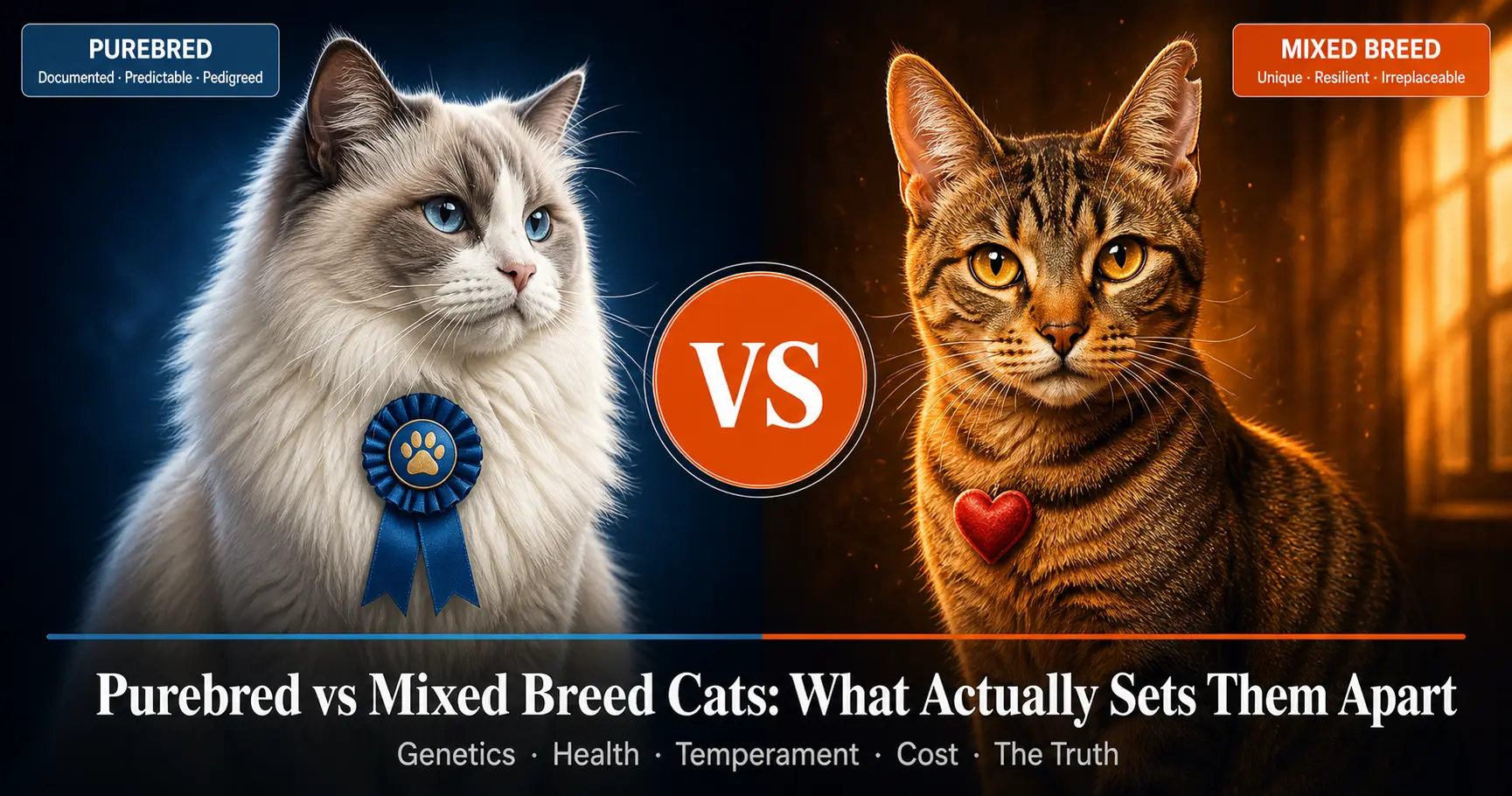
We have created a visual infographic summarizing the key differences between purebred and mixed breed cats — covering genetics, health, temperament, cost, and identification — in a single reference image you can save and return to.

Frequently Asked Questions
Cat Breeds Without Papers: Are They Still Purebred?
No — and this is one of the most common misunderstandings in cat ownership. A cat without registration papers from a recognized registry is not a purebred, regardless of how closely it resembles a specific breed. "Purebred without papers" is a contradiction in terms. The papers are the definition. A cat that looks like a purebred but lacks documentation is a mixed breed cat with strong breed characteristics — which is a legitimate and interesting thing to be, but it is not a registered purebred.
Do mixed breed cats really live longer than purebreds?
The evidence suggests they tend to, on average — though individual variation is significant in both categories. The lifespan advantage in mixed breeds is generally attributed to hybrid vigor: the health benefit of genetic diversity that reduces the risk of recessive disease genes pairing up. Purebred cats with breed-specific conditions like HCM or PKD face risks that are simply not as prevalent in the diverse mixed-breed population. That said, a well-bred purebred from health-tested lines, kept indoors with good veterinary care, can live just as long as any mixed breed cat.
Can a mixed breed cat be registered as a purebred?
No. Cat registries require documented ancestry through registered breeding cats. There is no process by which an unregistered cat can be retrospectively entered into a pedigree, regardless of its appearance or DNA test results. Some registries do have categories for foundation cats when establishing new breeds, but this is a formal process governed by strict rules — not available for individual pet owners.
How do I know if my cat is genuinely purebred?
Ask for the pedigree document and verify the registration numbers with the issuing registry. Both CFA and TICA maintain searchable databases of registered cats. If the registration numbers check out and the pedigree spans at least four generations of the same breed, the cat is a registered purebred. If papers are missing, incomplete, or unverifiable, treat the cat as a mixed breed with breed characteristics — which is an honest and useful framing.
What is the difference between a cat breed and a cat type?
A breed is a formally recognized group of cats with a documented standard maintained by a registry. A type is an informal description of general appearance — "tabby," "longhair," "domestic shorthair." Types are not breeds. A tabby is not a breed. A domestic longhair is not a breed. Understanding this distinction prevents a lot of confusion when trying to identify or discuss a cat's background. For a full look at how body type and breed connect, our conformation guide covers the structural differences between breed families in detail.