Fewer than 300 Sokoke cats are believed to exist outside their native Kenya. The Havana Brown has such a small registered population that the breed has been classified as genetically vulnerable by multiple feline preservation groups. The Chartreux — one of the oldest natural cat breeds in the world — remains almost entirely unknown to the average cat owner despite being one of the most visually distinct cats alive.
Here is the thing nobody tells you: rare breeds occasionally end up in shelters. They get surrendered when owners move. They are born in unplanned litters from a cat that turned out to carry more than domestic shorthair genetics. They are rescued as strays by people who had no idea what they were picking up.
The result is that some cat owners are living with genuinely rare cats without knowing it. The cat they call "my gray cat" might be a Chartreux. The one with the impossibly curled ears might be an American Curl from a line that traces back to a registered breeder. The small, warm-ticked cat that weighs barely seven pounds might be a Singapura.
This guide covers the rare and uncommon breeds most likely to appear in ordinary household or shelter settings — and exactly what to look for when you suspect your cat might be one of them.
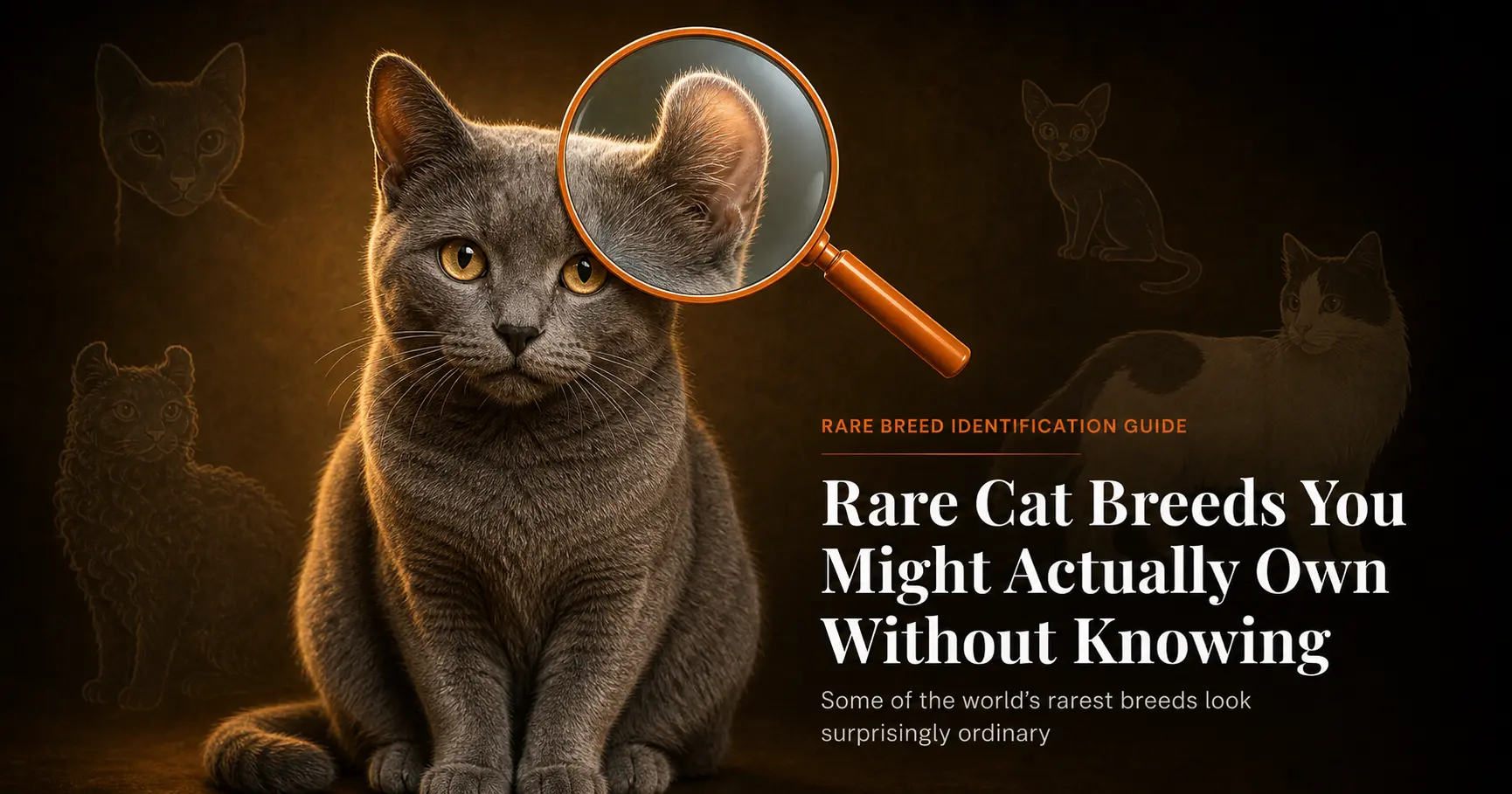
What Makes a Cat Breed Rare
Before getting into individual breeds, it helps to understand what "rare" actually means in this context — because the word gets used loosely.
A breed can be rare for several distinct reasons:
Small registered population. Some breeds have so few registered individuals that the breed itself is considered at risk of genetic bottleneck. When a breed's gene pool narrows to a small number of unrelated breeding lines, long-term health and viability become genuine concerns.
Geographic concentration. Some breeds are common in their country of origin but almost unknown elsewhere. The Chartreux is relatively well-known in France. Outside Europe, almost nobody can identify one on sight.
Recent development. Some breeds are so newly recognized that registered numbers are still low simply because the breed hasn't existed long enough to build a large population. The Lykoi — a cat with a partially hairless, werewolf-like appearance caused by a natural mutation — was only formally recognized in 2017.
Low commercial demand. Some breeds are rare not because they are difficult to breed but because few breeders work with them and few buyers seek them out. This creates a self-reinforcing cycle of low availability and low awareness.
None of these categories is better or worse than the others. What matters for identification is that rare breeds can and do surface in unexpected places — and that their physical characteristics, once you know what to look for, are often more distinctive than people realize.
Rare Breeds at a Glance
| Breed | Origin | Most Distinctive Feature | Common Mistaken For | Rarity Level |
|---|---|---|---|---|
| Chartreux | France | Blue-gray coat, orange-gold eyes, smiling expression | Russian Blue or gray domestic SH | Very rare outside Europe |
| Korat | Thailand | Silver-blue coat, heart-shaped face, vivid green eyes | Russian Blue | Rare globally |
| Havana Brown | UK / USA | Solid warm chocolate-brown coat, green eyes, oval paws | Brown domestic shorthair | Critically rare |
| Singapura | Singapore | Tiny size, large eyes, ticked sepia coat | Small Abyssinian mix | Rare |
| American Curl | USA | Ears curled backward — dominant gene mutation | Domestic cat with unusual ears | Uncommon |
| LaPerm | USA | Curly or wavy coat — spontaneous mutation | Devon Rex or random-bred curly cat | Rare |
| Selkirk Rex | USA | Dense, plush, tightly curled coat — cobby build | Curly-coated mixed breed | Uncommon |
| Sokoke | Kenya | Blotched tabby with modified coat pattern, lean body | Abyssinian or tabby mixed breed | Extremely rare |
| Turkish Van | Turkey | White body, colored head and tail only, water affinity | White bicolor domestic cat | Rare outside Turkey |
| Toyger | USA | Tiger-striped mackerel tabby, muscular, circular markings | Bold tabby domestic shorthair | Uncommon — still developing |
The Breeds Most Likely to Appear Without Warning
The Chartreux
The Chartreux is probably the most commonly misidentified rare breed in existence — because it looks, to an untrained eye, remarkably similar to a Russian Blue or a gray domestic shorthair. The difference, once you know it, is unmistakable.
The Chartreux is a cobby, heavily built cat with short, dense, water-resistant blue-gray fur that has an almost woolly texture — quite different from the fine, close-lying coat of a Russian Blue. The muzzle is narrow and tapered relative to the broad skull, giving the face a characteristic expression that breeders describe as a "smile" — the corners of the mouth naturally turn upward.
The eyes are the most reliable single identifier. Chartreux eyes range from gold to deep copper-orange. A Russian Blue has vivid green eyes. A gray cat with orange or copper eyes is almost certainly not a Russian Blue — and if the build is cobby and the coat has that woolly texture, Chartreux ancestry is genuinely worth investigating.
Chartreux cats are quiet, gentle, and observant. They watch rather than demand. Owners describe them as having a dog-like loyalty — following their person quietly without the vocalization of a Siamese or the chaos of a Bengal. If your gray cat is calmer and more self-possessed than you would expect, that temperament detail adds to the case.
The Korat
The Korat shares the silver-blue coat that makes the Chartreux and Russian Blue easy to confuse — but it has its own completely distinct profile once you know what to look at.
The Korat's most recognizable feature is its heart-shaped face. This is not a metaphor. The forehead is broad and rounded, the cheeks full, and the face genuinely narrows in a smooth curve to a pointed muzzle — producing a front-facing outline that resembles a heart. No other cat breed has this specific facial geometry.
The body is semi-cobby — muscular and substantial without the extreme roundness of a Persian. The coat is single-layered (no undercoat), which gives it a close, glossy appearance and makes the silver tips on each blue-gray hair shimmer distinctively in light. The eyes are large, luminous, and an exceptionally vivid green — the most intense green eye color of any cat breed.
Korats are sacred in their homeland of Thailand, where they are considered good luck symbols. Outside Thailand and specialist breeding circles, they are almost unknown — which is exactly why one might sit in a shelter for months labeled as a "gray cat."
The Havana Brown
The Havana Brown is one of the most critically rare cat breeds in existence. At various points in its history, the entire registered global population has dropped below 1,000 individuals. It came close to extinction in the 1990s before a dedicated preservation effort stabilized the lines.
It is a solid, uniformly warm chocolate-brown cat — not the cooler, darker brown of some Oriental Shorthairs, but a rich, warm, almost mahogany tone reminiscent of the tobacco leaf the breed is named after. The coat is short, smooth, and glossy. The whiskers are brown — the only breed where the whiskers match the coat.
The muzzle has a distinctive corn cob shape when viewed from the side — a squared-off, blunt end that is unlike the tapered muzzle of most cats. The eyes are oval and vivid green. The paws are distinctively oval rather than round.
If you find yourself looking at a brown cat and thinking "this brown is unusually warm and even" — and the muzzle is blunter than expected, the eyes a clear green — you might be looking at something rarer than you realize.
The Singapura
The Singapura holds a particular distinction: it is the smallest recognized domestic cat breed in the world. Adult Singapuras typically weigh between 4 and 8 pounds. A fully grown Singapura is smaller than many kittens of larger breeds.
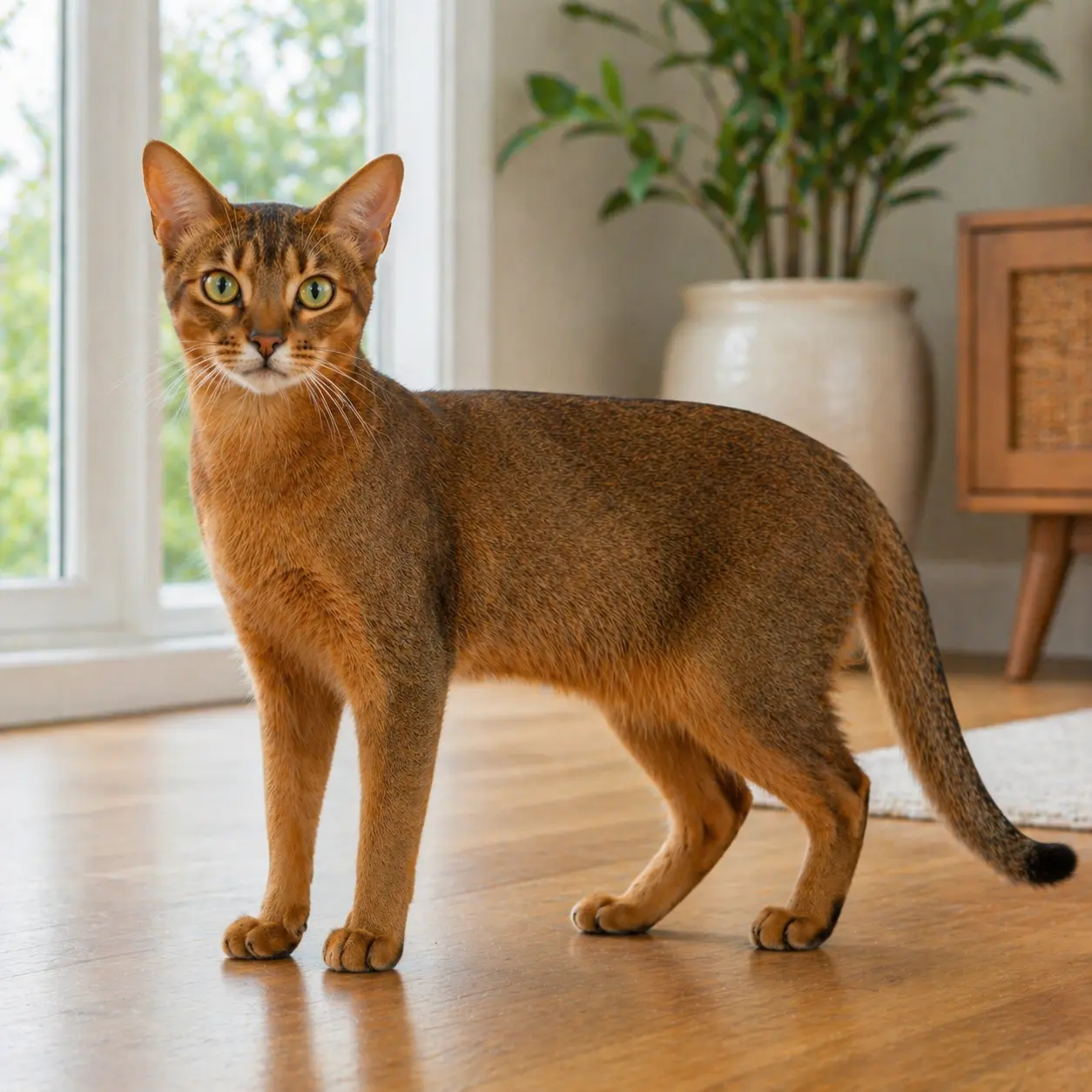
Beyond size, the Singapura has a specific coat pattern — a warm sepia-toned ticked coat, similar in structure to an Abyssinian's agouti pattern but distinctly different in color. The base coat is warm ivory, ticked with dark sepia banding. The overall effect is a glowing, warm, slightly golden appearance.
The eyes are large relative to the face — very large. The ears are also large relative to the head. This combination of tiny body, large eyes, and large ears gives the Singapura an almost perpetually kitten-like appearance, regardless of age.
A small cat with a ticked sepia coat, enormous eyes, and large ears is not automatically a Singapura — Abyssinian mixes can produce something superficially similar. But if all three features appear together in a cat that genuinely weighs under 7 pounds as an adult, Singapura genetics are worth considering.
The American Curl
The American Curl is rare in the sense that most people have never heard of it — but it has one feature so distinctive that it is impossible to miss once you know about it.
The ears curl backward, away from the face. Not down like a Scottish Fold. Not upright like a normal cat. Backward — the cartilage curves outward and backward, so the ear tip points away from the head rather than forward over it.
This is caused by a dominant cartilage gene — which means one copy of the gene produces the curl. A cat with any degree of backward ear curl almost certainly carries American Curl genetics. The curl develops progressively in kittens, typically becoming evident within the first two weeks of life and reaching its final degree of curl by four months.
Unlike the Scottish Fold mutation — which affects cartilage throughout the body and causes joint disease — the Curl gene appears to be structurally benign. The ears are the only affected cartilage.
American Curls appear in both shorthaired and longhaired varieties. The coat and body type otherwise resemble a moderate domestic cat — it is the ears that set them completely apart from every other breed.
The LaPerm
The LaPerm emerged from a spontaneous mutation on a cherry orchard in Oregon in 1982. A barn cat produced a litter, and one kitten was born bald. It grew a coat of soft, wavy curls. The owner — Linda Koehl — was not a cat breeder. She let the barn cats breed freely for a decade before realizing what she had.
The result is a breed with a curly or wavy coat caused by a dominant gene mutation that affects the structure of each hair shaft. Unlike the Devon Rex or Cornish Rex — which have short, very fine wavy coats — the LaPerm's curls can be quite loose and long, producing a tousled, almost poodle-like texture.
The curl intensity varies between individuals and with seasonal coat changes. Some LaPerms have tight ringlets. Others have loose waves. Some kittens are born bald and grow their curly coat gradually. The mutation is dominant, so mixed-breed LaPerms — where the breed's gene has entered the random-bred population — do exist and can produce unexpectedly curly-coated cats in ordinary household settings.
If your cat has curly or wavy fur that is not fine enough to be Devon Rex and not sparse enough to be Cornish Rex, LaPerm ancestry is a genuine possibility.
The Selkirk Rex
The Selkirk Rex is distinct from the LaPerm, Devon Rex, and Cornish Rex in a way that matters for identification: it is the only rex mutation that produces a dense, plush, heavily curled coat on an otherwise cobby, substantial body.
Where Devon Rex and Cornish Rex cats are fine-boned and lean, the Selkirk Rex is wide-chested, heavy, and rounded — built more like a British Shorthair than a foreign-type cat. The curls are thick and full rather than wispy. The overall appearance is often described as a "sheep cat" — an unusually round, heavily coated cat with unmistakably curled fur.
The Selkirk mutation is also dominant, appearing in both shorthaired and longhaired varieties. The shorthaired Selkirk Rex can look, at first glance, simply like a cat with unusually textured fur — until you notice that each individual hair is genuinely curled rather than wavy or kinked.
The Turkish Van
Most people know the concept of a "van pattern" — a mostly white cat with color restricted to the head and the base of the tail. What most people do not know is that this pattern is named after an actual breed that originated in the Lake Van region of eastern Turkey.
True Turkish Vans are large, semi-longhaired cats with a cashmere-soft, water-resistant coat that lacks a significant undercoat. The breed is famous for an enthusiasm for water that goes well beyond the curiosity most cats show — Turkish Vans actively seek water out, swim voluntarily, and have been documented hunting fish in their native environment.
A mostly white cat with colored markings only on the head and tail is not automatically a Turkish Van — van patterning appears in domestic cats of all types. But if the cat is also large-framed, has a semi-long coat with a distinctive texture, and shows genuinely unusual water behavior, the combination points toward something more specific than a random-bred white cat.
Why Rare Breeds End Up in Shelters
This is a reasonable question. If these breeds are rare and valuable, how do they end up in shelters?
Several routes:
Unplanned litters from breeding lines. A registered breeder's intact cat occasionally escapes or is accidentally bred. The resulting kittens may be surrendered to a shelter if the owner cannot find homes for them through their usual network.
Owner surrender without breed knowledge. Cats are sometimes surrendered by owners who never knew what they had. A person who adopted a "gray cat" from a neighbor may surrender it a decade later having never learned it was a Chartreux.
Breed genetics entering the mixed population. Dominant-gene mutations — like the American Curl ear curl or the LaPerm coat curl — can enter the random-bred population when unregistered cats carry the gene. The offspring are not registered purebreds, but they carry the genetic feature clearly enough to identify.
Geographic displacement. Cats that originated in breed-concentrated regions sometimes travel with relocating owners and end up in shelters far from where specialist breeders operate.
The practical implication: if a shelter cat displays a very specific physical feature — curled ears, backward-curled ears, a heart-shaped face, a chocolate coat with brown whiskers — it is worth pausing before assuming "domestic shorthair" is the whole story.
How to Identify a Rare Breed in Practice
Rare breed identification works the same way as any other breed identification — systematically, feature by feature, with converging evidence rather than a single smoking gun.
The physical identification methodology covered in our guide to identifying cat breeds by physical features applies directly here. The difference with rare breeds is that you are comparing against a less familiar reference set — most people can instantly recognize a Siamese or Persian but have no visual memory for a Korat or Havana Brown.
Two things help most with rare breed identification:
Focus on the most specific features first. Backward-curling ears, curly coats, chocolate-brown whiskers, a genuinely heart-shaped facial outline — these are features with very few possible explanations. If your cat has backward-curling ears, you do not need to work through a long elimination process. That feature narrows the field to one breed immediately.
Photograph in good natural light. Coat texture — the difference between the Chartreux's woolly blue-gray coat and a Russian Blue's fine one, or the distinction between a LaPerm's loose curls and Devon Rex's tiny waves — is almost impossible to assess accurately in artificial or flash lighting. Natural daylight from a window is worth waiting for.
The Governing Council of the Cat Fancy (GCCF) maintains detailed breed standards for many rare breeds, including visual descriptions and photographs that serve as useful reference — particularly for breeds less covered in North American sources. Their breed profile pages are worth bookmarking if you are working through an identification that has produced an unusual result.
If physical identification leaves you genuinely uncertain — which it will more often with rare breeds than common ones, simply because there are fewer reference images to compare against — our piece on cat DNA testing covers how genetic testing handles rare breeds specifically, including the important caveat about database coverage for low-population breeds.
Understanding where rare breeds fit relative to the common breed families covered in our complete breed guide provides useful context — rare breeds are often outliers within the main body type and coat pattern categories, which is precisely what makes them stand out once you know what you are looking at.
For cats showing features that suggest multiple possible backgrounds — a common outcome when a rare breed has mixed with domestic cats across generations — our mixed breed physical reading guide covers how to interpret partial or diluted breed expression systematically.
We have created a visual infographic covering all ten rare breeds in this guide — showing each breed's most distinctive identifying feature alongside its typical body type, coat, and the breed it is most commonly mistaken for. Everything on this page in one saveable reference image.

Frequently Asked Questions
Cat Breeds That Are Rarest: Which Has the Smallest Population?
The Havana Brown is widely considered one of the rarest cat breeds in the world by registered population. At various points its global registered numbers have dropped below a few hundred individuals, prompting active preservation programs. The Sokoke — a natural breed from Kenya — also has an extremely small population, with estimated numbers outside their native range in the low hundreds. Population figures for registered breeds are tracked by major cat registries and shift year to year as breeding programs expand or contract.
Can Rare Cat Breeds Really End Up in Shelters?
Yes — more commonly than most people assume. Unplanned litters from lines carrying dominant-gene mutations like the American Curl ear gene can produce cats with rare breed features without any connection to a registered breeder. Owners surrender cats without knowing their background. Cats are also occasionally displaced geographically when owners move and cannot keep them. A shelter cat displaying a very specific anatomical feature — curled ears, chocolate-brown whiskers, a heart-shaped face — is worth examining carefully before categorizing as a plain domestic shorthair.
How Do I Know If My Cat Is a Rare Breed or Just an Unusual-Looking Mixed Breed?
The most reliable approach is to focus on features controlled by specific dominant genes — because these appear clearly even in mixed-breed cats carrying the gene from one parent. Backward-curling ears point to American Curl. Forward-folding ears point to Scottish Fold. A curly coat points to a rex mutation. These features do not arise spontaneously in random-bred cats — they indicate specific genetic heritage. For everything else, the combination of body type, facial structure, coat pattern, and temperament builds a case that may or may not be conclusive without DNA testing.
Are Rare Cat Breeds Healthier Than Common Breeds?
Not necessarily — and in some cases, the opposite is true. Many rare breeds have very small gene pools, which increases the risk of recessive genetic diseases becoming prevalent in the population. The Havana Brown, for example, has been subject to careful genetic management precisely because its small population creates bottleneck risks. Rare breeds that emerged from large random-bred populations — like the LaPerm or American Curl — tend to have better genetic diversity than breeds developed within closed lines. The relationship between rarity and health is not straightforward.
Cat Breed Identification for Rare Breeds: Is DNA Testing Reliable?
Partially — and this is an important nuance. DNA tests identify breeds by comparing your cat's genetic profile against a reference database of known purebred cats. Rare breeds with small registered populations often have small or absent reference databases. A Sokoke or Havana Brown may not appear in a consumer DNA test's results even if your cat genuinely carries that ancestry — it simply returns as "unknown." For the rare breeds with larger or better-documented populations — like the Turkish Van or American Curl — DNA testing is more likely to return a useful result. Always check what breeds a specific test includes in its reference panel before purchasing.