Run your hand along your cat's back. Notice how the fur moves — whether it springs back immediately in a dense plush layer, lies flat and sleek against the skin, or cascades in long flowing waves that take a moment to resettle. That sensation is telling you something genetic.
Coat length in cats is not random. It is not determined by climate, diet, or how often you brush them. It is controlled by a specific gene — and the rules governing whether that gene expresses are clean enough that understanding them changes how you read your cat's physical profile entirely.
This matters for breed identification because coat length is one of the first things you observe and one of the first things that narrows the field. A long-haired cat eliminates dozens of short-haired breed possibilities immediately. A very specific coat texture — woolly, plush, silky, wavy — narrows it further. By the time you have assessed coat length and texture together, you have already eliminated more than half the breed landscape before looking at anything else.
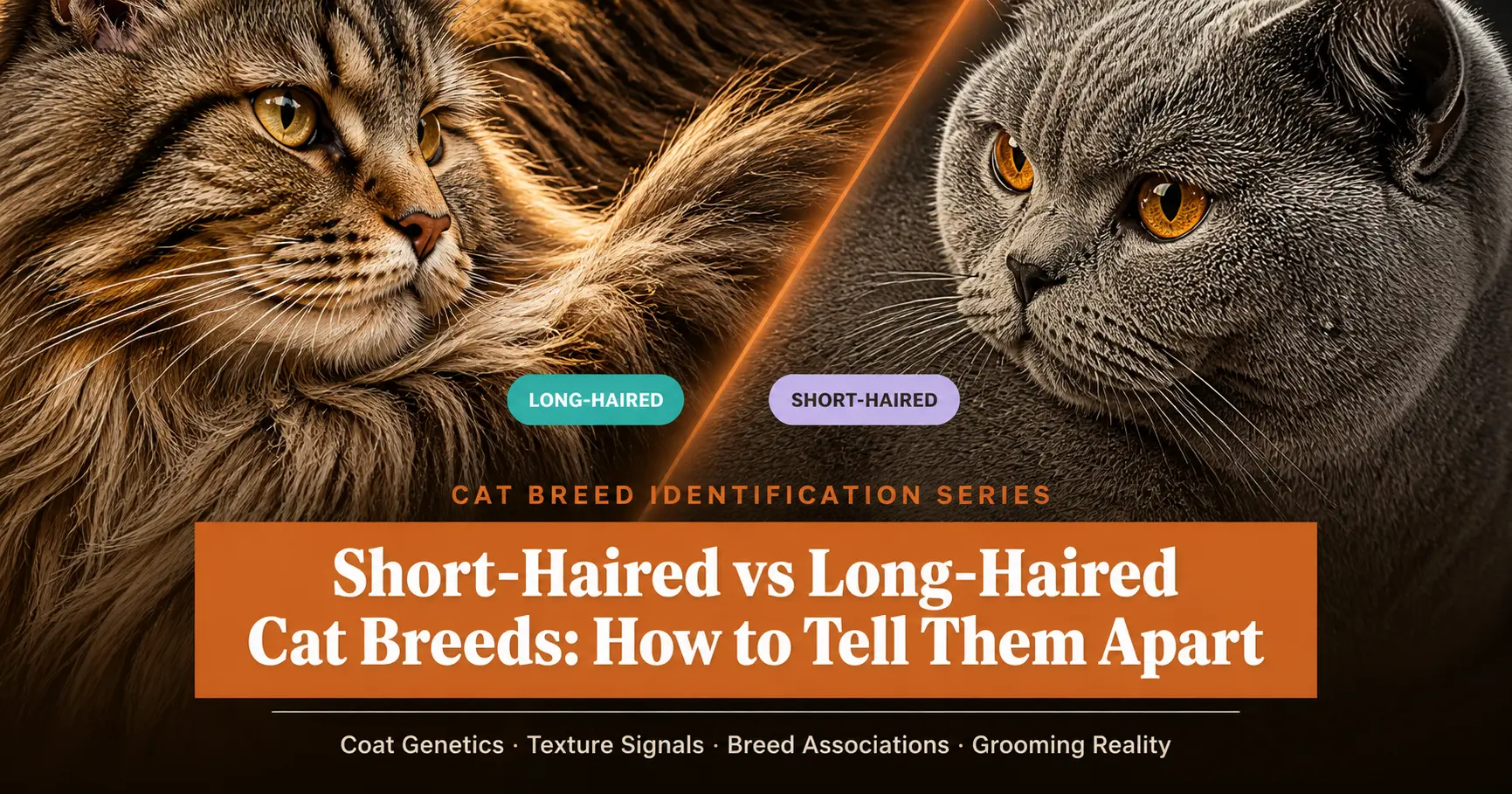
The Genetics of Coat Length: One Gene, Simple Rules
Coat length in domestic cats (Felis catus) is controlled primarily by a single gene called FGF5 (fibroblast growth factor 5). The long-coat version of this gene is recessive — meaning a cat must inherit two copies of the long-coat allele (one from each parent) to express a long coat.
This single genetic fact explains several things that confuse cat owners:
Two short-haired parents can produce long-haired kittens. If both parents carry one copy of the long-coat gene silently — without expressing it — they can each pass that copy to a kitten, which then has two copies and grows a long coat. This is not a mystery or a mix-up. It is Mendelian genetics working exactly as expected.
A long-haired cat always passes one long-coat gene to every kitten. If a long-haired cat breeds with a short-haired cat that does not carry the gene, all kittens will be short-haired — but every single one will carry the long-coat gene silently.
Long coat in a shelter cat signals dual-carrier ancestry. If your rescue cat has a long coat, both of its parents carried the long-coat gene — one or both of them may have had long-haired ancestors, even if the parents themselves appeared short-haired.
This genetic simplicity is useful for breed identification because it means coat length does not appear randomly. A consistently long-haired population of cats — a recognized breed — has been selectively bred to carry two copies of the long-coat gene reliably. When you see a domestic cat with a genuinely long, flowing coat, that trait was not accidental in its ancestry.
Short-Haired Cat Breeds: What the Coat Reveals
Short coat is the dominant state — most cats in the world carry at least one copy of the short-coat gene and express it. But within the short-coat category, enormous variation exists in texture, density, and lie.
Plush and Dense Short Coats
British Shorthair cats carry perhaps the most recognizable short coat in the cat world — extraordinarily dense, plush, and springy. When you press your hand into a British Shorthair's coat, it resists like a firm cushion and springs back slowly. The coat stands slightly away from the body rather than lying flat. Individual hairs are short but thick, producing a feel that many owners describe as touching a deep-pile carpet.
This coat texture is a direct function of the breed's physical structure — the cobby, wide-bodied British Shorthair developed this coat partly through selective breeding for the plush, dense appearance. The American Shorthair and Scottish Fold share similarly dense coat textures.
Russian Blue cats have an equally dense coat but with a distinctive layering — the double coat (plush undercoat plus slightly longer guard hairs) produces a silvery sheen that separates it visually from the denser, more uniform British Shorthair coat. When you part the Russian Blue's fur, the dense pale undercoat is clearly visible beneath the blue-gray guard hairs.
Sleek and Close-Lying Short Coats
At the opposite end of the short-coat spectrum, several breeds have extremely fine, close-lying coats that cling to the body and accentuate rather than obscure body structure.
The Siamese coat is the reference point for this type — extremely short, very fine, with almost no visible texture. It lies completely flat against the angular body, making every structural detail of the underlying frame visible. This is why the Siamese's angular build looks more extreme than other similar-sized cats — the coat reveals rather than softens the body.
Abyssinian, Burmese, and Cornish Rex cats share variations of this close, fine coat type. The Cornish Rex takes it furthest — the coat is so short and fine that the skin is nearly visible, and each hair is actually a wavy/curled structure that lies in ripples against the body rather than standing upright at all.
Satin and Glossy Coats
Burmese cats have a coat quality that owners consistently describe as satin — not because it is silk (it isn't) but because the coat has a lustrous, light-catching quality and lies so smoothly and closely that the cat's body seems almost polished. This is related to the specific structure of the guard hairs in this breed. Running a hand over a Burmese coat in good light produces a visible sheen that most short-coated cats do not share.
| Coat Type | Texture Description | Key Breeds | ID Signal |
|---|---|---|---|
| Plush / Dense | Springy, stands away from body, carpet-like | British SH, American SH, Scottish Fold | Resists hand pressure, springs back |
| Double coat (dense) | Visible undercoat beneath guard hairs, silvery | Russian Blue, Chartreux | Part the fur — pale dense undercoat visible |
| Sleek / Close-lying | Flat, fine, shows body structure | Siamese, Abyssinian, Bengal | No resistance — hand glides straight through |
| Satin / Glossy | Smooth, light-catching, almost polished | Burmese, Havana Brown | Visible sheen in natural light |
| Rex / Wavy | Curled or wavy texture, very fine | Cornish Rex, Devon Rex, LaPerm | Visible wave or curl pattern on short coat |
Long-Haired Cat Breeds: Reading the Coat Structure
Long-haired cats are not simply cats with more of the same coat. The structure, layering, and texture of long-haired coats varies dramatically between breeds — and those variations carry specific breed signals.
Multi-Layered Coats Built for Weather
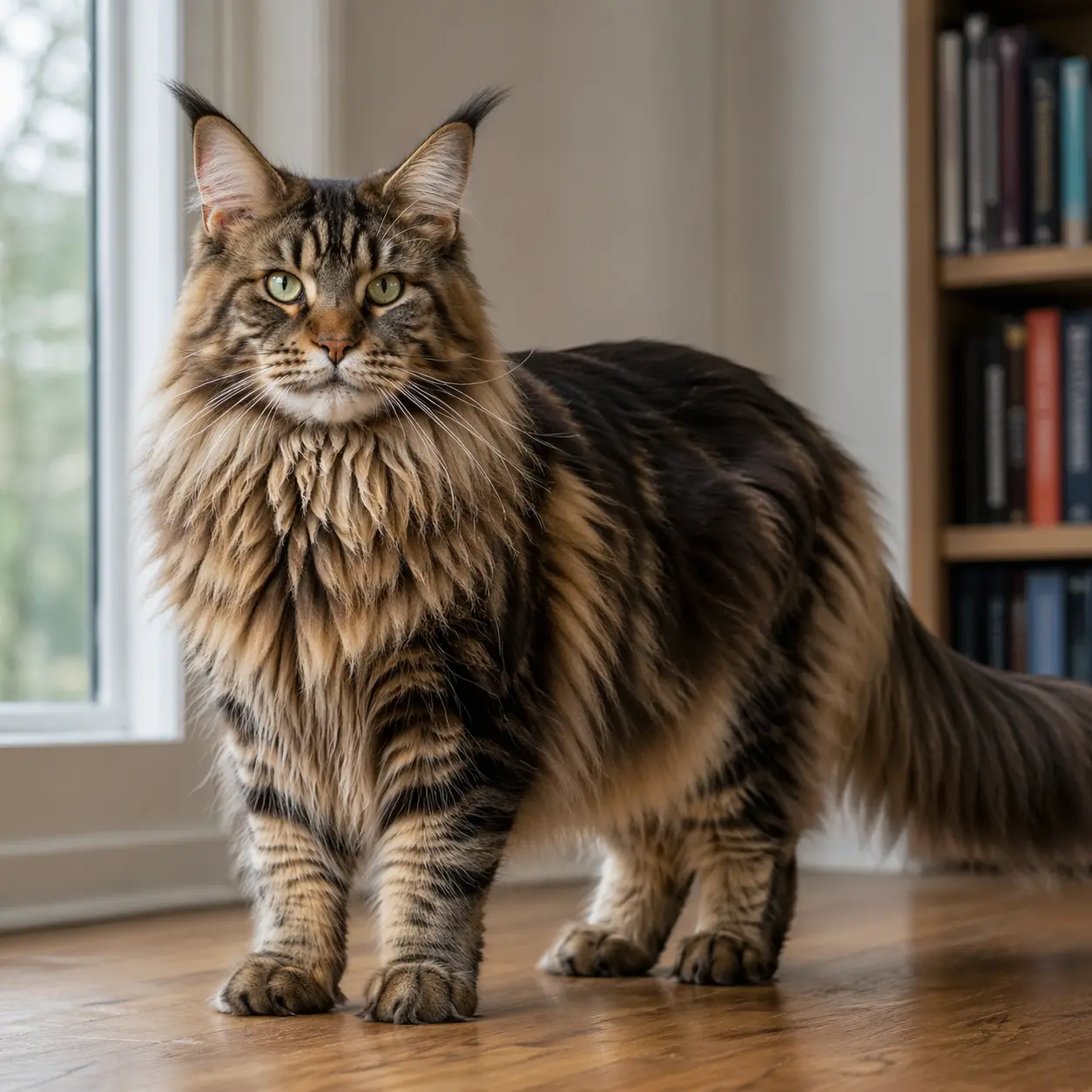
The Maine Coon and Norwegian Forest Cat are the clearest examples of coats developed for environmental function. Both breeds originated in cold climates and developed multi-layered coats through natural selection — an outer layer of longer, coarser guard hairs that repels water and wind, and a dense woolly undercoat for insulation.
The distinction between these two breeds matters for identification. The Maine Coon coat is shaggy and uneven — longer around the neck (creating a ruff), shorter on the back, with a dramatically full tail. The overall impression is a coat that has not quite been tamed. The Norwegian Forest Cat coat is neater — the outer guard hairs create a more uniform, water-shedding surface, and the silhouette is tidier despite comparable length.
Both coats share one important feature: they are functionally layered. When you push your fingers into the coat, you encounter distinct resistance at different depths — the outer guard hairs and the inner undercoat feel genuinely different from each other. This layered quality is absent in long-haired cats whose coat is a single long layer (like the Persian).
Single-Layer Flowing Coats
The Persian coat is one of the most extreme coat expressions in any domestic cat — extraordinarily long, dense, and silky, but in a single flowing layer rather than the functional double coat of weather-adapted breeds. A Persian's coat does not have the structural distinction between guard hairs and undercoat that a Maine Coon's coat has. Instead, every hair is roughly the same length and texture, producing the characteristic flowing, ground-length coat.
This also explains why Persian coats mat so readily — without the structural differentiation of a double coat, the long hairs can tangle and knot throughout the entire coat rather than in just the undercoat layer.
The Ragdoll coat is similar in concept but somewhat easier to maintain — semi-long rather than full Persian length, and with a silkier texture that resists matting better than the Persian's denser coat.
Coat Length as a Breed Family Signal
| Coat Length Category | Technical Description | Breeds | Grooming Reality |
|---|---|---|---|
| Full long | Ground-length, single dense layer | Persian, Himalayan | Daily brushing essential |
| Semi-long | Long but not floor-length, manageable | Ragdoll, Birman, Balinese | 2–3 times per week |
| Double / weather coat | Layered — coarse outer + dense undercoat | Maine Coon, Norwegian FC, Siberian | 2–3 times per week, heavy seasonal shed |
| Shaggy / uneven | Variable length across body regions | Maine Coon (body shorter, tail/ruff longer) | Focus on ruff and tail areas |
| Short / standard | Uniform short length, low maintenance | British SH, Siamese, American SH, Bengal | Weekly brush, minimal shedding management |
| Very short / close | Near-skin-level, minimal visible coat | Cornish Rex, Sphynx (peach fuzz) | Near zero — Sphynx needs bathing instead |
The Domestic Shorthair and Domestic Longhair: What These Labels Mean
Most cats in shelters and homes are classified as either domestic shorthair (DSH) or domestic longhair (DLH). Neither is a breed. Both are coat-length descriptions applied to cats of unknown or mixed ancestry.
The domestic shorthair label covers an enormous range of cats — from cats with tightly close-lying fine coats to cats with quite dense, slightly shaggy coats. The label tells you one thing only: the cat does not have a long coat. Everything else about that cat's appearance, genetics, and ancestry is open.
The domestic longhair label is more genetically informative than it appears. As established by the genetics above, a DLH cat carries two copies of the long-coat gene — which means both parents carried it. For a shelter cat with no known history, that is a real genetic data point. The parents were not random — they were specifically cats that both carried the long-coat gene, either expressing it or carrying it silently from long-haired ancestors.
This means a domestic longhair cat from a shelter may carry significantly more breed ancestry than the label suggests. Many DLH cats show features associated with Maine Coon, Ragdoll, Norwegian Forest Cat, or other long-haired breeds — because those breeds, or their genetics, entered the general cat population through unplanned breeding long ago.
Identifying Coat Length Incorrectly: Common Mistakes
Several situations cause owners to misjudge their cat's coat length:
Young kittens. Kittens are not reliable indicators of their adult coat. Many cats that will develop medium to long coats as adults appear quite short-haired through their first six months. The full adult coat typically develops between 9 and 18 months — longer for large-framed breeds like the Maine Coon, which continues developing its ruff and full tail coat until age three or four.
Shaved or clipped cats. A recently groomed cat with a shave-down or lion cut cannot be assessed for coat length until the coat regrows — typically six to twelve months for a full return.
Seasonal coat changes. All cats shed seasonally, but double-coated cats (Maine Coon, Norwegian Forest Cat, Siberian) shed dramatically in spring — losing the dense undercoat almost entirely. A Maine Coon in its summer coat looks significantly different from the same cat in winter, and a first-time owner who adopted in summer may be surprised by the transformation when the winter coat grows in.
Rexed coats. Devon Rex and Cornish Rex cats have coats so short and fine that they are sometimes mistaken for nearly hairless cats. Conversely, a LaPerm's curly medium-length coat sometimes reads as a short coat because the curls compress the apparent length.
Coat Length in Breed Identification: Practical Framework
When you are working through a breed identification, coat length gives you your first major filter. Apply it in this sequence:
Step 1 — Determine the coat length category. Using the categories in the table above, assign your cat to one: very short/rex, short standard, semi-long, or long/full-long. If the cat is young, note that the adult coat may be longer.
Step 2 — Note the coat texture. Plush and springy, close and sleek, wavy, or layered double coat? This narrows the field significantly within each length category.
Step 3 — Check specific coat features. Is there a visible ruff around the neck? Tufted paws? A dramatically full tail relative to the body? Lynx tufts at the ear tips? These features are additional breed signals that appear alongside coat length.
Step 4 — Combine with body type. Coat length tells you one thing. Body type tells you another. A very long-haired cat with a cobby, round-bodied build points toward Persian or Exotic Shorthair. A very long-haired cat with a large, rectangular, heavy-boned build points toward Maine Coon or Norwegian Forest Cat. The combination is far more diagnostic than either feature alone. The full framework for combining these signals is covered in our physical features identification guide.
Short-Haired vs Long-Haired: Grooming, Health, and Practical Differences
The practical differences between owning a short-haired and long-haired cat are real and significant enough to warrant honest discussion before adoption.
Shedding — Long-haired cats shed longer hairs that are more visible and more challenging to remove from furniture and clothing. Double-coated breeds shed cyclically and dramatically in spring. Short-haired cats shed too — fine short hairs can be equally pervasive — but individual hairs are less visually apparent.
Matting — Only long-haired cats mat. A Persian or Himalayan that goes without daily brushing will develop painful mats within days. These mats tighten against the skin, cause discomfort, and require professional grooming or shaving to remove safely. This is not a grooming preference — it is a welfare issue. A long-haired cat without adequate coat maintenance is an uncomfortable cat.
Hairballs — Long-haired cats typically produce more hairballs than short-haired cats because they ingest more hair during self-grooming. This is manageable but requires monitoring — persistent unproductive retching in a long-haired cat warrants veterinary attention.
Hygiene in brachycephalic long-haired cats — Persians combine brachycephalic facial structure with very long coat, which creates specific hygiene challenges. The facial skin folds need daily cleaning. The coat around the rear needs monitoring for hygiene issues. This is a breed combination that requires committed, consistent care.
For owners trying to decide between coat types, understanding the full personality and care profile of each breed family — not just the coat maintenance — is important. Our article on how breed affects behavior and temperament covers what living with each breed actually involves beyond the coat.
Cat Breeds Commonly Mistaken for Each Other by Coat
Several breed pairs are routinely confused because their coat types are superficially similar. Understanding where the confusion happens — and what actually distinguishes the breeds — is useful for both identification and ownership decisions.
Maine Coon vs Norwegian Forest Cat. The most common long-haired confusion. Both are large, double-coated, with tufted ears and bushy tails. The key differences: Maine Coon has a square muzzle, slightly concave nose profile, and a shaggy uneven coat with a pronounced ruff. Norwegian Forest Cat has a triangular face, straight nose profile, and a neater, more uniform outer coat.
Persian vs Ragdoll. Both are long-haired with pointed or solid coat options. Key differences: Persian has a flat brachycephalic face, extremely dense full-length coat, and a cobby low-slung body. Ragdoll has a normal nose profile, semi-long silkier coat, and a larger, more substantial frame. Ragdolls also always have blue eyes; Persians come in many eye colors.
British Shorthair vs Russian Blue. Both can be solid blue-gray. Key differences: British Shorthair has a rounder, broader skull, copper or gold eyes, and a wider, cobby body. Russian Blue has a more refined wedge head, vivid green eyes, and a leaner, more elegant frame.
Domestic Longhair vs Maine Coon. This is not really a confusion between two breeds — it is the question of whether a shelter cat with a long coat is simply a DLH or has Maine Coon genetics. Ear tufts (lynx tips), a genuinely square muzzle, tufted paws, and a heavy rectangular body frame are the most reliable Maine Coon indicators in a DLH cat. Not every DLH cat with long fur is a Maine Coon mix — but many are, and the physical features distinguish them when present.
The full breakdown of how common breeds differ from each other physically — including the long-haired breed families — is available in our complete domestic breed guide.
For cats whose coat suggests mixed ancestry — a long coat on a very foreign-type frame, or a wavy coat on an otherwise unremarkable mixed-breed cat — the mixed breed physical signals guide covers how to interpret coat length and texture as part of a broader ancestry picture.
The Veterinary Information Network ([VIN]{https://vin.com}) maintains clinical resources on feline dermatology and coat genetics that are particularly useful for understanding how medical conditions — hypothyroidism, nutritional deficiencies, stress — can affect coat quality in ways that may be mistaken for breed characteristics. Worth consulting if your cat's coat has changed significantly rather than if you are assessing an inherited trait.
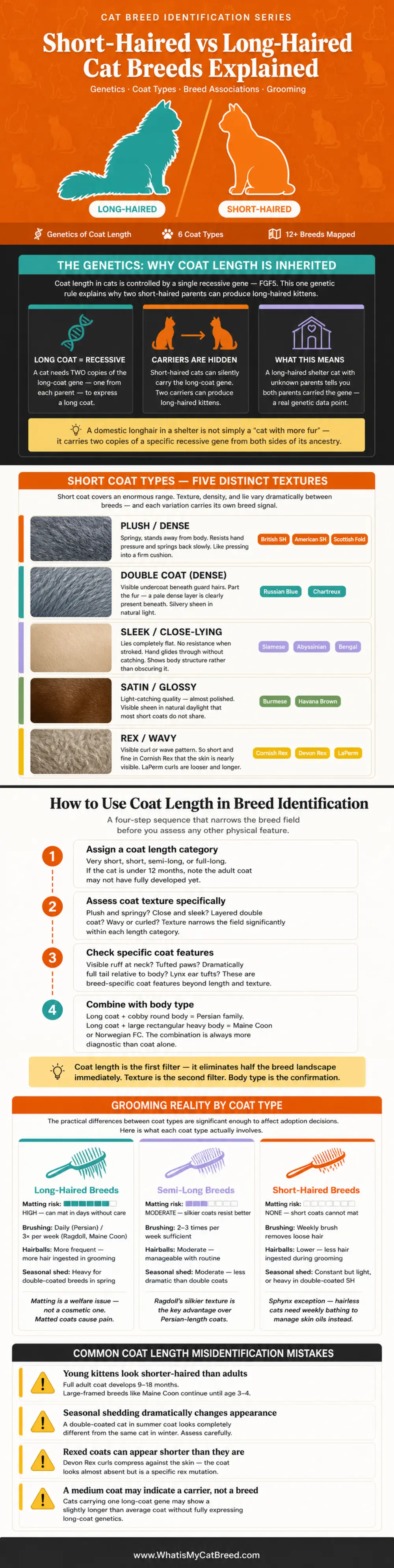
We have put together a visual infographic that maps all major coat length and texture types to their associated breeds — covering the genetics, the visual cues, and the grooming implications in one compact reference image you can save and return to.
Frequently Asked Questions
Short-Haired Cat Breeds: Do They Really Shed Less Than Long-Haired Cats?
Not always — and this is one of the most persistent misconceptions in cat ownership. Short-haired cats shed short hairs that can be equally pervasive on furniture and clothing. The hairs are simply less visible individually because of their length. Double-coated long-haired breeds like the Maine Coon shed dramatically but seasonally — meaning the volume is concentrated in spring rather than constant. Fine-coated single-layer short-haired cats like the Siamese or Burmese may shed less total volume than a double-coated long-haired cat across a full year.
Can Two Short-Haired Cats Have a Long-Haired Kitten?
Yes — and this surprises many people. If both short-haired parents carry one copy of the recessive long-coat gene without expressing it, they can each pass that copy to a kitten. That kitten inherits two copies of the long-coat gene and grows a long coat despite both parents being short-haired. This is straightforward Mendelian genetics and does not indicate mixed paternity or a genetic error. It simply means both parents were carriers of a recessive trait.
Cat Breed Identification by Coat: How Reliable Is It?
Coat length is a reliable first filter — it immediately narrows the breed landscape significantly. Coat texture adds a second filter that narrows it further. But coat alone is never sufficient for definitive breed identification, particularly in mixed-breed cats where a long coat may reflect carrier genetics from a distant ancestor rather than a close purebred relative. Coat length and texture work best combined with body type, head shape, and ear characteristics as a complete physical assessment.
My Cat Has a Medium-Length Coat — What Does That Mean?
Medium-length coats that are neither definitively short nor definitively long typically indicate one of two things. First, the cat may carry one copy of the long-coat gene (making it a carrier that expresses a slightly longer than average coat without fully expressing the long-coat phenotype). Second, the cat may be a mixed breed whose long-haired ancestry is diluted enough that the coat length falls between the two clear categories. Ragdolls and Birmans are legitimately semi-long-coated breeds — so if the coat length is consistent with breed standard for those breeds alongside their other physical features, that is worth investigating.
Does Coat Length Affect a Cat's Personality?
No — coat length and personality are genetically unrelated. A Persian being calm and a Siamese being vocal has nothing to do with their respective coat lengths. Those behavioral traits are independently selected for in each breed. The coincidence that many long-haired breeds (Persian, Ragdoll) tend toward calmer personalities and many short-haired breeds (Siamese, Abyssinian, Bengal) tend toward higher activity is a function of which behaviors were historically selected for alongside those coats in specific breeding programs — not a causal relationship between coat length and temperament.