Here is a question that trips up almost everyone: what breed is a tabby cat?
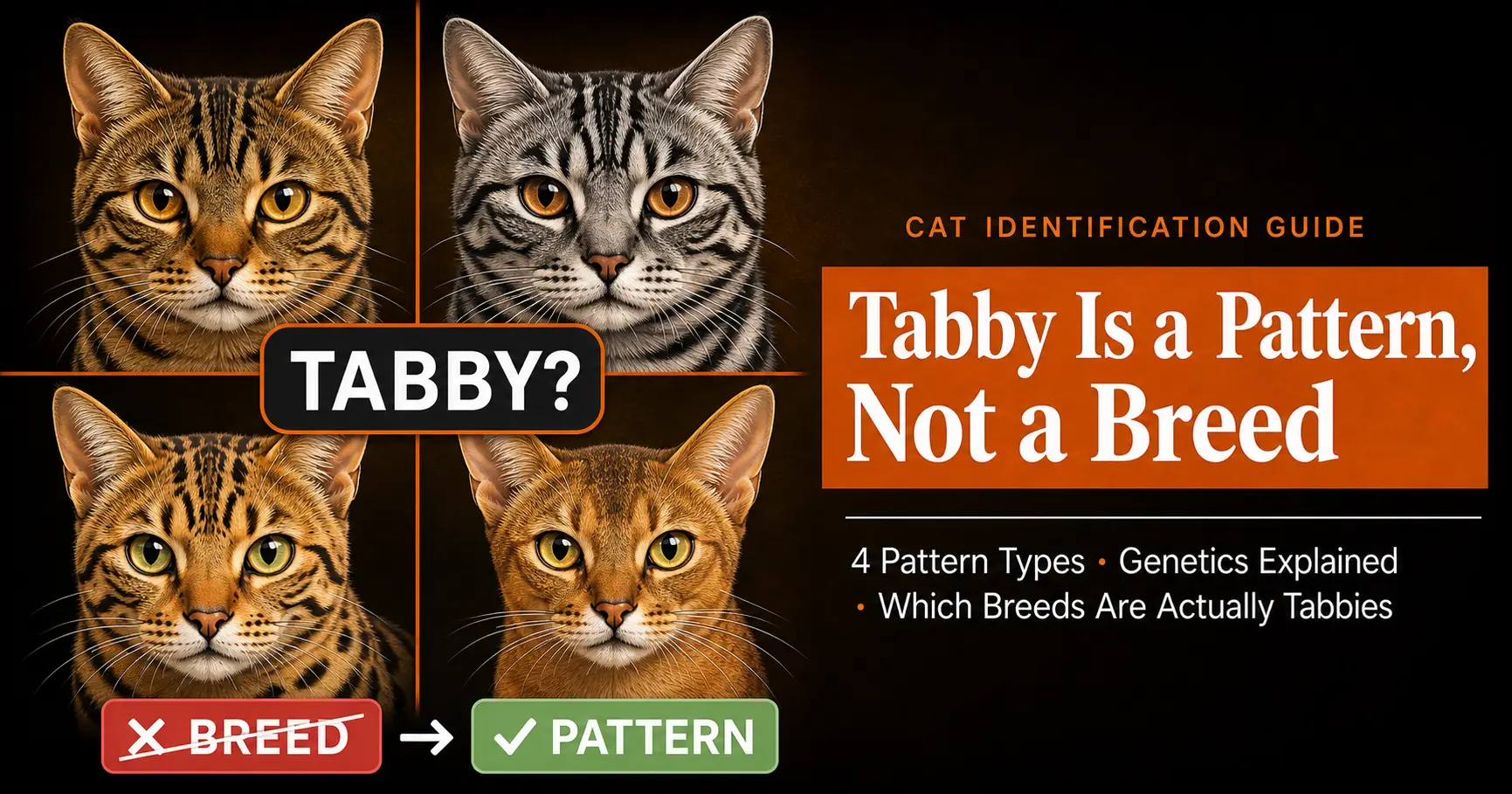
The answer is that it is the wrong question entirely. Tabby is not a breed. It never was. It is a coat pattern — a family of related coat patterns, actually — that appears across dozens of recognized breeds and in the vast majority of random-bred domestic cats worldwide. Calling a cat a "tabby" tells you about its coat. It tells you nothing about its breed.
This distinction matters more than it might seem. A striped orange cat and a spotted brown cat and a ticked golden cat can all correctly be called tabbies — while having completely different genetic backgrounds, breed ancestry, and physical characteristics. Conversely, some of the most famous recognized breeds — the Abyssinian, the Bengal, the Maine Coon — are, by coat pattern, tabbies. Their tabby status does not make them less of a breed. It simply means they express a pattern that spans the entire domestic cat species.
Understanding tabby genetics, tabby pattern types, and which breeds express which patterns gives you one of the most useful tools available for cat breed identification — because once you can read a tabby pattern accurately, you can use it to narrow down breed possibilities rather than simply labeling a cat and moving on.
The Genetics Behind Tabby Pattern in a Domestic Cat
The tabby pattern is the ancestral coat pattern of the domestic cat. Before selective breeding, before breed standards, before any of the categories we now use to classify cats — essentially all domestic cats were some form of tabby. The non-tabby coat states we see today (solid colors, pointed patterns, ticked coats without visible striping) are modifications of the tabby baseline, produced by genes that suppress or alter its expression.
The core genetics involve two gene positions working in sequence:
The Agouti gene (A/a) determines whether any tabby pattern is visible at all. The dominant form (A) allows the tabby pattern to express — each individual hair shaft alternates between lighter and darker pigment bands, producing the visible striping and spotting. The recessive form (aa) suppresses this banding entirely, producing a uniform solid color. A solid black cat, a solid blue cat, a solid white cat — all of these carry the tabby gene silently but the agouti suppression gene prevents it from showing. This explains why solid-colored cats sometimes show ghost striping in bright sunlight — the underlying tabby pattern exists, it is simply suppressed under normal conditions.
The Tabby gene (T/t/ta) determines which type of tabby pattern appears once the agouti gene allows expression. This gene controls whether the cat shows mackerel stripes, classic blotches, spotted marks, or ticked banding — the four distinct pattern families within the tabby category.
This two-gene interaction is why a cat can be simultaneously a tabby (agouti dominant) and a specific tabby subtype (controlled by the secondary gene) — and why understanding these two layers separately is more useful than treating "tabby" as a single undifferentiated category.
Cat Tabby Patterns: The Four Distinct Subtypes
The tabby category contains four genetically distinct pattern subtypes. Each has a different appearance, a different genetic basis at the tabby locus, and different breed associations. Confusing them is the most common mistake in tabby identification.
Mackerel Tabby
The mackerel tabby is the most common tabby subtype and the pattern most people picture when they say "tabby cat." Thin, parallel vertical stripes run down the sides of the body — the stripes are relatively narrow and evenly spaced, reminiscent of a fish skeleton (which is where the name comes from). The stripes are continuous or near-continuous rather than broken into spots.
From the front, a mackerel tabby shows:
- A clear M marking on the forehead — formed by the stripes converging above the eyes
- Two or three thin stripes running from the inner corner of each eye across the cheeks
- Necklace stripes across the chest
- Striped legs and a ringed tail
Mackerel is the ancestral tabby pattern — the pattern carried by the wild ancestor of the domestic cat (Felis lybica) before domestication. It is the most genetically primitive form and appears across virtually every cat breed and most random-bred cats worldwide. Its ubiquity is precisely why it has the least breed-diagnostic value of the four subtypes.
Classic Tabby
The classic tabby (also called blotched tabby) replaces the narrow parallel stripes of the mackerel with wide, sweeping blotch patterns. The most characteristic marking is an oyster or bullseye pattern on the sides — a dark circular blotch surrounded by one or more rings of slightly different color. The classic tabby has a broader, more dramatic graphic quality than the mackerel — the markings are bold and highly visible.
The genetic difference between mackerel and classic is significant: classic tabby is actually recessive to mackerel. A cat needs two copies of the classic gene to express classic markings. This makes classic tabby somewhat less common than mackerel globally, though it is the dominant pattern in certain populations — particularly in the United Kingdom, where centuries of relatively isolated breeding produced a higher frequency of the classic allele.
The British Shorthair in its silver tabby form, the American Shorthair in its classic silver tabby expression, and the Maine Coon all frequently carry classic tabby patterns. The classic silver tabby American Shorthair — silver background with bold black classic blotches — is one of the most photographically striking tabby expressions available in a domestic breed.
Spotted Tabby
The spotted tabby is mackerel tabby stripes that have been broken into discrete spots. The spots may be oval, round, or elongated — and their arrangement often retains the hint of the stripe rows they originated from. In some spotted cats, particularly at certain growth stages, you can see the spots partially connecting in a way that reveals their striped origin.
True spotted tabbies at the genetic level carry a modifier gene that breaks the mackerel stripes into spots. The spots themselves are still tabby-gene products — which is why spotted tabbies are correctly classified within the tabby category rather than as a separate pattern type.
The spotted tabby pattern appears prominently in:
- Bengal cats — where the spots have been developed into the more complex two-tone rosette structure through Asian leopard cat genetics
- Egyptian Mau — the only naturally spotted domestic cat breed, with spots that occur independently of the tabby modifier gene
- Ocicat — a spotted breed developed deliberately from Abyssinian, Siamese, and American Shorthair crosses
- Arabian Mau and some Domestic Shorthair cats with bold spot expression
The important distinction for identification: Bengal rosettes are structurally different from the solid spots of most spotted tabbies. Rosettes have a two-tone structure (pale center, darker outline). Ordinary tabby spots are uniform in color throughout each mark. This difference — covered in detail in our Bengal cat identification guide — is the key to distinguishing Bengal ancestry from ordinary spotted tabby genetics.
Ticked Tabby
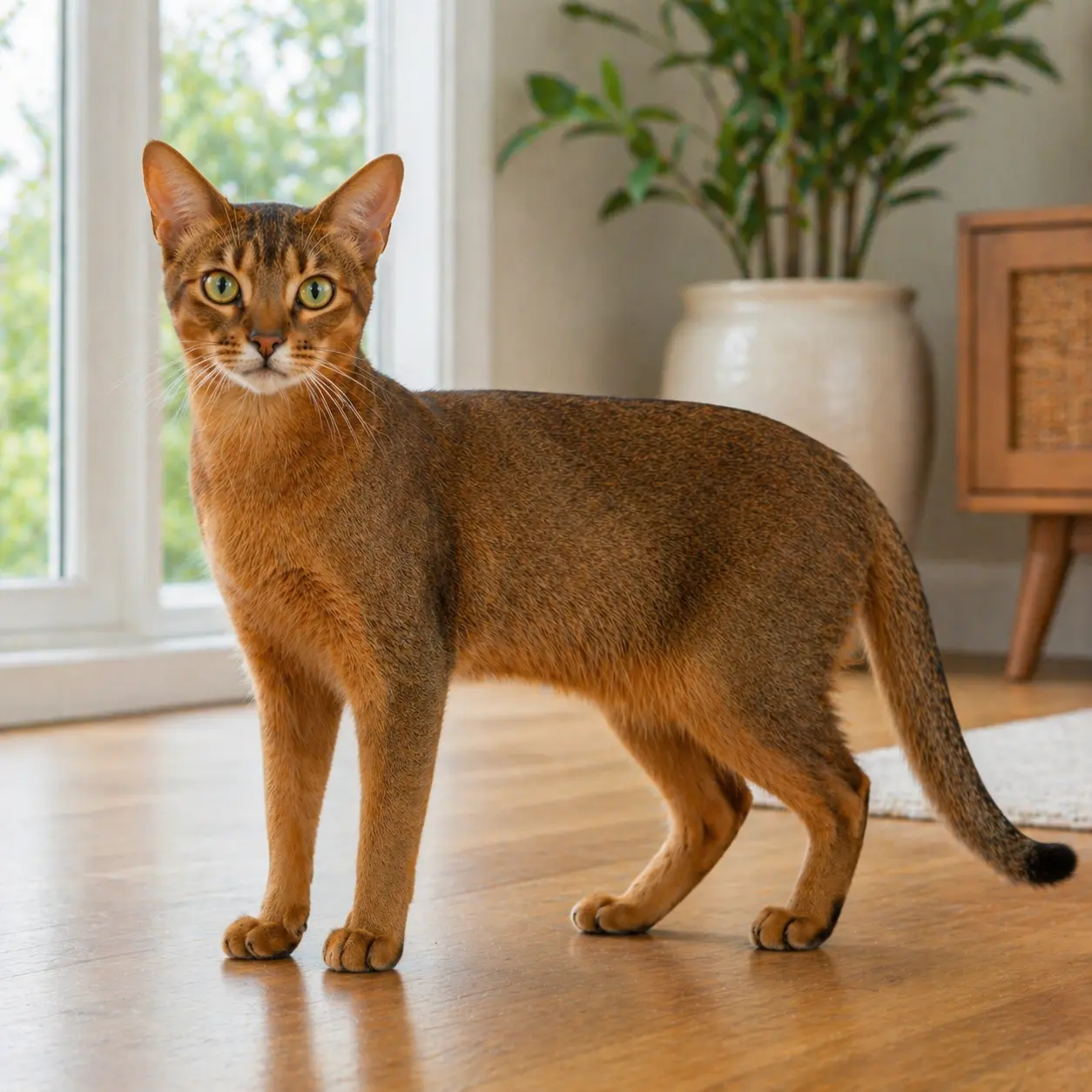
The ticked tabby is the least immediately recognizable pattern — and consequently the one most often misidentified or overlooked entirely. A ticked tabby shows no visible stripes or spots on the body. Instead, each individual hair carries alternating bands of lighter and darker pigment (called agouti banding). The result is a coat that appears uniformly warm and glowing — almost luminous — with a subtle depth that shifts in changing light.
The absence of bold markings is what confuses people. A ticked tabby does not look like what most people picture when they say "tabby." But it is — at the gene level — expressing the tabby pattern through the ticked allele at the tabby locus. The agouti gene is functioning; the individual hairs are banded; the tabby pattern is there. It simply expresses at the level of individual hairs rather than at the level of whole-body stripes or spots.
The Abyssinian is the breed most strongly associated with the ticked tabby pattern — it is the defining feature of the breed and what gives the Abyssinian its distinctive warm, shimmering appearance. The Somali (a longhaired Abyssinian variant) and the Singapura (which carries a ticked sepia pattern) also express this subtype.
Some ticked tabby cats show faint residual striping on the legs, tail, and face — particularly the M marking on the forehead — even when the body appears stripe-free. This is a normal expression of partial ticking and does not indicate a different pattern type.
| Tabby Subtype | Visual Description | Genetic Basis | Breed Association | ID Difficulty |
|---|---|---|---|---|
| Mackerel | Narrow parallel vertical stripes | Dominant allele (T) | Very widespread — most breeds and mixes | Easy to identify, low breed-diagnostic value |
| Classic | Wide swirling blotches, bullseye on flanks | Recessive allele (t) | British SH, American SH, Maine Coon | Easy to identify, moderate diagnostic value |
| Spotted | Stripes broken into discrete spots | Modifier gene breaks mackerel stripes | Bengal, Egyptian Mau, Ocicat | Moderate — requires distinguishing rosettes |
| Ticked | No body stripes — banded individual hairs | Ticked allele (Ta) — dominant over others | Abyssinian, Somali, Singapura | Often missed — easy once you know to look |
Cat Breeds That Commonly Express Tabby Patterns
One of the most useful reframings in cat breed identification is understanding that tabby is a descriptor that crosses breed lines — and knowing which breeds most strongly express which tabby subtypes gives you directional identification data that "it's just a tabby" entirely misses.
Breeds Defined by Their Tabby Expression
Some breeds are so strongly associated with a specific tabby pattern that the pattern is a breed-defining feature:
Abyssinian — ticked tabby is not just common in this breed; it is obligatory. Every Abyssinian has a ticked coat. A ticked cat with the lean, semi-foreign build, large ears, and warm ruddy or golden coloration of the Abyssinian is providing very strong breed signals through its tabby pattern alone.
Bengal — the spotted and marbled tabby patterns of the Bengal, combined with the rosette structure and potential glitter, are what make this breed visually unmistakable. The Bengal's tabby pattern is the primary identification tool for the breed — more reliable than body size alone.
Toyger — a developing breed explicitly designed around an exaggerated mackerel tabby pattern intended to evoke tiger stripes. The Toyger's markings are selected for width, boldness, and a circular/branching quality that distinguishes them from ordinary mackerel stripes.
Egyptian Mau — the only naturally spotted domestic breed (spots arising without the tabby modifier gene). The Egyptian Mau's spots are a breed-defining characteristic and one of the breed's primary registration requirements.
Breeds Where Tabby Is Common But Not Exclusive
Many major breeds appear in tabby variations alongside other coat expressions:
Maine Coon — appears in a very wide range of tabby expressions including mackerel, classic, and ticked, as well as solid and bicolor patterns. The Maine Coon's tabby expression does not help confirm the breed on its own — the ear tufts, square muzzle, and heavy body frame are more diagnostic.
British Shorthair — the classic silver tabby British Shorthair is iconic, but the breed appears in over 80 color and pattern combinations. Tabby pattern plus cobby build plus round head points toward British Shorthair; tabby pattern alone does not.
Norwegian Forest Cat — most commonly seen in brown mackerel tabby, a coat that accentuates the breed's substantial double-coat texture and contributes to its wild forest-cat appearance.
American Shorthair — the classic silver tabby is the breed's most photographed and recognized expression, though American Shorthairs appear in many other pattern and color combinations.
Domestic Shorthair / Domestic Longhair — these catch-all categories include the majority of tabby cats in homes and shelters worldwide. Most striped cats with no other strongly diagnostic features are domestic shorthairs expressing the tabby pattern through their general random-bred genetics.
The M Marking: What It Is and What It Is Not
The M marking on the forehead of tabby cats has accumulated an impressive number of myths — religious, folkloric, and practical. The reality is more prosaic but no less interesting.
The M is produced by the convergence of the tabby forehead stripes. All four tabby subtypes produce some version of the M marking, though it is clearest in mackerel and classic tabbies and sometimes reduced or absent in heavily ticked cats. The M is formed by:
- Two arching stripes above each eye that curve toward the center
- Lines running vertically from the forehead toward the nose
- The overall convergence of the striping pattern at the narrowing forehead geometry
The M marking has zero breed-diagnostic value. It appears in virtually every tabby cat of every breed and mix. It is caused by the tabby pattern interacting with the geometry of the cat's forehead — not by breed-specific genetics. If you are trying to identify a cat's breed, the M marking tells you only that the cat expresses a tabby pattern. Nothing more.
What does have diagnostic value is the forehead's broader striping pattern surrounding the M:
- Dense, clearly defined striping around the M — classic or mackerel tabby expression
- A clean, relatively unbroken M with minimal surrounding pattern — often appears in ticked cats, where body striping is suppressed but facial marking persists
- Bold M with spotted rather than striped surrounding marks — spotted tabby or Bengal territory
Tabby Colors: What the Color Tells You Separately from the Pattern
The tabby pattern and the tabby color are genetically independent. The same mackerel pattern can appear in brown, silver, blue, red (orange), cream, or several other color expressions — each produced by a different color gene operating on top of the tabby pattern gene.
Brown tabby — the most common expression. A warm brown to dark brown background with black or dark brown markings. Appears in virtually every breed and most mixed-breed cats.
Silver tabby — the inhibitor gene (I) prevents pigment from being deposited in the lighter portions of the coat, replacing the warm background with a bright silver-white. The dark markings remain, producing very high contrast. The silver tabby expression is strongly associated with the British Shorthair and American Shorthair but appears across many breeds.
Blue tabby — brown tabby modified by the dilute gene (dd), which softens black to blue-gray and transforms the warm background to a pale blue-gray. The markings remain distinct but in softer tones.
Red / orange tabby — caused by the orange gene (O) on the X chromosome. All red/orange cats are tabbies — the agouti suppression gene does not function fully on the orange/red pigment, so even cats that would otherwise be solid still show some tabby striping in the orange color. This is why orange cats always show some kind of tabby marking.
Cream tabby — dilute version of orange. The same rules apply — all cream cats show some tabby patterning.
Ticked tabby colors — the ticked pattern appears in ruddy (warm brown-orange), sorrel (warm red-brown), blue, fawn, and silver expressions, primarily in the Abyssinian.
The color provides additional identification data alongside the pattern. A ticked coat in a warm ruddy-golden tone strongly suggests Abyssinian. A spotted tabby in a high-contrast silver coloring with rosette structure strongly suggests Silver Bengal. A classic tabby in dense silver with bold black markings strongly suggests American Shorthair or British Shorthair.
Why "Tabby" Fails as a Breed Label
The specific problem with using "tabby" as a breed label — beyond the obvious genetic inaccuracy — is that it stops the identification process prematurely. Someone who decides their cat is "a tabby" and leaves it there has essentially given up on identification before it started.
A more useful approach: treat "tabby" as the starting gate, not the finish line.
Identifying the tabby subtype is the first useful step. Mackerel? Classic? Spotted? Ticked? Each subtype has different breed associations and different degrees of diagnostic value. A ticked tabby in a warm ruddy tone is a much more specific identification lead than "brown tabby" — it immediately points toward Abyssinian-family genetics.
The next step is combining the tabby subtype with the other physical features covered across this series — body type, head shape, eye characteristics, and ear structure. The tabby pattern does not carry breed identity by itself. But a specific tabby subtype combined with a specific body type and specific facial features starts to build a case.
The American Association of Feline Practitioners (AAFP) — the primary professional organization for veterinarians specializing in cats — notes in its feline wellness guidelines that coat pattern assessment is part of routine visual examination but is not used in isolation for breed identification in clinical settings. Veterinarians combine coat pattern with structural and behavioral assessment — exactly the layered approach that produces the most reliable identification outcomes.
For owners who want to apply this layered approach to their own cat, our guide to cat coat patterns and breed associations covers all pattern types — including tabby subtypes — in the context of the full pattern landscape. Understanding how tabby fits among pointed, ticked, bicolor, and solid patterns gives you the broader framework that makes any single pattern type more interpretable.
The physical identification process — combining coat pattern with body structure, facial features, and behavioral signals — is covered as a complete system in our physical features identification guide. Tabby pattern is one layer of that system, not the whole picture.
For owners who have identified a specific tabby subtype and want to cross-reference it against the breed profiles most likely to match, the complete domestic breed guide covers all 14 major pedigree breeds with their typical coat expressions.
If your cat's tabby pattern has ticking with no bold stripes, our Bengal identification guide and the rare breed guide both cover breeds where ticking or spotting is a defining feature — including Abyssinian, Singapura, and Bengal-family patterns.
We have put together an infographic that maps all four tabby pattern subtypes visually — showing the genetic basis, the visual description, and the breeds most associated with each — alongside a tabby color reference and a common identification mistakes section. Everything on this page in one saveable image.

Frequently Asked Questions
Tabby Cat Breed: What Breed Is My Tabby Cat Actually?
There is no breed called tabby — so the question needs reframing. Your cat's breed (or likely breed mix) is determined by physical features like body type, head shape, ear characteristics, and coat texture, alongside the specific tabby pattern subtype it expresses. A mackerel tabby with a cobby round head and plush coat points toward British Shorthair. A ticked tabby with a lean semi-foreign body and large ears points toward Abyssinian. The tabby label is the starting point — the other physical features are what lead to a breed answer.
Why Are All Orange Cats Tabbies?
Because the orange (red) pigment gene interferes with the suppression mechanism that normally produces solid-colored cats. The agouti suppression gene (which creates solid colors in other coat colors) does not function effectively over the orange/red pigment. As a result, all cats expressing the orange gene show some degree of tabby patterning — even cats that would otherwise be genetically solid show visible tabby markings in their orange areas. This is why you will never see a genuinely solid, non-patterned orange cat. All orange cats are tabbies by necessity.
What Is the Rarest Tabby Pattern?
The ticked tabby pattern is the least common in the general domestic cat population — primarily because it is so strongly associated with specific breeds (Abyssinian, Somali, Singapura) rather than appearing broadly across random-bred cats. Among random-bred cats, classic tabby is generally less common than mackerel because the classic allele is recessive. The spotted tabby is intermediate in frequency. Ticked, as a body pattern without visible stripes, is the least likely pattern to appear spontaneously in a cat with no Abyssinian or related-breed ancestry.
Can a Cat Be Both Tabby and Pointed?
Yes — this pattern is called a lynx point or tabby point. The pointing gene restricts pigment to the extremities (face, ears, paws, tail) while the tabby gene produces striping within those pointed areas. A lynx point Siamese, for example, has the cream or white body of a pointed cat but shows tabby stripes within the colored mask, ear backs, and tail. The Ragdoll also appears in lynx point variants. The tabby and pointed patterns operate at different gene loci and are entirely compatible with each other.
Does Tabby Pattern Affect a Cat's Personality?
No. Tabby pattern is a coat characteristic with no causal relationship to personality or temperament. The behavioral traits associated with specific breeds — Abyssinian energy, Bengal intelligence, Maine Coon sociability — exist independently of the tabby pattern. The fact that the Abyssinian is always ticked and highly active is a coincidence of breeding history, not a causal connection between the ticked pattern and high energy. Coat pattern is determined by genes on different chromosomes from the genes that influence behavioral traits.