Most cat owners stop at the identification. They find out their cat is probably a Maine Coon mix, or a likely Siamese cross, or a suspected Ragdoll — and that is where the process ends. A satisfying answer to a question they had been wondering about.
But the identification is not the destination. It is the beginning of something more useful: a care framework built on the specific genetic tendencies your cat carries rather than on generic advice that treats all cats as interchangeable.
A Maine Coon mix and a Siamese mix and a Persian mix are not the same cat in different packaging. They carry different health predispositions, different activity requirements, different grooming needs, and different behavioral patterns. Breed knowledge gives you the ability to anticipate these differences rather than react to them — which, in practical terms, means fewer health surprises, better-matched care, and a cat that lives more comfortably because its needs are understood rather than guessed at.
This is what breed identification is ultimately for.
Step One: Take Your Breed Hypothesis to Your Veterinarian
The first and most clinically important thing to do after identifying your cat's likely breed is to have that conversation with your vet.
This is not about presenting a certificate or proving anything. It is about giving your vet additional context that changes the health monitoring priorities for your specific cat. Breed hypotheses — even uncertain ones — are clinically useful because they shift the probability of specific conditions.
Say your cat shows features consistent with Maine Coon ancestry. You tell your vet. The vet does not need a pedigree to act on that information. They can note "probable Maine Coon ancestry" in the clinical record and schedule cardiac monitoring earlier than they would for a cat with no such indication. If your cat shows brachycephalic features, your vet can prioritize dental crowding assessment and respiratory function — again, without confirmed registration papers.
Bring the following to your vet conversation:
- Your breed identification result — whether from physical assessment, an AI tool, or a DNA test
- Any specific features that drove the identification (ear tufts, flat face, spotted coat, etc.)
- Behavioral observations that supported the hypothesis (water-seeking, vocalization patterns, activity level)
- Any DNA test results, if you have them
Your vet will calibrate how much clinical weight to give the hypothesis based on how strongly the features converge. A cat with five clearly converging Maine Coon signals warrants a different level of cardiac vigilance than a cat with one ambiguous signal.
Cat Breed Health Monitoring: What to Screen For and When
Breed knowledge translates directly into a health monitoring calendar. Each major breed family carries specific elevated risks — not certainties, but statistically meaningful elevations in risk that justify targeted screening.
Large-Breed Cats (Maine Coon, Ragdoll, Norwegian Forest Cat, Siberian)
Hypertrophic Cardiomyopathy (HCM) is the most significant concern for large-breed cats, particularly Maine Coons and Ragdolls. Both breeds carry identified genetic mutations associated with HCM. A cat suspected of carrying these genetics should have:
- A baseline cardiac ultrasound (echocardiogram) by age 2–3
- Annual or biannual cardiac screening from age 2 onward
- Immediate cardiac assessment if any respiratory symptoms appear — labored breathing, open-mouth breathing at rest, reduced exercise tolerance
HCM can be present without obvious symptoms for years before becoming clinically apparent. Screening catches it earlier, when management options are broader.
Joint health becomes relevant for large-framed cats as they age. A Maine Coon or Ragdoll male at 15+ lbs carries more mechanical load on its joints than a 7 lb Abyssinian. Monitor for:
- Reluctance to jump or changes in jumping height
- Stiffness after rest, particularly in the morning
- Changes in grooming behavior suggesting discomfort in reaching
Brachycephalic Cats (Persian, Exotic Shorthair, Himalayan)
Flat-faced cats have a cluster of structural considerations that require ongoing management rather than one-time screening:
Respiratory — brachycephalic cats have narrowed nostrils (stenotic nares), an elongated soft palate, and sometimes a narrowed trachea. These structural features limit airflow and become more significant under stress, heat, or during exercise. Any labored breathing in a brachycephalic cat warrants immediate veterinary attention. Snoring, chronic snuffling, and open-mouth breathing at rest are all signs that the airway anatomy needs assessment.
Dental — the compressed skull creates less space for the same number of teeth, resulting in crowding, abnormal alignment, and higher rates of periodontal disease. Dental X-rays and professional cleaning more frequently than the standard cat population — often annually from an early age.
Facial skin folds — the skin folds between the nose and eyes in severely flat-faced cats collect moisture and debris, creating conditions for bacterial and yeast skin infections. Daily cleaning of these folds is a care requirement, not an occasional task.
Eye health — large, forward-set eyes in brachycephalic cats are more exposed than in other breeds. They are prone to corneal ulceration from minor trauma and to epiphora (overflow tearing) due to abnormal tear duct drainage. Regular eye health monitoring is standard care.
Scottish Fold Cats
The cartilage mutation that creates the characteristic folded ear also affects cartilage throughout the body. This is not a theoretical risk — it is a documented, progressive condition called osteochondrodysplasia. Cats with two copies of the fold gene (fold-to-fold breeding) develop severe, painful joint disease. Even cats with one copy (fold-to-straight breeding) are at elevated risk and should be monitored.
Monitoring approach:
- Regular assessment of mobility, posture, and willingness to move
- Attention to tail flexibility — reduced tail mobility is often an early sign
- Veterinary joint assessment at least annually from age 2
- Radiography if stiffness or posture changes are observed
Siamese and Oriental Family Cats
Siamese-type cats carry an elevated risk for dental disease and progressive retinal atrophy (PRA) in some lines. They are also prone to stress-related conditions when their social and environmental needs are not met — which can manifest as:
- Psychogenic alopecia (stress-related over-grooming leading to hair loss)
- Digestive upset and inflammatory bowel conditions
- Behavioral changes that signal chronic stress rather than medical illness
For Siamese-type cats, the quality of the home environment — adequate stimulation, social interaction, predictable routine — is as much a health variable as the clinical screening schedule.
| Breed / Type | Primary Health Watch | Screening Start Age | Frequency |
|---|---|---|---|
| Maine Coon / Ragdoll | HCM — cardiac ultrasound | Age 2–3 | Annual or biannual |
| Persian / Exotic SH | PKD (DNA test) · Dental · Respiratory | As early as possible — PKD is genetic | Annual dental · Ongoing respiratory monitoring |
| Scottish Fold | Osteochondrodysplasia — joint assessment | Age 2 · earlier if symptoms appear | Annual radiography if indicated |
| Bengal | PRA · HCM variant | DNA test available — use it | Annual cardiac check from age 3 |
| Abyssinian | PRA · Renal amyloidosis | PRA DNA test · renal monitoring from age 5+ | Annual bloodwork including renal panel |
| Siamese family | Dental disease · Stress conditions | Annual dental from age 1–2 | Environmental assessment ongoing |
| Norwegian FC / Siberian | HCM · Glycogen storage disease | DNA testing available for GSD IV | Cardiac monitoring from age 3 |
Diet Adjustments Based on Breed
Generic cat food advice — "feed a high-quality complete diet" — is correct but incomplete once you know your cat's breed background. Breed influences metabolism, body composition, activity level, and specific nutritional needs in ways that are worth addressing specifically.
Large-Breed Cats and Weight Management
Maine Coons and Ragdolls are both large and slow-maturing — males of these breeds continue growing until age 3–4. During this extended growth phase, the temptation to restrict food to prevent weight gain can actually be counterproductive. These cats need adequate nutrition to support genuine muscle and bone development.
In adulthood, the risk flips. Large-framed cats with lower activity levels — a sedentary indoor Ragdoll, for example — are prone to obesity. The combination of large frame and weight gain significantly increases joint stress and compounds the cardiac risks already present in these breeds. A breed-appropriate diet for an adult Maine Coon or Ragdoll includes:
- High-quality protein as the primary macronutrient
- Portion-controlled feeding rather than free-choice
- Regular weight monitoring — weigh monthly and track trends
High-Activity Breeds and Caloric Needs
Bengals and Abyssinians have significantly higher metabolic rates than sedentary breeds. Free-feeding a Bengal or an Abyssinian produces a leaner, more muscular cat than the same approach with a Persian — because these cats burn more calories even at rest.
The practical implication: high-activity cats fed the same portion sizes as moderate-activity cats of similar weight may be underfed. If your Bengal or Abyssinian is lean, active, and consistently hungry, that is not necessarily a medical concern — it may simply be appropriate breed-typical metabolism requiring slightly higher caloric intake.
Brachycephalic Cats and Feeding Considerations
Persian and Exotic Shorthair cats face a practical feeding challenge: their flat face makes eating from a standard deep bowl difficult. The compressed muzzle creates limited clearance between the mouth and a standard bowl's sides and bottom.
Practical adjustments:
- Flat, wide, shallow feeding dishes — sometimes called "whisker-relief" dishes or simply wide flat plates
- Elevated feeding positions (raised bowls) reduce the angle required to reach food
- Monitor eating pace — brachycephalic cats sometimes eat faster than other breeds and may benefit from puzzle feeders to slow intake and reduce regurgitation
Cats with Breed-Specific Dietary Needs
Certain breed associations suggest specific nutritional attention:
Struvite and calcium oxalate urinary crystals are elevated in Persian lines and in some Ragdoll and Maine Coon cats. Feeding a diet that maintains appropriate urinary pH and provides adequate hydration reduces this risk. Wet food provides significantly more hydration than dry food and is worth prioritizing for cats with suspected breed-elevated urinary risk.
Coat condition for long-haired breeds benefits from adequate omega-3 fatty acid intake. Maine Coon and Norwegian Forest Cat coats — double-layered, heavy coats that shed significantly in spring — benefit from diets or supplements that support coat health and reduce inflammatory shedding responses.
Grooming and Physical Care by Breed
Breed knowledge makes grooming decisions specific rather than generic. The difference between a Persian's grooming needs and a Siamese's grooming needs is not a matter of degree — they are categorically different requirements.
Long-Haired Breeds (Persian, Ragdoll, Maine Coon, Norwegian Forest Cat)
Persian: Daily brushing is not optional — it is welfare. A Persian that goes ungroomed for more than two or three days will begin to mat. Mats tighten against the skin, cause pain, and can only be removed by professional grooming or shaving. The grooming commitment of a Persian is comparable to a high-maintenance dog breed in terms of time investment.
Ragdoll: The silkier texture of the Ragdoll coat resists matting better than a Persian coat. Twice to three times per week brushing is typically adequate. Pay particular attention to the underarm and groin areas where friction-related mats develop most readily.
Maine Coon and Norwegian Forest Cat: The double coat requires attention particularly during the spring shed — when the dense winter undercoat is released in large quantities over several weeks. Daily brushing during this period prevents mat formation in the undercoat and significantly reduces hairball volume.
Short-Haired Breeds
Weekly brushing removes loose hair and reduces shedding volume around the home. For double-coated short-haired cats (Russian Blue, British Shorthair), spring shedding periods benefit from twice-weekly brushing to manage undercoat release.
Rex-coated cats (Devon Rex, Cornish Rex) have such a short, fine coat that brushing can damage it. A gentle weekly wipe with a warm damp cloth is typically sufficient and preferred.
Enrichment and Environment by Breed Temperament
The behavioral tendencies that come with breed genetics have direct implications for how you set up your home and what activities you provide. Getting this right prevents behavioral problems that are frequently misidentified as personality issues but are actually unmet needs.
High-drive breeds (Bengal, Abyssinian, Siamese) require structured daily interactive play — not toys left on the floor, but actively operated wand toys, puzzle feeders, and training activities that engage their hunting drive and intelligence. A Bengal without daily structured stimulation does not become a calm cat. It becomes a destructive one.
Social breeds (Maine Coon, Ragdoll, Burmese) need company. For owners who work full days, a second cat — particularly a breed-compatible pairing — is worth considering seriously. A social cat left alone for ten hours consistently will develop stress-related behavioral or physical symptoms.
Independent breeds (Russian Blue, Norwegian Forest Cat, British Shorthair) manage better with solitude but still require adequate physical space and environmental complexity — cat trees, window perches, and multiple resting areas that allow the cat to engage with its environment on its own terms.
Brachycephalic breeds (Persian, Exotic Shorthair) are typically low-activity cats, but their breathing limitations mean that play activity needs to be gentle and never pushed to the point of open-mouth breathing. They are also sensitive to heat — homes should be kept cool during summer months, and these cats should never be left in hot cars or warm enclosed spaces.
When Breed Information Suggests Genetic Testing
For some breed hypotheses, the identification itself is the beginning of a conversation about DNA testing — not for identification purposes, but for health screening.
If your physical assessment or AI identification suggests Maine Coon, Ragdoll, Persian, or Bengal ancestry in a cat you plan to breed from, breed-specific DNA health tests are worth discussing with your veterinarian before any breeding decisions.
For pet owners (not breeders), DNA health testing adds the most value when:
- The breed hypothesis suggests a heritable condition for which a genetic test is available (PKD in Persian lines, HCM variants in Maine Coon and Ragdoll lines, PRA in Bengal lines)
- The test result would change your clinical monitoring approach — for example, a positive PKD test result immediately changes the renal monitoring schedule
- You want genetic certainty rather than probabilistic assessment based on visual features
The DNA guide at www.whatismycatbreed.com/cat-dna-testing covers which tests screen for which conditions and how to interpret results in partnership with your veterinarian.
Building a Breed-Informed Care Calendar
The most practical output of breed identification is a personalised care calendar — a schedule of health checks, grooming sessions, and monitoring activities tailored to your cat's specific breed background.
Here is a framework for building one:
Monthly:
- Weight check (particularly important for large-framed breeds and brachycephalic cats)
- Coat condition assessment — note changes
- Behavioral check — any changes in activity, appetite, litter use, or social behavior
Quarterly:
- Full physical check at home — joints, ears, eyes, teeth, coat, body condition score
- For brachycephalic cats: facial fold cleaning assessment
Annually (at minimum):
- Full veterinary wellness examination
- Dental assessment — professional cleaning if indicated
- Bloodwork including organ function panels for cats over age 7
- Cardiac assessment for breeds with elevated HCM risk
Breed-specific additions:
- Maine Coon / Ragdoll: cardiac ultrasound from age 2–3
- Persian / Exotic SH: PKD test if not yet done; dental X-rays annually
- Scottish Fold: joint radiography from age 2 if symptoms appear
- Bengal / Abyssinian: PRA genetic test; renal monitoring from age 5
The cat breed personality traits guide is worth revisiting with this care calendar in mind — behavioral changes are often the earliest indicators of underlying health issues, and knowing your breed's typical behavioral baseline makes deviations easier to spot.
The International Cat Care (iCatCare) organisation maintains the most comprehensive publicly available resources on breed-specific feline health, including detailed guides for owners of cats with specific breed backgrounds. Their health and welfare resources cover breed-specific conditions in plain language that complements what your veterinarian discusses in the clinic.
The homepage tool at www.whatismycatbreed.com remains available if you want to revisit your breed identification with additional photos or if your cat's features have become clearer as it has matured — younger cats in particular benefit from reassessment once the adult coat and bone structure have fully developed.
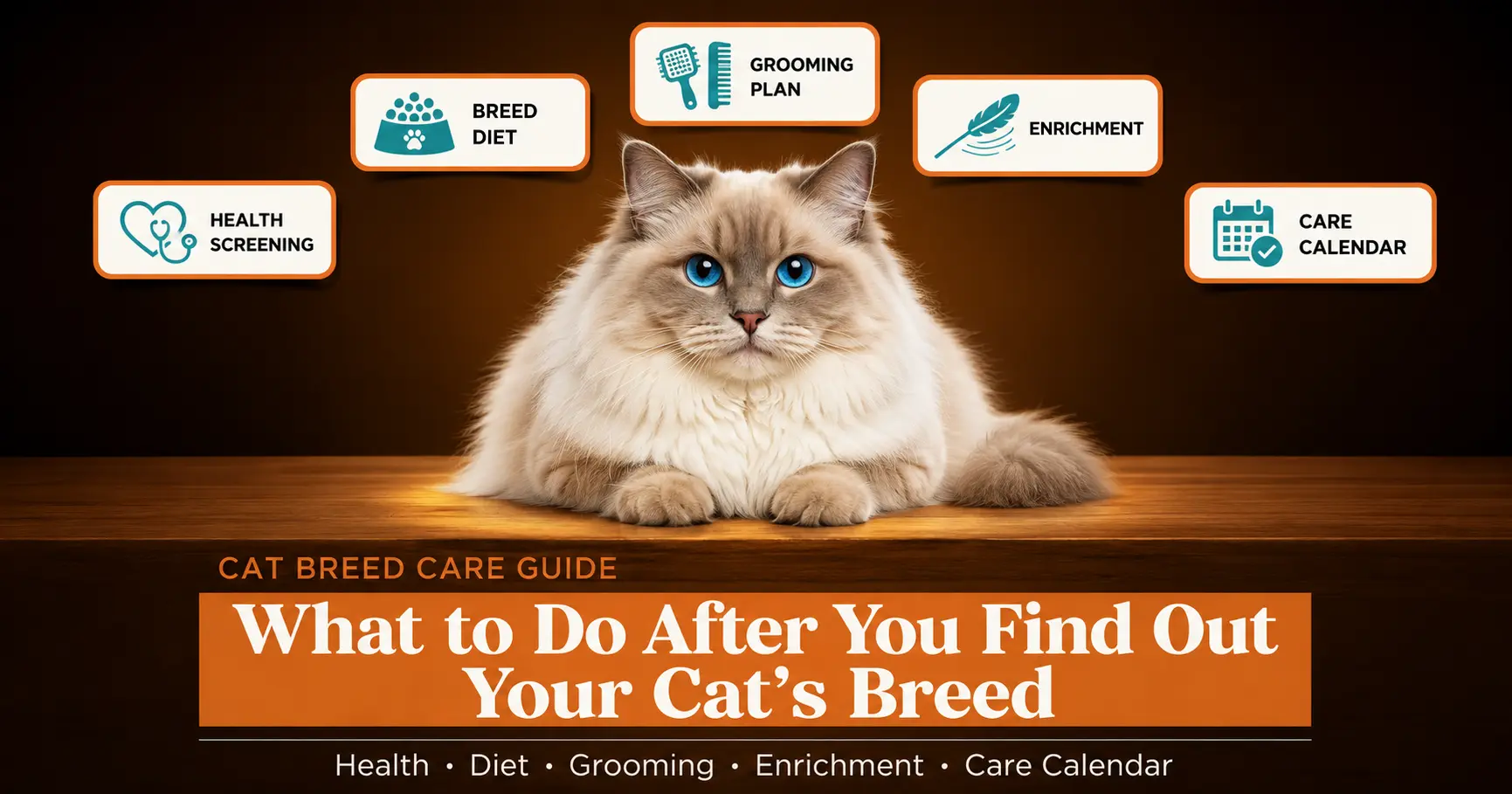
We have put together a visual infographic summarising all the breed-specific health monitoring priorities, diet adjustments, grooming schedules, and enrichment needs covered in this article — everything in one saveable reference chart you can pin to your fridge or share with your vet.

Frequently Asked Questions
What to Do After Identifying Cat Breed: Where Do I Start?
Start with your veterinarian. Breed knowledge is most valuable in a clinical context — it changes what gets screened for and when. Bring your identification result (physical assessment, AI tool result, or DNA test) and any specific physical or behavioral observations that supported it. Your vet will integrate that information into a health monitoring plan tailored to your cat's likely genetic background.
Cat Breed Health Risks: Are They Guaranteed?
No — breed-associated health risks are elevated probabilities, not certainties. A Maine Coon suspected mix that develops HCM has expressed a genetic predisposition. A Maine Coon mix that lives to age 18 with a healthy heart has benefited from the genetic lottery that goes in its favour. Screening is valuable precisely because it catches problems early when they are manageable — not because every cat of a given breed will inevitably develop the associated condition.
Does My Cat's Diet Need to Change Now That I Know Its Breed?
Possibly — particularly if the breed background suggests specific nutritional considerations. Brachycephalic cats benefit from wide, shallow feeding dishes. High-activity breeds may need slightly higher caloric intake than the standard guideline for their weight suggests. Cats with breed-elevated urinary risk benefit from wet food prioritisation. For most cats, the changes are refinements rather than overhauls — adjustments within a high-quality complete diet rather than a complete dietary restructure.
How Does Breed Knowledge Change Grooming?
Significantly for long-haired breeds — less so for short-haired ones. A Persian's grooming requirement is a welfare issue, not an aesthetic preference. Daily brushing prevents painful matting. For short-haired breeds, weekly brushing is typically sufficient with increased frequency during seasonal shedding. Rex-coated breeds need the least grooming of all and may actually be damaged by conventional brushing — a gentle damp cloth wipe is preferred.
Can I Use Breed Information to Better Understand My Cat's Behavior?
Absolutely — and this is one of the most immediately useful applications of breed knowledge. Understanding that a Siamese mix's persistent vocalization is breed-typical rather than a problem to solve changes how you respond to it. Understanding that a Russian Blue's initial aloofness with strangers is a stress response rather than unfriendliness allows you to manage introductions appropriately. Breed knowledge does not excuse behavioral issues — but it provides context that makes those behaviors interpretable and, in many cases, manageable through environmental adjustments rather than veterinary intervention.