Hold a Devon Rex kitten next to a British Shorthair kitten of the same age and look only at the ears. The Devon Rex carries ears so large they seem borrowed from a much bigger animal — wide-based, low-set, and angled outward like satellite dishes. The British Shorthair's ears are small, rounded, and set wide on a broad, domed skull. Both cats are sitting in front of you. Neither has declared its breed in words. But the ears already have.
Ear shape is one of the most genetically stable physical features a cat carries. Unlike coat color — which can vary enormously even within a single breed — the structure of the ear changes very little between individuals of the same breed. Size, set, angle, shape at the tip, and the presence or absence of furnishings all follow tight breed-specific patterns. Cat ear shape and breed are more closely linked than most owners realise, which makes the ears one of the first places worth looking when you want to narrow down a cat's background.
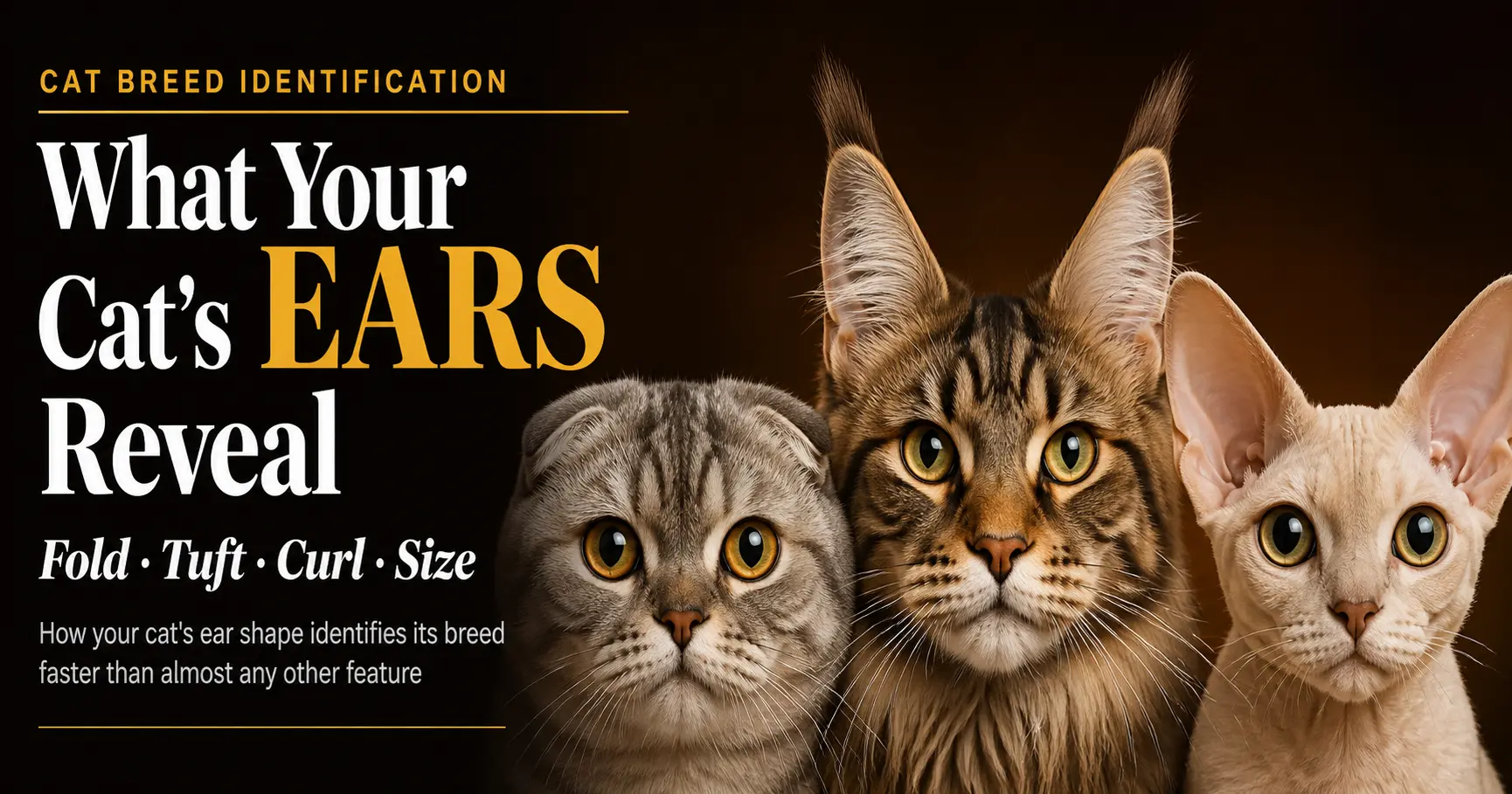
This isn't a subtle signal either. Ear differences between breeds are often dramatic enough to read from across a room — before you've assessed the face, the body, or the coat. The Scottish Fold's ears announce themselves immediately. So do the Abyssinian's, the Maine Coon's, and the Sphynx's.
This guide covers how to read ear shape systematically — which features carry the most information, which breeds each ear type points toward, and where ear assessment reaches its natural limit.
Cat Ear Anatomy: The Four Features That Carry Breed Information
The ear isn't a single thing to assess — it's four distinct features, each carrying its own breed signal. Reading all four together produces a far more reliable result than looking at the ear as a whole.
Ear set is the position of the ear base on the skull — high, medium, or low — and the angle at which the ears sit relative to each other. High-set ears angle toward the top of the skull and often tilt slightly inward. Low-set ears sit further down the sides of the head and angle outward. This feature is visible at four to six weeks in kittens and remains stable throughout life. It is one of the earliest reliable breed signals available on a young cat.
Ear base width describes how wide the ear is at the point where it meets the skull. Some breeds carry a very wide base that occupies most of the side of the skull — Devon Rex and Savannah cats both show this dramatically. Others carry a narrow, refined base that sits more modestly on the head — the Siamese and Oriental Shorthair are textbook examples. Base width correlates tightly with overall head shape: wider skulls tend to carry wider-based ears, and narrower skulls carry narrower ones.
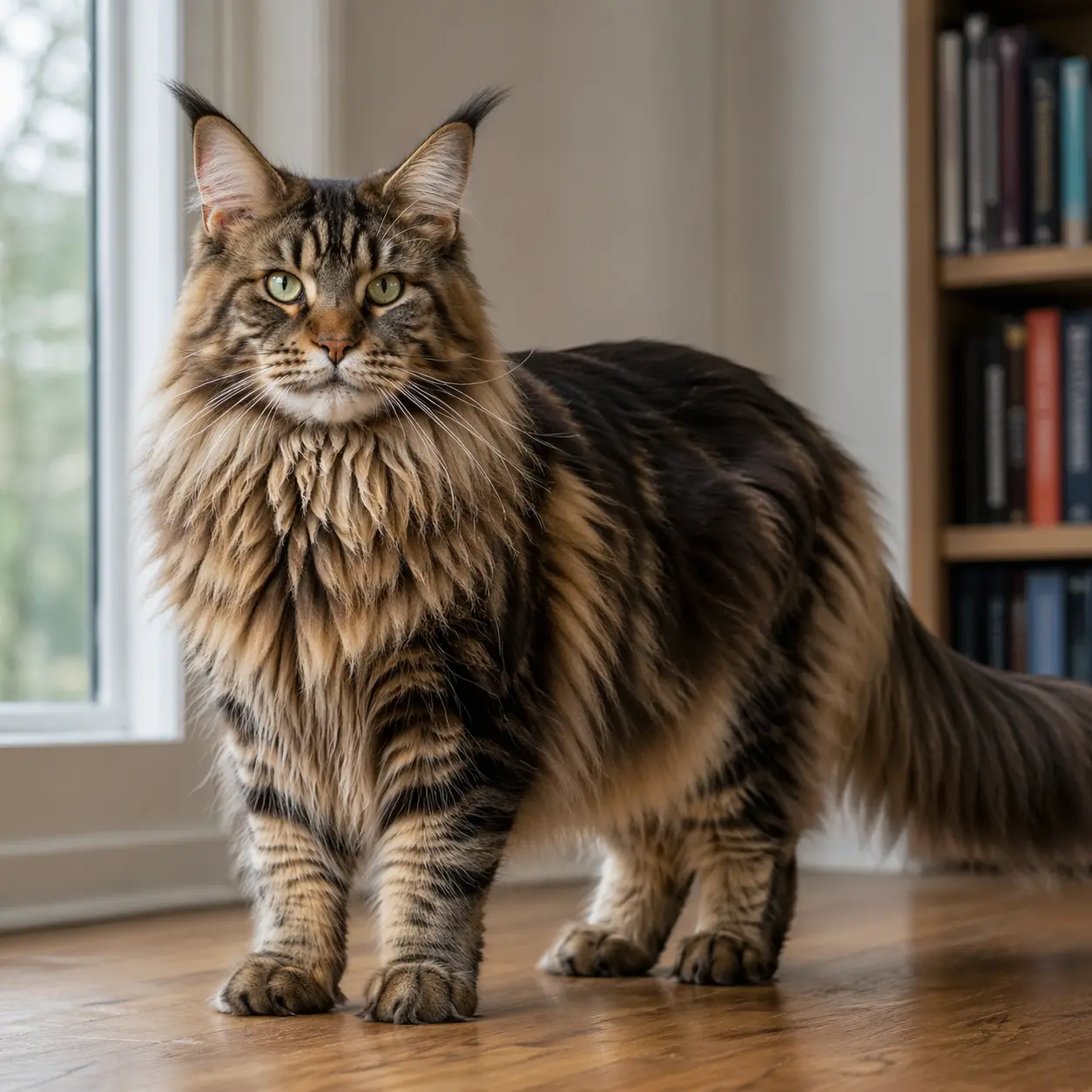
Ear shape at the tip ranges from sharply pointed to fully rounded. Pointed tips associate with active, lean-built breeds — Abyssinian, Oriental Shorthair, Siamese, Bengal. Rounded tips associate with heavier, more cobby breeds — British Shorthair, Persian, Scottish Fold (when unfolded). The Maine Coon sits in a category of its own: a moderately pointed tip with distinctive tufting above it — the lynx tip — that no other common breed replicates precisely.
Furnishings — the hair growing inside the ear and above the tip — divide immediately into three categories: absent, moderate, or pronounced. Shorthaired and Oriental breeds typically carry no visible ear furnishings. Semi-longhaired breeds like the Maine Coon and Norwegian Forest Cat carry dense inner ear tufts and visible lynx tips. The presence of pronounced ear furnishings in a shorthaired cat is a significant mixed-ancestry signal worth noting.
Ear Set as a First-Pass Filter
Before examining any other ear feature, ear set alone eliminates large breed categories quickly. This makes it the most efficient starting point in any ear-based breed assessment.
High-set ears with a slight inward lean associate directly with Oriental-type breeds. The Siamese, Oriental Shorthair, Abyssinian, and Burmese all carry their ears high on the skull, angled slightly toward each other at the top. From the front, this gives the face a pointed, alert, almost triangular quality. My own cat has this exact ear set — high, slightly forward-angled, and alert-looking even when she's half asleep on the radiator. It's one of the features that made me suspect Oriental ancestry well before anything else confirmed it.
Wide-set ears with medium height point toward the substantial, rounder-headed breeds — British Shorthair, Persian, Exotic Shorthair, Ragdoll, and Birman. These ears don't angle inward. They sit wide and apart, which emphasises the rounded dome of the skull. In profile, they often appear almost flat against the top of the head rather than dramatically upright.
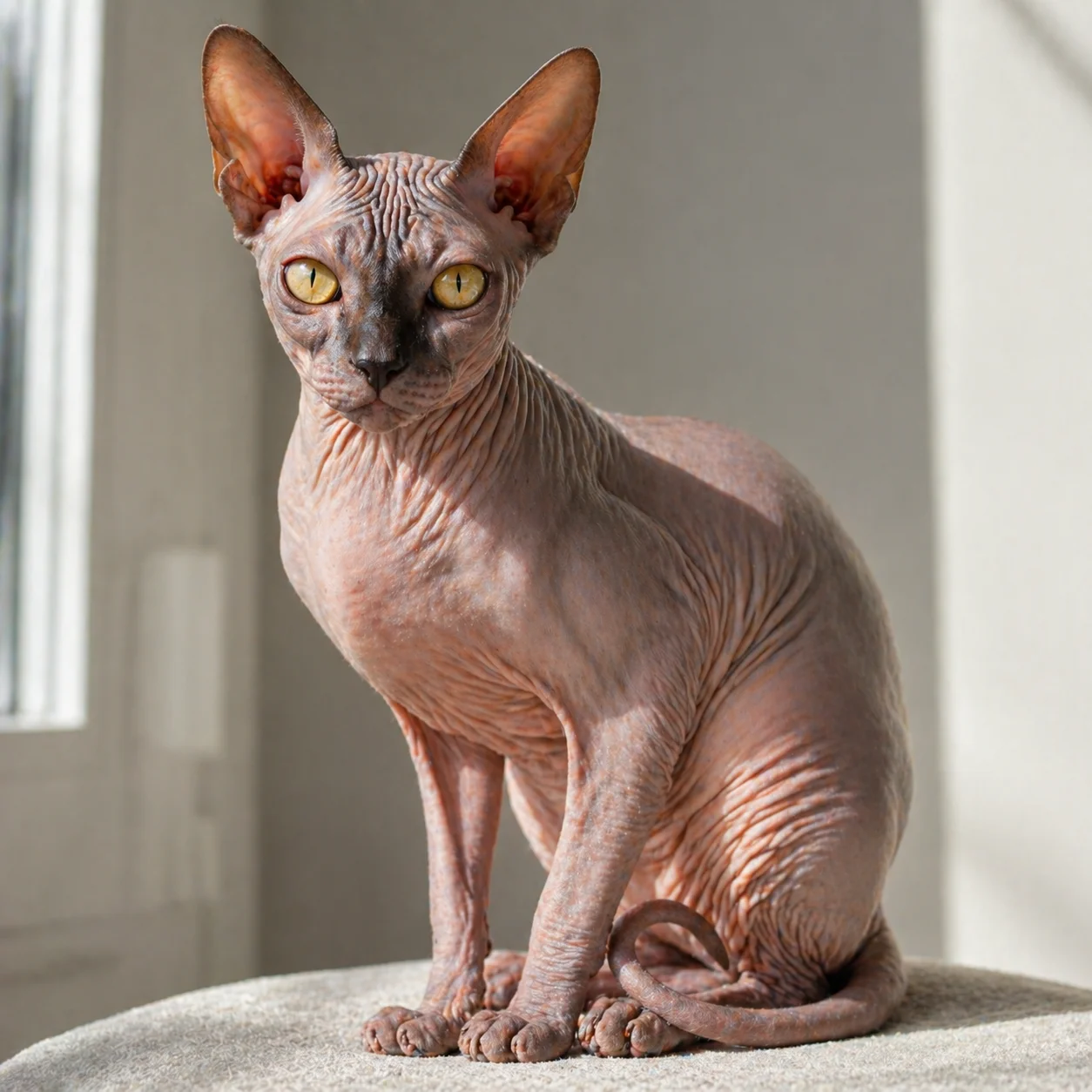
Low-set, dramatically large ears that angle outward belong to a short, specific list: Devon Rex, Sphynx, and — at the extreme end — Savannah cats. These ears are not just large; they are positioned lower on the skull and angled outward, which creates the wide-eyed, slightly alien appearance these breeds are known for. This ear set is functionally unmistakeable once you have seen it.
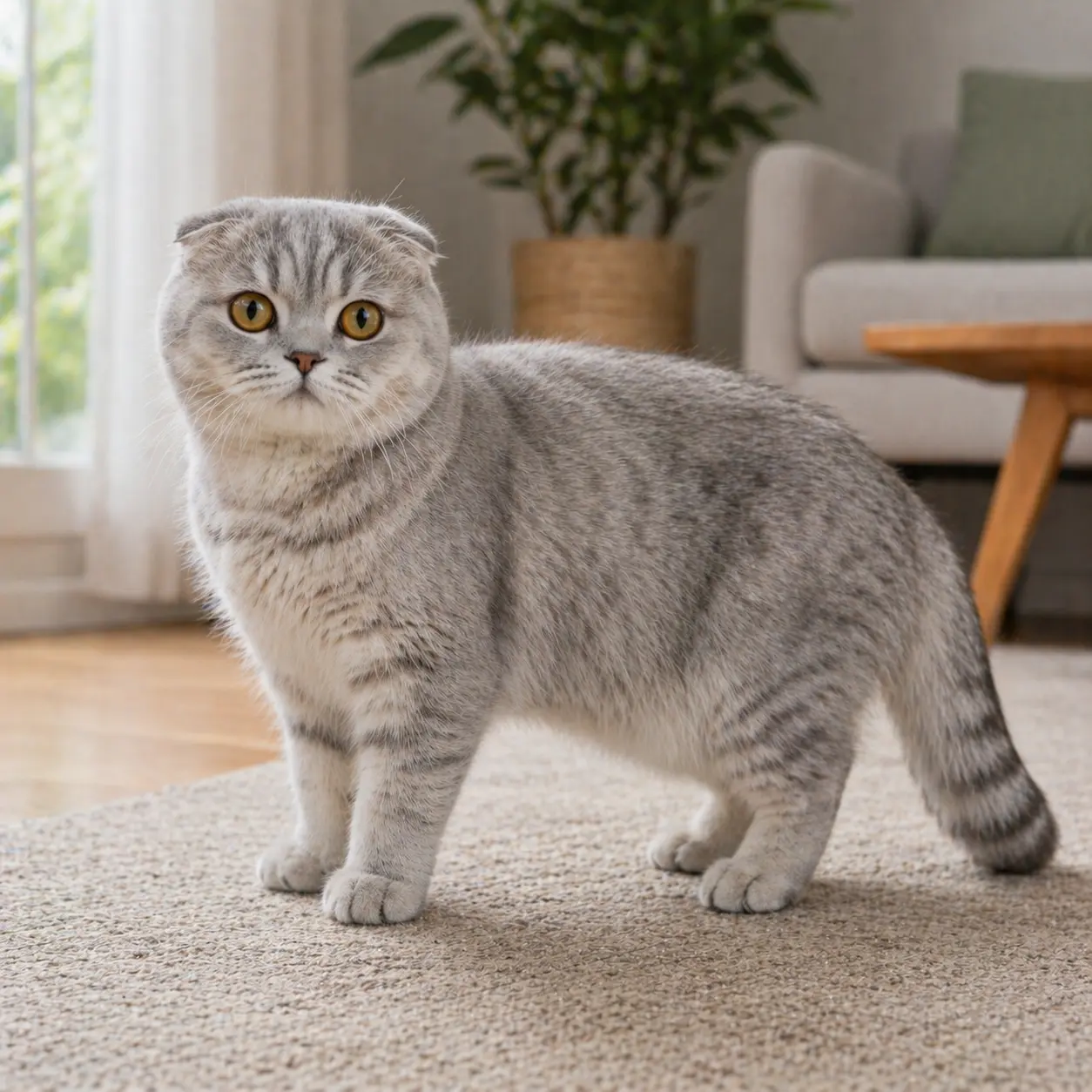
Folded ears — where the cartilage bends the ear tip downward and forward — narrow the field to two breeds immediately: the Scottish Fold and the American Fold (an uncommon variant). No other established breed produces a natural forward fold. If the fold is present, the breed identification narrows substantially before any other feature is examined.
Ear set is the single fastest breed filter available. In under five seconds, it sorts a cat into one of four broad ear-set categories — each of which points to a completely different set of possible breeds.
The Folded Ear: Scottish Fold and the Cartilage Mutation
The Scottish Fold's folded ear is arguably the most recognisable ear shape in domestic cat breeding — and it comes with a genetic story that matters beyond identification.
The fold itself results from a dominant mutation in the TRPV4 gene, which disrupts normal cartilage development. The ear cartilage fails to maintain its upright structure, causing the ear tip to fold forward and downward toward the face. The degree of fold varies: some cats show a single fold with a slightly bent tip; others show a tight double or triple fold where the ear lies almost flat against the skull. The tighter the fold, the closer the ear sits to the head.
A Scottish Fold kitten is not born with folded ears. All kittens are born with straight ears. The fold develops between three and four weeks of age as the cartilage settles. This means you cannot assess a Scottish Fold kitten's ears at birth — you wait for the fold to appear or confirm its absence. Kittens from Scottish Fold parents that do not develop a fold are called Straights and carry significant breeding value.
The American Curl produces the opposite mutation: ears that curl backward and outward rather than forward. The curl ranges from a slight arc to a dramatic backward sweep that exposes the inner ear fully. Like the Scottish Fold, the curl develops after birth — typically appearing by four months. Unlike the Scottish Fold mutation, the American Curl's cartilage mutation does not carry the same systemic health concerns at the heterozygous level.
The American Veterinary Medical Association has raised ongoing concerns about the Scottish Fold's cartilage mutation — noting that the same gene responsible for the fold also affects cartilage throughout the body, which can cause painful joint conditions (osteochondrodysplasia) in affected cats, particularly those carrying two copies of the mutation. This health context is worth knowing when the fold appears in an unidentified cat — it informs the welfare conversation, not just the breed identification one.
Large, Dramatic Ears: The Breeds That Lead With Them
Several breeds carry ears so visually dominant that the ears function as the primary identifying feature — before body type, coat, or face shape have been assessed.
The Devon Rex carries ears that appear genuinely enormous relative to the size of the skull. They are wide at the base, positioned low on the sides of the head, and angled outward — giving the face a bat-like quality that is immediately distinctive. The inner ear often shows sparse, fine furnishings that match the Devon Rex's rippled, sparse coat texture. At six weeks, a Devon Rex kitten's ears already look disproportionately large for the head. That proportion holds throughout life and flags the breed before any other assessment is needed.
The Sphynx carries similarly oversized, wide-based ears — but without the dramatic outer coat that would soften them, the ears appear even more pronounced. The naked, wrinkled skin of the Sphynx ear shows the full structure of the pinna without any fur obscuring the base width or the angling. On a Sphynx, the ears look almost architectural. Any cat with very large, very wide-based, outward-angled ears combined with a hairless or near-hairless coat points immediately and uniquely to this breed.
The Savannah — a hybrid breed crossed with the Serval — carries large, upright, wide-based ears that sit high on the skull with a notably wide ear base. The inner ear often shows a pale marking on the back of the ear called an ocelli — a light spot surrounded by darker fur that mimics the eye-spot markings of the Serval. The ocelli is essentially breed-specific to Savannahs among domestic cats and functions as a confirming marker when large ear size has already flagged the breed as a candidate.
The Oriental Shorthair and Siamese carry large ears for different reasons. These breeds' ears are large in proportion to the head, but the head itself is narrow and wedge-shaped — so the ears appear large relative to the face even though they are not as wide-based as the Devon Rex or Sphynx. The difference: Devon Rex and Sphynx ears look large because of an exceptionally wide base. Oriental Shorthair and Siamese ears look large because the face around them is narrow. That structural distinction separates two different categories of "large ears" clearly.
Small, Rounded Ears: The Cobby-Breed Signature
Where large, prominent ears signal lean, active, or extreme-type breeds, small rounded ears consistently point toward heavier-bodied, cobby breeds.
The British Shorthair carries small to medium ears with distinctly rounded tips and wide spacing on a broad, domed skull. The ears are not dramatically upright — they sit with a slight outward tilt rather than pointing straight up. Paired with the broad, flat-topped head and round, wide-set eyes, the ear reads as a deliberate design choice: nothing angular, nothing sharp, nothing that breaks the overall round quality of the face.
The Persian takes this further. Persian ears are small, wide-set, and almost hidden in the dense, long coat that frames the face. The tips are rounded. The set is low enough that the ears barely register as prominent features at all — the flat face, the round skull, and the eye-filling coat dominate the visual impression. If you struggle to locate the ears clearly on a heavily coated, flat-faced cat, you are almost certainly looking at a Persian or Exotic Shorthair.
The Ragdoll and Birman sit between the wide-eared Oriental types and the small-eared cobby types — medium ears, moderately wide-set, with slightly forward tilt. Neither dramatic nor hidden. This middle ground is actually a useful identifying marker for both breeds: ears that are proportional, slightly forward-tilting, and set at roughly the width of the eye spread.
| Breed | Ear size | Ear set | Tip shape | Furnishings |
|---|---|---|---|---|
| Devon Rex | Very large | Low, wide, outward angle | Rounded | Sparse, fine |
| Sphynx | Very large | High, wide base, upright | Rounded | None |
| Siamese | Large | High, angled inward at top | Pointed | None to minimal |
| Abyssinian | Large | High, wide base, upright | Pointed | Minimal inner tufting |
| Maine Coon | Medium-large | High, wide base | Pointed with lynx tip | Dense — lynx tips + inner tufts |
| Norwegian Forest Cat | Medium-large | Wide, upright | Pointed | Dense inner tufts |
| Scottish Fold | Small-medium | Folded forward and down | Rounded (folded) | None to minimal |
| American Curl | Medium | Curled backward and outward | Rounded | Tufted inner ear |
| British Shorthair | Small-medium | Wide-set, slight outward tilt | Rounded | None |
| Persian | Small | Wide-set, low, hidden in coat | Rounded | None visible |
| Bengal | Medium | Wide base, slight forward tilt | Rounded with slight point | Minimal |
| Turkish Van | Medium-large | Wide-set, upright | Pointed | Moderate inner tufting |
| Burmese | Medium | Wide-set, forward tilt | Rounded | None |
Ear Furnishings: Tufts, Lynx Tips, and What They Indicate
Ear furnishings — the hair growing inside the ear canal and extending above the ear tip — provide a secondary layer of breed information on top of shape and set. They are particularly useful for distinguishing between breeds whose ear shape is otherwise similar.
Lynx tips are the tufts of hair that extend beyond the pointed ear tip itself, pointing further upward. The Maine Coon's lynx tips are the most recognisable version — dense, prominent, and clearly visible from across a room on a fully grown adult. The Norwegian Forest Cat also carries lynx tips, though typically less dramatic than the Maine Coon's. The Siberian carries them too. If you are trying to separate a young Maine Coon from a Norwegian Forest Cat — which is genuinely difficult — the lynx tip density and the overall ear set are among the more useful distinguishing features, though head shape remains the most reliable separator between these two breeds.
Inner ear tufts are dense tufts of fur growing from inside the ear canal, often visible as a plume of hair curling outward when viewed from the front. These appear in both Maine Coons and Norwegian Forest Cats, as well as in the Turkish Van and several other semi-longhaired breeds. They are entirely absent in shorthaired Oriental breeds and in most British Shorthairs. Their presence on a shorthaired or mixed-coat cat is a notable signal pointing toward semi-longhaired breed ancestry.
No furnishings at all is the baseline for most shorthaired breeds — Siamese, British Shorthair, Bengal, Abyssinian, Burmese, and Sphynx (for obvious anatomical reasons). A cat with clearly shorthaired coat that shows pronounced inner ear tufts or visible lynx tips is showing a physical inconsistency worth noting — it often signals a mixed background where one parent contributed semi-longhaired breed genetics.
The TICA breed standards specify ear furnishing requirements for longhaired and semi-longhaired breeds explicitly — treating tufting density as a measurable conformation point rather than a cosmetic preference. That specificity underlines how genetically reliable furnishing patterns are within established breed lines.
Breed Identification by Cat Ear Shape: Reading the Full Picture
Ears carry reliable breed information — but they perform best as part of a complete physical assessment rather than as a standalone identifier.
The cases where ear shape alone closes the identification are specific: a folded ear confirms Scottish Fold immediately. A curled-back ear confirms American Curl. A massive, wide-based, outward-angled ear on a hairless cat confirms Sphynx. These are breed-exclusive features with no realistic alternative explanation.
For most other breeds, ear shape narrows the field to a category of three to five possibilities. Those candidates then need support from head shape, body type, coat texture, and tail — the same multi-feature approach that produces reliable breed reads consistently. Our guide on identifying cat breed by tail shape and structure covers how tail signals complement ear assessment to produce a faster, more confident result when used together.
The most common error in ear-based identification is confusing ear size caused by a wide skull with ear size caused by a genuinely oversized ear. A Persian on a narrow-skull mixed cat produces apparent ear prominence purely by proportion — not by genuine ear size. Measure the base width against the skull width to separate these cases. A genuinely large ear has a wide base that occupies most of the lateral skull surface. A proportionally prominent ear on a narrow skull looks large but has a narrow base relative to the skull width.
For mixed-breed cats showing contradictory ear signals — one feature pointing toward an Oriental breed and another pointing toward a cobby breed — our mixed breed cat identification guide covers how to interpret physical inconsistencies as data rather than treating them as identification failures.
If you want to work through your cat's ear features systematically alongside other physical signals, the breed identification quiz walks you through each feature zone with scoring that accounts for how features interact — which produces a more accurate result than assessing ears in isolation.
Frequently Asked Questions
Cat ear shape and breed: which ear feature is the most reliable identifier?
Ear set — the position and angle of the ear on the skull — is the most consistently reliable single feature. It appears early in kittens, remains stable throughout life, and immediately sorts a cat into one of four broad categories: high-set inward (Oriental breeds), wide-set medium height (cobby breeds), low-set outward (Devon Rex, Sphynx type), or structurally modified (Scottish Fold, American Curl). Each category points to a completely different group of possible breeds, making ear set the fastest first filter in any ear-based breed assessment.
Breed identification by ear: can folded ears appear in cats that aren't Scottish Folds?
Naturally folded ears — where the cartilage genuinely fails and the ear tip drops forward — are essentially exclusive to the Scottish Fold and its longhaired variant, the Highland Fold. Ears that tilt slightly forward without a true fold appear in several breeds, including the Burmese and some domestic mixed-breed cats, but these lack the distinctive downward cartilage collapse of a true fold. If the ear tip bends forward and downward as a permanent structural feature rather than sitting at a mild forward angle, Scottish Fold ancestry is the realistic explanation in the vast majority of cases.
Do cat ears change shape as a kitten grows into an adult?
The fundamental structure — set, base width, tip shape — establishes itself early and holds relatively constant from around eight to twelve weeks onward. Ear size does scale slightly as the skull grows, but the proportional relationship between ear and skull stays consistent. The one significant exception is the Scottish Fold: kittens are born with straight ears that fold between three and four weeks of age, and the degree of fold can tighten slightly through the first few months. For all other breeds, what you observe at eight weeks is a reliable preview of the adult ear.
What do very large ears on a mixed-breed cat suggest about its ancestry?
Very large, wide-based ears on a mixed-breed cat most commonly suggest Oriental breed ancestry — Siamese, Oriental Shorthair, or Abyssinian lines are the most likely contributors in Western domestic cat populations. Devon Rex ancestry is also a realistic candidate if the ears are positioned low and angled outward rather than upright. Large ears without these structural specifics — simply prominent relative to a narrow face — may reflect proportional genetics rather than any specific breed contribution. Ear size is most informative when combined with the set angle and base width rather than assessed as a single measurement.
How do I tell a Maine Coon's ears apart from a Norwegian Forest Cat's ears?
Both breeds carry large, wide-based ears with pointed tips, dense inner tufts, and visible lynx tips — the ear profiles are genuinely similar. The Maine Coon typically shows more dramatic lynx tip development: longer, denser tufts extending further above the ear tip. The Norwegian Forest Cat's ear tufts tend to be slightly less pronounced, with a more even distribution of inner furnishings. The more reliable separator between these two breeds is head shape: the Maine Coon develops a distinctly rectangular skull with a prominent squared muzzle, while the Norwegian Forest Cat carries a more triangular head with a straighter nose profile. Our guide on identifying cat breed by physical features covers how combining ear, head, and body signals produces a more accurate read than any single feature can deliver on its own.