The Russian Blue has green eyes. Not blue. Not copper. Not the vivid aqua that many owners expect from a breed named after a colour. Deep, gooseberry green — a shade so specific that it functions as a breed standard requirement. Most people hearing this for the first time pause and reconsider everything they assumed about cat eye colour and what it means.
That pause is exactly the right response. Cat eye color and breed genetics are closely linked — but the relationship is more specific, more conditional, and more counterintuitive than most cat owners expect. Eye color alone narrows the field. It rarely closes the identification. And in kittens under four months, it tells you almost nothing useful at all — every kitten, regardless of what breed it will grow into, enters the world with blue eyes.
Eye shape is actually the stronger breed signal of the two, and it is consistently overlooked in favour of colour. The combination of eye colour, eye shape, and eye placement on the skull produces a reliable breed read in a way that colour alone simply cannot.
This guide covers all three — and is honest about which eye features
carry genuine breed information versus which ones get overread.
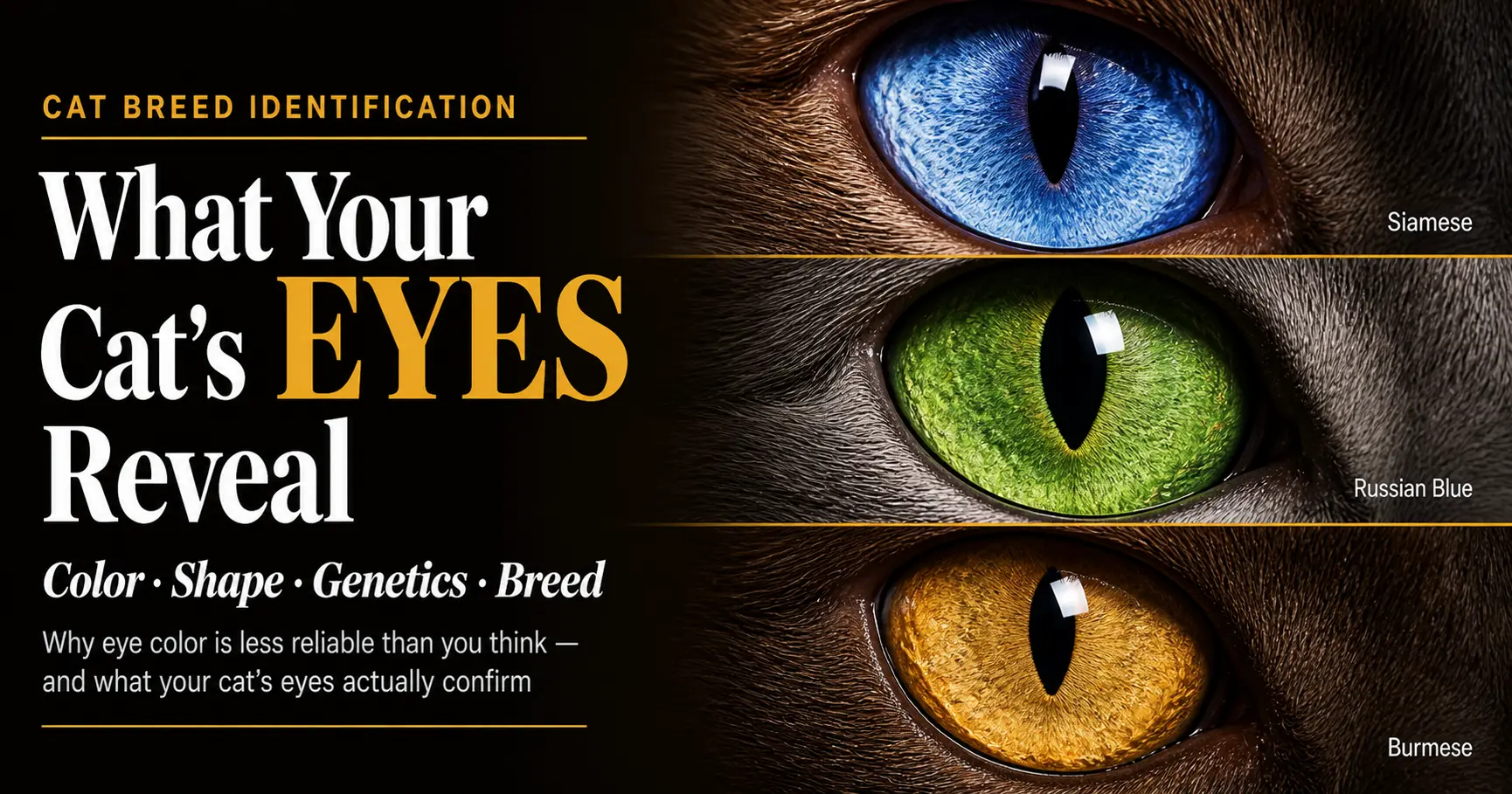
Cat Eye Color: How Genetics and Melanin Actually Work
Eye colour in cats works through a single mechanism: melanin. More melanin in the iris produces darker colours — deep copper, rich orange, warm gold. Less melanin produces lighter colours — hazel, green, yellow. No melanin at all produces blue eyes — not through blue pigment, but through light scattering in the unpigmented iris. The same physics that makes the sky blue makes a cat's eyes blue.
This single-mechanism system has a direct practical consequence for breed identification. All kittens are born with blue eyes because melanin production in the iris doesn't begin at birth — it develops over the first weeks and months of life. The OCA2 gene, which controls melanin production in the eye, activates progressively. By twelve to sixteen weeks in most breeds, the adult eye colour has largely settled. Before that point, blue eyes on a kitten carry no breed information whatsoever.
I watched my own cat's eyes shift through three distinct stages — a pale grey-blue at six weeks, a murky greenish-yellow at ten weeks, and then a settled warm amber by five months. At no point in that process did the intermediate colours predict the final result. Anyone who assessed her breed from eye colour at eight weeks would have reached a wrong conclusion.
Melanin distribution also explains why some cats show multiple colours within a single iris — the dichromatic eye, where the inner iris shows one colour and the outer iris shows another. This appears most visibly in breeds with high melanin variability, including the Maine Coon and some domestic longhaired mixes. It is not a breed-exclusive feature, but it is worth noting as a signal of genetic complexity in the eye colour development process.
The tapetum lucidum — the reflective layer behind the retina that produces eyeshine in photographs — affects how eye colour appears in different lighting conditions. A cat whose eyes look amber indoors may show a more vivid copper in daylight. Assess eye colour in consistent natural lighting, not flash photography, for the most accurate read.
Eye Colour by Breed — Reading the Full Spectrum
Each eye colour region associates with a specific set of breeds — not exclusively, but reliably enough to function as a narrowing filter.
Deep copper and orange represent the highest melanin end of the spectrum. The British Shorthair standard requires copper to gold eyes in most colour variants — the deep orange eye against a blue-grey coat is one of the most visually striking breed combinations in domestic cats. The Persian carries similar copper to deep gold eye colour across most coat variants. The Scottish Fold shows copper to gold eyes. In all three breeds, the deep copper eye associates with a cobby, heavily built body type — a useful cross-check.
Gold and yellow occupy the middle-high melanin range. The Burmese produces some of the most consistently vivid gold eyes of any breed — a bright, warm yellow-gold that owners describe as almost luminous. The Bengal typically shows gold, hazel, or green eyes depending on coat colour; spotted Bengals more frequently carry gold or hazel, while snow Bengals often carry blue or aqua. The Abyssinian shows rich gold to green eyes, with the colour varying somewhat between individuals.
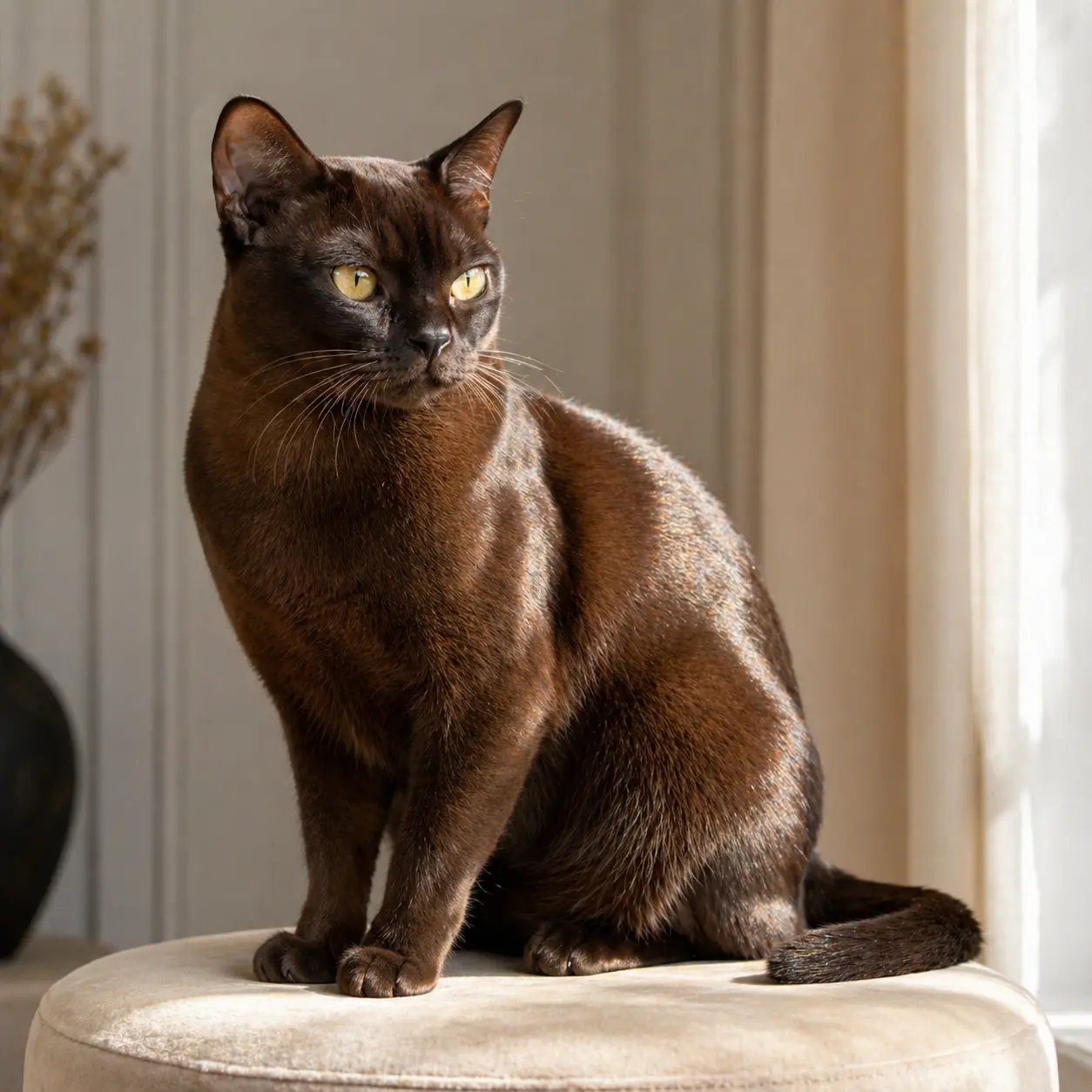
Green eyes occupy the lower-melanin range — still pigmented, but with less melanin density than gold or copper. The Russian Blue's vivid gooseberry green is breed-standard-specific — not just any green, but a particular rich, saturated shade. Ask any Russian Blue owner to describe their cat's eyes and the word they reach for most often is "startling." The green is that specific. The Abyssinian ranges from gold into green in some lines. The Norwegian Forest Cat commonly shows green to gold. The Sphynx shows a wide range of eye colours including green, which is relatively uncommon in many other breeds.
Blue eyes in adult cats narrow to a specific genetic explanation: the presence of the colorpoint gene (the gene responsible for the Siamese-type point pattern) or the white spotting gene in cats carrying significant white coat areas. The colorpoint gene works through a temperature-sensitive enzyme called tyrosinase, which restricts melanin production in warmer body regions — including the iris. The result is an iris with very low melanin, producing blue eyes regardless of what other colour genes the cat carries.
This means blue eyes in an adult cat point immediately toward one of two backgrounds: a colorpoint breed (Siamese, Ragdoll, Birman, Snowshoe, Balinese, Colorpoint Shorthair), or a cat carrying significant white coat genetics. A non-white cat with vivid blue adult eyes almost certainly carries the colorpoint gene.
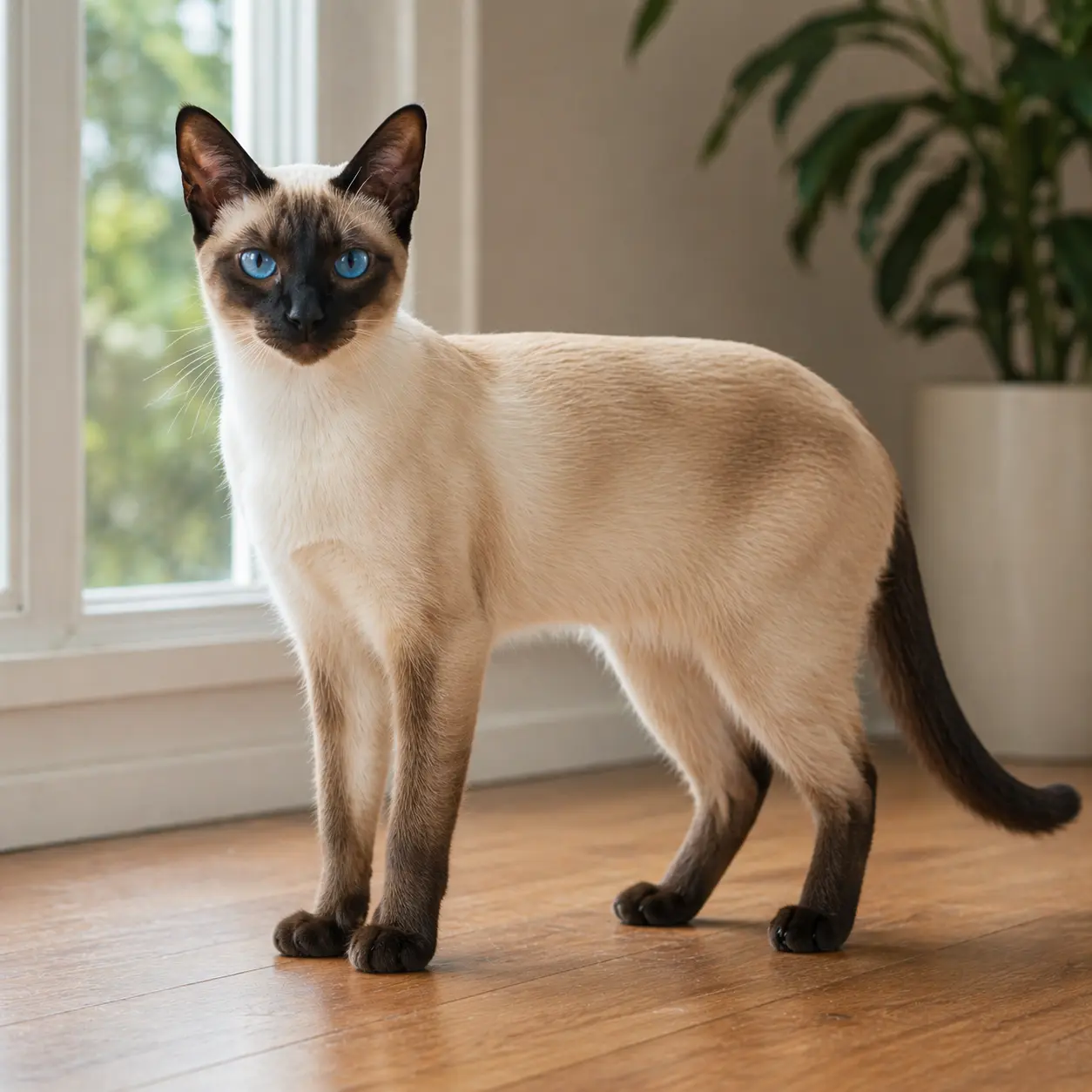
Aqua — the blue-green midpoint — is the rarest and most breed-specific eye colour in domestic cats. The Tonkinese breed produces aqua eyes through a specific combination: one copy of the colorpoint gene and one copy of the full-colour gene, creating a partial reduction in iris melanin that settles at a teal-aqua tone. Neither the full colorpoint (which produces blue) nor the full colour (which produces gold or green) produces aqua — only the heterozygous combination does. If a cat has vivid aqua eyes and is not a solid white, the Tonkinese breed is the strongest candidate by a significant margin. This level of colour specificity is unusual in cat genetics and makes aqua one of the most reliable single-feature breed signals in the entire discipline.
Eye Shape as a Breed Signal
Eye shape carries more consistent breed information than eye colour in most cases — and it develops earlier in kittens, making it useful at younger ages. Three features matter: the overall shape of the eye opening, the angle of the eye axis, and the eye's placement on the skull.
Round eyes sit in cats with broad, flat skulls. The Persian, Exotic Shorthair, British Shorthair, and Scottish Fold all carry eyes that are genuinely round — not slightly oval, but circular when the cat faces forward. In brachycephalic breeds like the Persian, the compressed skull positions the eyes facing more directly forward than in longer-faced breeds, which contributes to the characteristic "staring" expression. Round eyes on a broad flat face point immediately toward the cobby breed category.
Almond-shaped eyes — longer horizontally than vertically, with a distinct point at both the inner and outer corners — associate with active, athletic, moderately built breeds. The Maine Coon, Ragdoll, Norwegian Forest Cat, and Bengal all show almond to oval eye shapes. These breeds share structural similarities: moderate to large body size, semi-longhaired to shorthaired coats, and active temperaments. The almond eye shape is the most common across domestic cat breeds in general.
Slanted, upward-angled eyes — where the outer corner of the eye sits higher than the inner corner, creating a distinctly angled axis — are characteristic of the Oriental breeds. The Siamese carries this slanted eye most distinctly: the outer corner rises noticeably above the inner corner, giving the eye a dramatic, alert appearance that reinforces the wedge-shaped skull. The Oriental Shorthair and Balinese show the same axis. This upward slant is breed-specific enough to flag Oriental ancestry as a strong candidate when it appears.
Eye set — how wide apart the eyes sit on the skull — divides broadly along the same cobby-versus-lean axis as ear set does. Wide-set eyes on a broad skull point toward British Shorthair, Persian, and Ragdoll. Close-set eyes on a narrow wedge skull point toward Siamese and Oriental Shorthair. This feature is visible from the front at any age and functions as a rapid first-sort filter.
Breed Eye Color and Shape: The Complete Reference Table
| Breed | Standard eye colour(s) | Eye shape | Eye axis | Eye set |
|---|---|---|---|---|
| Russian Blue | Vivid gooseberry green | Almond | Slight upward angle | Wide-set |
| Siamese | Deep vivid blue | Almond | Distinctly slanted upward | Medium-set |
| Ragdoll | Deep vivid blue | Oval | Slight upward angle | Wide-set |
| Burmese | Vivid gold to yellow | Round to oval | Slight upward angle | Wide-set |
| Tonkinese | Aqua (blue-green) | Almond | Slight angle | Medium-set |
| British Shorthair | Copper to gold (varies by coat) | Round | Horizontal — no angle | Wide-set |
| Persian | Copper to deep orange | Round | Horizontal — forward-facing | Wide-set, close together |
| Maine Coon | Gold, green, copper — all accepted | Oval to almond | Slight upward angle | Wide-set |
| Bengal | Gold, hazel, green; aqua in snow | Oval to almond | Slight angle | Medium-wide |
| Abyssinian | Gold, green, hazel | Almond | Slight upward angle | Wide-set |
| Turkish Angora | Blue, amber, odd-eyed; green in some | Almond | Upward angle | Medium-set |
| Scottish Fold | Copper to gold; varies by coat | Round | Horizontal | Wide-set |
| Norwegian Forest Cat | All colours accepted — green common | Almond | Slight upward angle | Wide-set |
| Birman | Deep vivid blue | Round to oval | Near-horizontal | Wide-set |
| Sphynx | Wide range — all colours accepted | Lemon-shaped | Slight upward angle | Wide-set |
| Devon Rex | All colours accepted | Large oval | Slight angle | Wide-set |
Heterochromia and the Odd-Eyed Cat
Heterochromia — where each eye displays a different colour — catches attention immediately. It is also one of the most misunderstood eye features in breed identification.
Odd-eyed cats carry one blue eye and one eye of another colour — typically amber, gold, or copper. The blue eye results from either the colorpoint gene or, more commonly, the white spotting gene. White spotting restricts pigment distribution across the body — and when it affects only one eye's iris melanin production, the result is one blue eye and one normally pigmented eye.
The Turkish Angora produces odd-eyed individuals more frequently than almost any other breed — particularly in white-coated cats. White Turkish Angoras with odd eyes are among the most photographed cats in the world, and the combination has become so associated with the breed that many people assume odd eyes equal Turkish Angora. That assumption overreaches. The Turkish Van, white Maine Coon, white British Shorthair, and various white domestic mixed-breed cats all produce odd-eyed individuals through the same white spotting mechanism. Odd eyes in a white cat narrow the field significantly toward the Turkish Angora — they do not confirm it.
The connection between odd eyes and deafness is real and worth stating directly. The white spotting gene that causes one blue eye can also affect the development of the cochlea — the inner ear structure responsible for hearing. White cats with two blue eyes carry the highest risk of congenital deafness. White cats with one blue eye show a moderate but real elevated risk on the blue-eyed side. The Winn Feline Foundation has documented this relationship extensively, noting that the same melanocyte pathway responsible for iris pigmentation also plays a role in cochlear development — which is why depigmentation of the iris correlates with depigmentation of the cochlear melanocytes and subsequent hearing loss.
This health context matters for breed identification: a white cat with heterochromia has a statistically meaningful chance of unilateral deafness on the blue-eyed side. Knowing this before you attempt to assess the cat's breed background is useful — it affects the welfare conversation that follows the identification.
What Eye Features Actually Confirm About a Cat
Eye colour is the most overread single identifier in cat breed assessment. Most owners weight it far too heavily — which leads to overconfident breed guesses based on a feature that varies significantly even within individual breeds.
What eye features genuinely confirm, with reasonable reliability:
Colorpoint gene presence: Any adult non-white cat with vivid blue eyes carries the colorpoint gene. This narrows the breed candidates to a short, specific list: Siamese, Ragdoll, Birman, Balinese, Snowshoe, Colorpoint Shorthair, and Tonkinese (in its pointed colour form). No other common breeds produce blue eyes in non-white adults without the colorpoint gene. This is the single most reliable breed-narrowing conclusion available from eye colour alone.
Tonkinese aqua specifically: Vivid aqua eyes in a non-white, non-blue-eyed adult cat point more specifically toward the Tonkinese than any other breed. The aqua colour requires the precise genetic combination that defines the Tonkinese mink pattern — one colorpoint gene copy paired with one full-colour gene copy. No other common domestic breed produces this colour through the same mechanism.
Russian Blue vivid green specifically: The deep, saturated gooseberry green of the Russian Blue is specific enough to function as a confirming feature when paired with the breed's blue-grey tipped coat and distinctive head type.
Eye shape for fast category sorting: Round eyes eliminate lean active breeds immediately. Distinctly slanted, upward-angled eyes eliminate cobby breeds immediately. These shape-based eliminations are fast, reliable, and work consistently across adult cats regardless of coat colour.
What eye colour cannot do: confirm a specific breed in the absence of other supporting features. Copper eyes appear across Persian, British Shorthair, Scottish Fold, Maine Coon, and many domestic mixed-breed cats. Gold eyes appear across Burmese, Bengal, Abyssinian, and countless domestic shorthairs. Green eyes appear across Russian Blue, Norwegian Forest Cat, Abyssinian, and ordinary domestic cats. For cats showing common eye colours without the specific confirming combinations above, the eyes narrow the field without closing it.
Our guide on cat ear shapes and what they tell you about breed covers how combining ear set with eye shape produces a significantly faster and more accurate category sort than either feature delivers alone — which is the practical approach that works in real-world identification.
For kittens specifically, our guide on identifying kitten breeds before they develop explains why eye colour assessment should carry almost no weight before four months, and which features at that age are actually reliable.
When eye colour, eye shape, facial structure, and body type all point consistently toward one breed family but you want certainty rather than probability, our overview of cat DNA tests and breed identification covers what genetic testing can and cannot confirm — and when it is genuinely worth the investment.
For a complete face-first assessment that integrates eye features with skull shape, nose profile, and muzzle structure, the cat facial features breed identification guide covers how these elements work as a system rather than as independent data points.
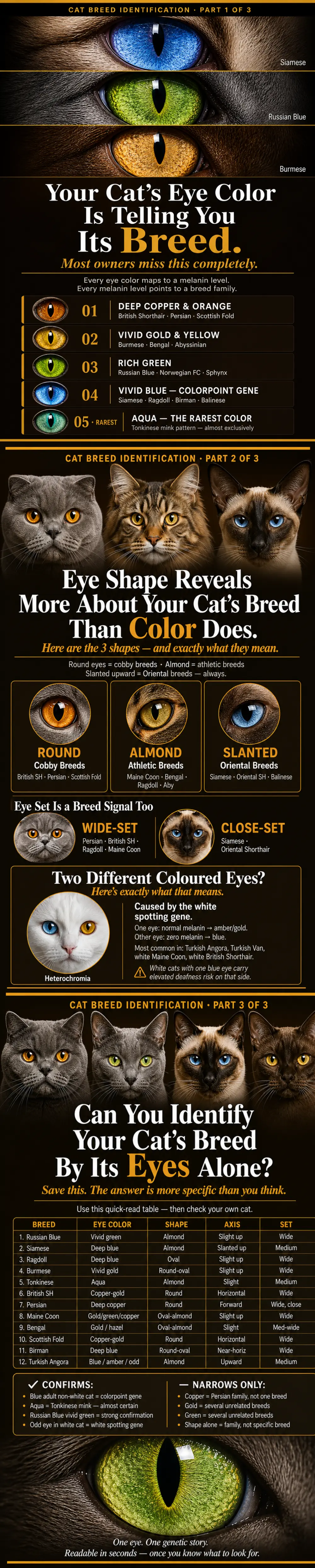
We have put together a visual infographic summarising cat eye colour and breed genetics — covering the full colour spectrum from copper to aqua, the eye shape categories with breed examples for each, and the heterochromia and odd-eye explanation — in a single reference image you can save and return to.
The aqua versus blue distinction in the colour section is the most shareable element — most cat owners have never heard of Tonkinese aqua, and seeing it compared directly to Siamese blue in one image makes the difference immediately clear.
Frequently Asked Questions
Cat eye color breed genetics: does eye color really confirm a specific breed?
In most cases, eye colour narrows the field rather than confirming a specific breed. The exceptions are meaningful: vivid blue eyes in a non-white adult cat confirm the presence of the colorpoint gene, limiting candidates to Siamese, Ragdoll, Birman, and related colorpoint breeds. Aqua eyes point specifically toward the Tonkinese mink pattern. The Russian Blue's vivid gooseberry green is breed-standard-specific enough to function as a supporting confirmation. For most other eye colours — copper, gold, green, hazel — the colour eliminates some breeds but cannot identify a specific one without support from body type, coat, head shape, and other physical features.
Why does my cat have blue eyes if it's not a Siamese?
Adult cats produce blue eyes through two separate mechanisms. The colorpoint gene — which the Siamese, Ragdoll, Birman, and related breeds carry — restricts iris melanin production, producing blue eyes in any adult cat that carries it regardless of coat colour. The white spotting gene produces blue eyes specifically in cats with white coats or significant white areas by disrupting melanin distribution in the iris. A non-Siamese blue-eyed adult cat almost certainly carries one of these two genetic mechanisms — and the distinction between them comes from the coat colour context: colorpoint blue eyes appear in non-white cats, white spotting blue eyes appear specifically in white or heavily white-marked cats.
Breed identification by eye shape: which shape is the most reliable single signal?
The upward-slanted eye axis — where the outer corner of the eye sits noticeably higher than the inner corner — is the most breed-specific single eye shape signal. It associates tightly with Oriental-type breeds (Siamese, Oriental Shorthair, Balinese) and eliminates virtually all cobby, round-headed breeds immediately. Round eyes with a horizontal, non-angled axis point just as reliably toward the cobby breeds — Persian, British Shorthair, Scottish Fold — and eliminate all Oriental types. These two shape signals work as a first-sort filter before any other eye feature is assessed.
What does it mean if my cat has two different coloured eyes?
Heterochromia — one blue eye and one eye of a different colour — results from the white spotting gene affecting melanin production differently in each iris. It appears most frequently in white or partly white cats. The Turkish Angora, Turkish Van, white British Shorthair, and white Maine Coon all produce odd-eyed individuals. It is worth knowing that the same gene pathway responsible for the blue eye also affects cochlear development — white cats with one blue eye have a statistically elevated risk of deafness on the blue-eyed side, and white cats with two blue eyes carry the highest risk. A simple hand-clap test near each ear while the cat faces away gives a rough initial indication of whether unilateral hearing loss may be present.
Can cat eye color change after kittenhood is over?
In most cats, eye colour stabilises between three and five months of age and does not change significantly after that. The exception is gradual darkening in some individuals as melanin continues to deposit through the first year of life — a copper-eyed British Shorthair may show slightly richer colour at eighteen months than at six. Sudden changes in eye colour in an adult cat — particularly one eye changing while the other stays stable — are not a breed signal. They are a veterinary concern, as sudden iris colour change in adult cats can indicate inflammation, iris melanoma, or other conditions requiring professional assessment. If your adult cat's eye colour has changed noticeably in a short period, contact a vet rather than looking for a breed explanation.