You've been staring at your cat for ten minutes. The coat is fluffy. The eyes are big. The ears do something unusual. And you still have no idea what breed it is. You're not alone — most cat owners ask this question at some point. The most common domestic cat breeds share the world with millions of mixed-breed cats, and telling them apart takes a little knowledge. According to The Cat Fanciers' Association (CFA) and The International Cat Association (TICA), there are over 40 officially recognized breeds — each with distinct physical traits, personalities, and care needs. Understanding these breeds helps you read clues in any cat you meet.
How this guide is organized
This guide groups breeds by coat length first, then by temperament type — so you can scan to the section that matches what you're seeing. Each breed entry covers its origin, size, coat, personality, and care needs, plus a quick-glance summary box for fast reference. At the end, you'll find a full comparison table covering all 14 named breeds side by side. Whether you're trying to identify your cat or just curious about the world of Felis catus, this guide gives you a solid, practical foundation.
Long-Haired Cat Breeds
Long-haired breeds tend to be visually striking and deeply rewarding to own — but they come with a grooming commitment. Their coats need regular brushing to stay healthy and mat-free.
1. Maine Coon
The Maine Coon comes from the northeastern United States and is one of the oldest natural breeds in North America. It is large — genuinely large, not just "big for a cat." Males regularly hit 15–18 lbs. The coat is long, thick, and shaggy, with a full ruff around the neck and a bushy tail that the cat wraps around itself like a scarf in cold weather. The ears carry distinctive tufts at the tips, called lynx tips, that make this breed instantly recognizable.
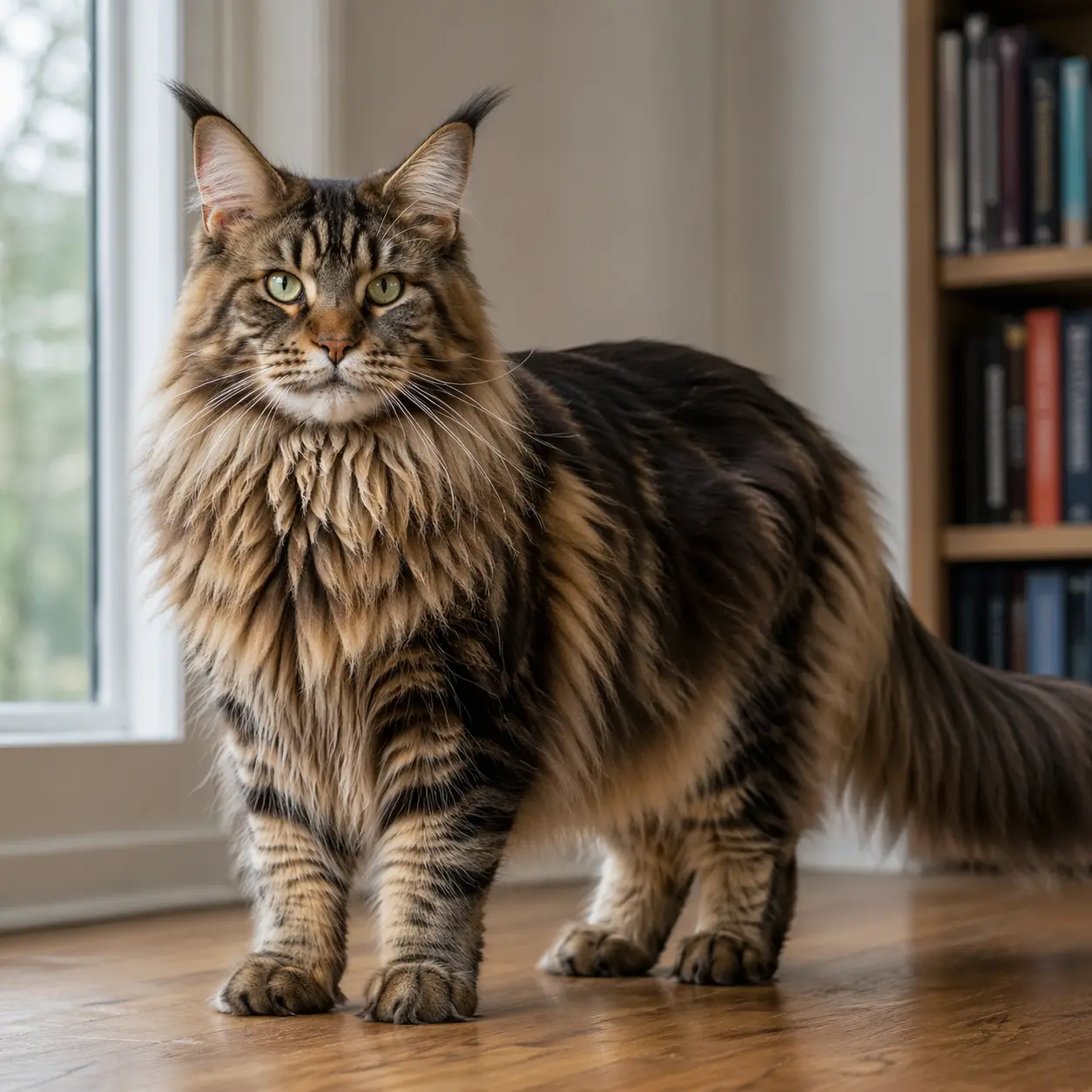 Caption: The Maine Coon's ear tufts and heavy, layered coat are two of its most reliable identification markers.
Ask any Maine Coon owner and they'll tell you — this cat thinks it's a dog. Maine Coons follow their people from room to room, learn to play fetch, and respond to their names reliably. They are sociable without being clingy. They suit active households, families with children, and owners who want a cat that participates in daily life rather than just observing it.
| Feature | Details |
|---|---|
| Origin | United States (Maine) |
| Size & Weight | Large to Giant (10–18 lbs) |
| Coat | Long, shaggy, multi-layered; common in tabby and solid patterns |
| Grooming Needs | High — brush 2–3 times per week |
| Activity Level | Moderate to High |
| Good With | Children, dogs, other cats, active families |
| Health Watch | Prone to hypertrophic cardiomyopathy (HCM) |
| Lifespan | 12–15 years |
If your cat has a similar build but a flatter, silkier coat, the Norwegian Forest Cat covered below may be a closer match.
2. Persian
The Persian traces its origins to Iran (formerly Persia) and has been selectively bred for centuries into one of the most recognizable cats on the planet. The coat is extraordinarily long, dense, and silky — it flows to the floor when the cat sits still. The face is flat. The nose barely protrudes. The eyes are large, round, and set wide on a broad, rounded skull. Persians are a classic example of a brachycephalic breed — a term describing the shortened facial structure that gives them their characteristic look.
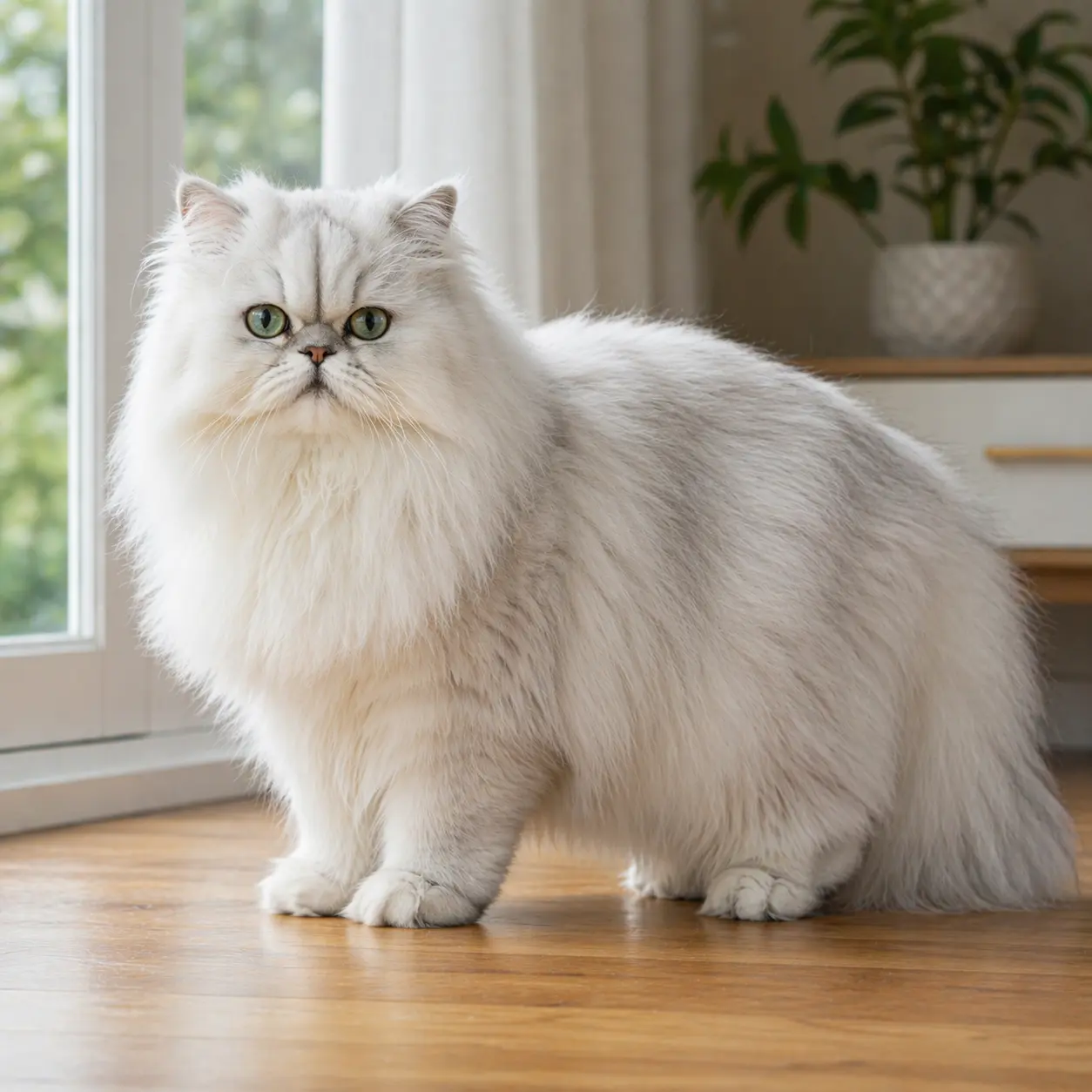 Caption: The Persian's flat face and flowing coat make it one of the easiest cat breeds to identify at a glance.
Persians move at their own pace. They prefer calm environments, quiet routines, and a warm lap over anything else. They won't demand your attention — they'll simply be present, serene, and quietly magnificent. This breed suits apartment living, single owners, seniors, or anyone who wants a low-energy companion. They are not the right fit for chaotic homes or households with very young children.
| Feature | Details |
|---|---|
| Origin | Iran (Persia) / refined in the UK |
| Size & Weight | Medium to Large (7–12 lbs) |
| Coat | Long, dense, silky; found in virtually every color and pattern |
| Grooming Needs | Very High — daily brushing required to prevent matting |
| Activity Level | Low |
| Good With | Seniors, singles, quiet households |
| Health Watch | Brachycephalic airway issues, polycystic kidney disease (PKD) |
| Lifespan | 12–17 years |
For a look at how coat patterns like the Persian's relate to breed genetics, see our guide to cat coat patterns and their breed associations.
3. Ragdoll
The Ragdoll was developed in California in the 1960s by breeder Ann Baker. It is a large, semi-longhaired cat with a pointed coat pattern — meaning the face, ears, paws, and tail are darker than the rest of the body. The eyes are always a vivid, deep blue, regardless of coat color. The body is substantial and heavy-boned, but the coat is silky rather than rough, and it doesn't mat as easily as a Persian's.
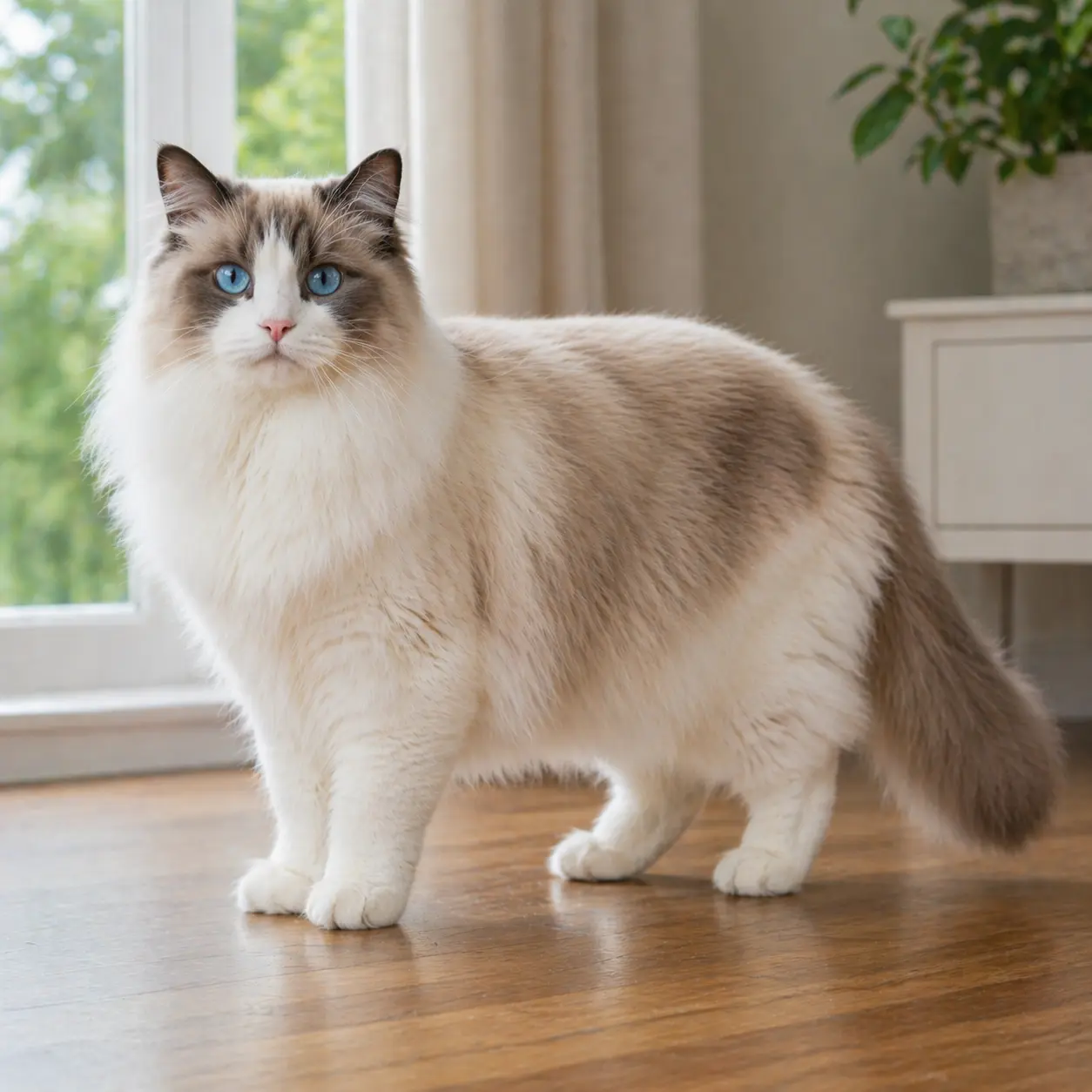 Caption: The Ragdoll's vivid blue eyes and pointed coat are its most distinctive visual traits.
The name comes from behavior, not appearance. Pick up a Ragdoll and it goes limp in your arms — fully relaxed, trusting, floppy. That's exactly what these cats do. They are gentle, quiet, and deeply attached to their owners. Ragdolls follow their people around the house and prefer to stay close. They suit families, first-time owners, and anyone who wants a calm, affectionate cat that won't scratch the furniture out of spite.
| Feature | Details |
|---|---|
| Origin | United States (California) |
| Size & Weight | Large (10–20 lbs) |
| Coat | Semi-long, silky, low-matting; always in a pointed pattern |
| Grooming Needs | Moderate — brush twice a week |
| Activity Level | Low to Moderate |
| Good With | Children, seniors, multi-pet households, first-time owners |
| Health Watch | HCM genetic variant present in the breed — screen before adopting |
| Lifespan | 12–17 years |
Ragdolls and Siamese share that pointed coat pattern — the next section explains the key differences between them.
4. Norwegian Forest Cat
The Norwegian Forest Cat — called the Norsk skogkatt in its homeland — developed naturally in the forests of Norway over hundreds of years. It is a large, heavily built cat with a thick, water-resistant double coat designed for harsh Scandinavian winters. The outer coat is long and coarse. The undercoat is dense and woolly. The face is triangular with a straight nose profile — very different from the Maine Coon's slightly concave nose and squarer muzzle, though the two breeds are often confused.
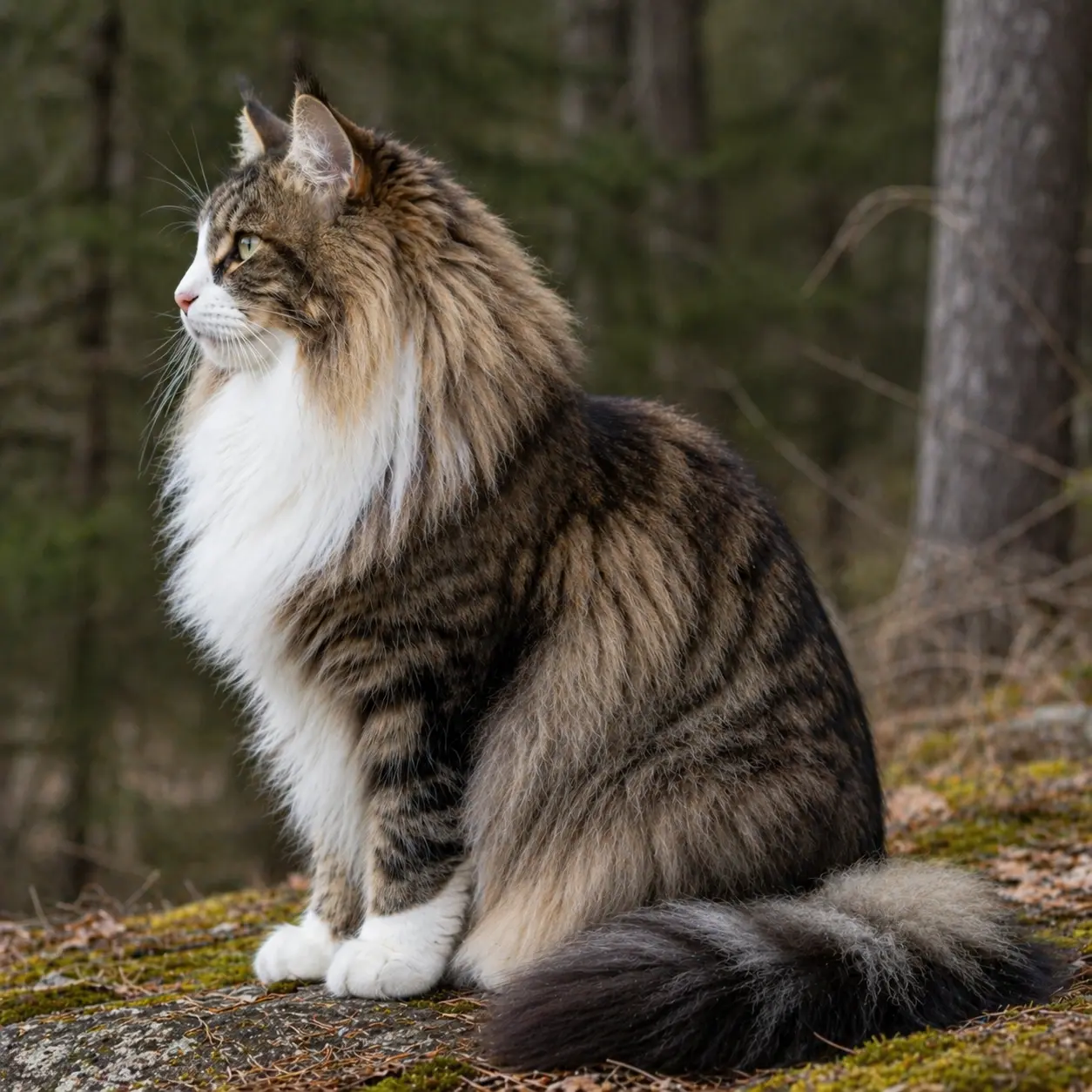 Caption: The Norwegian Forest Cat's triangular face and water-resistant double coat set it apart from the similar-looking Maine Coon.
Norwegian Forest Cats are independent. They are affectionate on their own terms — not cold, but not needy either. They love to climb. A tall cat tree is essentially a requirement. They adapt well to families but also do fine in quieter homes. Owners describe them as loyal companions who choose when to engage, rather than demanding attention constantly.
| Feature | Details |
|---|---|
| Origin | Norway |
| Size & Weight | Large (9–16 lbs) |
| Coat | Long, coarse outer coat with dense woolly undercoat |
| Grooming Needs | High — especially during seasonal shedding |
| Activity Level | Moderate to High |
| Good With | Families, other pets, experienced cat owners |
| Health Watch | Glycogen storage disease type IV (rare but breed-specific) |
| Lifespan | 14–16 years |
Short-Haired Cat Breeds
Short-haired breeds need less grooming, but that's where the similarities end. This group spans every personality type from loud and demanding to quiet and reserved.
5. Siamese
The Siamese is one of the oldest recognized cat breeds in the world, originating in Thailand (formerly Siam). It has a lean, muscular body with a long neck, long limbs, and a wedge-shaped head that narrows sharply from the ears to the muzzle. The coat is short and fine. The pointed coat pattern is the breed's defining feature — cream or white body with dark coloring on the face, ears, paws, and tail. The eyes are always blue and always almond-shaped.
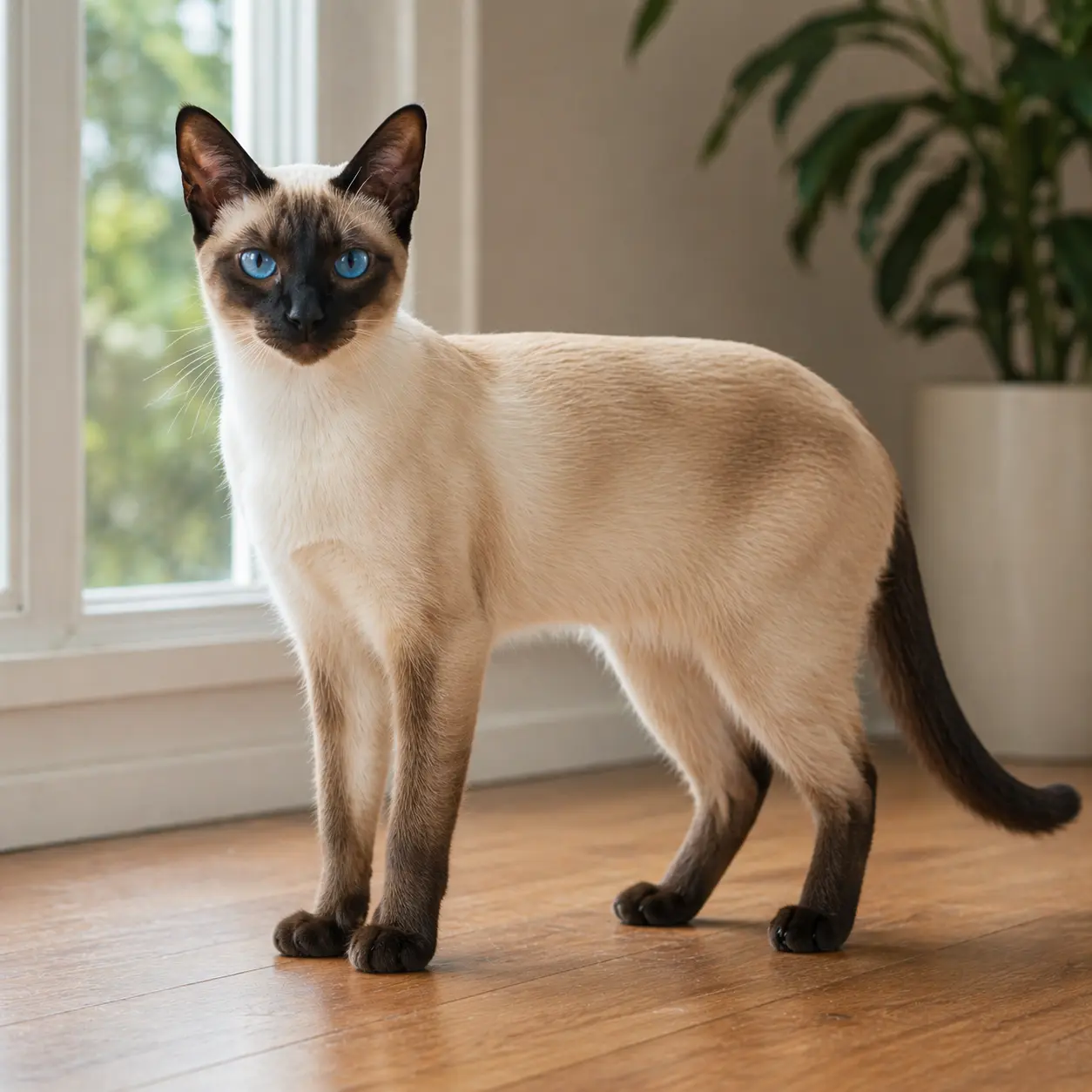 Caption: The Siamese's triangular head and color-point coat make it one of the most visually distinct cat breeds.
Siamese cats are vocal. They will tell you when they're hungry, bored, lonely, or simply have opinions about the furniture arrangement. They form intense bonds with one or two people and prefer not to be left alone for long stretches. This is not a low-maintenance companion. But for owners who want a deeply engaged, communicative, almost dog-like relationship with their cat, no breed delivers more.
| Feature | Details |
|---|---|
| Origin | Thailand (Siam) |
| Size & Weight | Medium (6–10 lbs) |
| Coat | Short, fine; always in a pointed pattern (seal, chocolate, blue, lilac, and more) |
| Grooming Needs | Low — weekly brush is sufficient |
| Activity Level | High |
| Good With | Active owners, families with older children, people who are home often |
| Health Watch | Dental issues and progressive retinal atrophy — regular vet checks recommended |
| Lifespan | 15–20 years |
The Siamese's coat genetics, particularly the temperature-sensitive pointed pattern, directly influenced breeds like the Ragdoll, Birman, and Burmese.
6. British Shorthair
The British Shorthair is one of the most popular cat breeds in the UK and has steadily grown its fanbase worldwide. It originates from Britain, with roots tracing back to working cats brought by Roman invaders. The body is cobby — short, wide, and solidly built. The head is round with full cheeks, a short nose, and a strong chin. The coat is dense and plush, like pressing your hand into a thick carpet. The British Blue — a solid blue-gray coat with copper eyes — is the most recognized color variety, though this breed comes in dozens of combinations.
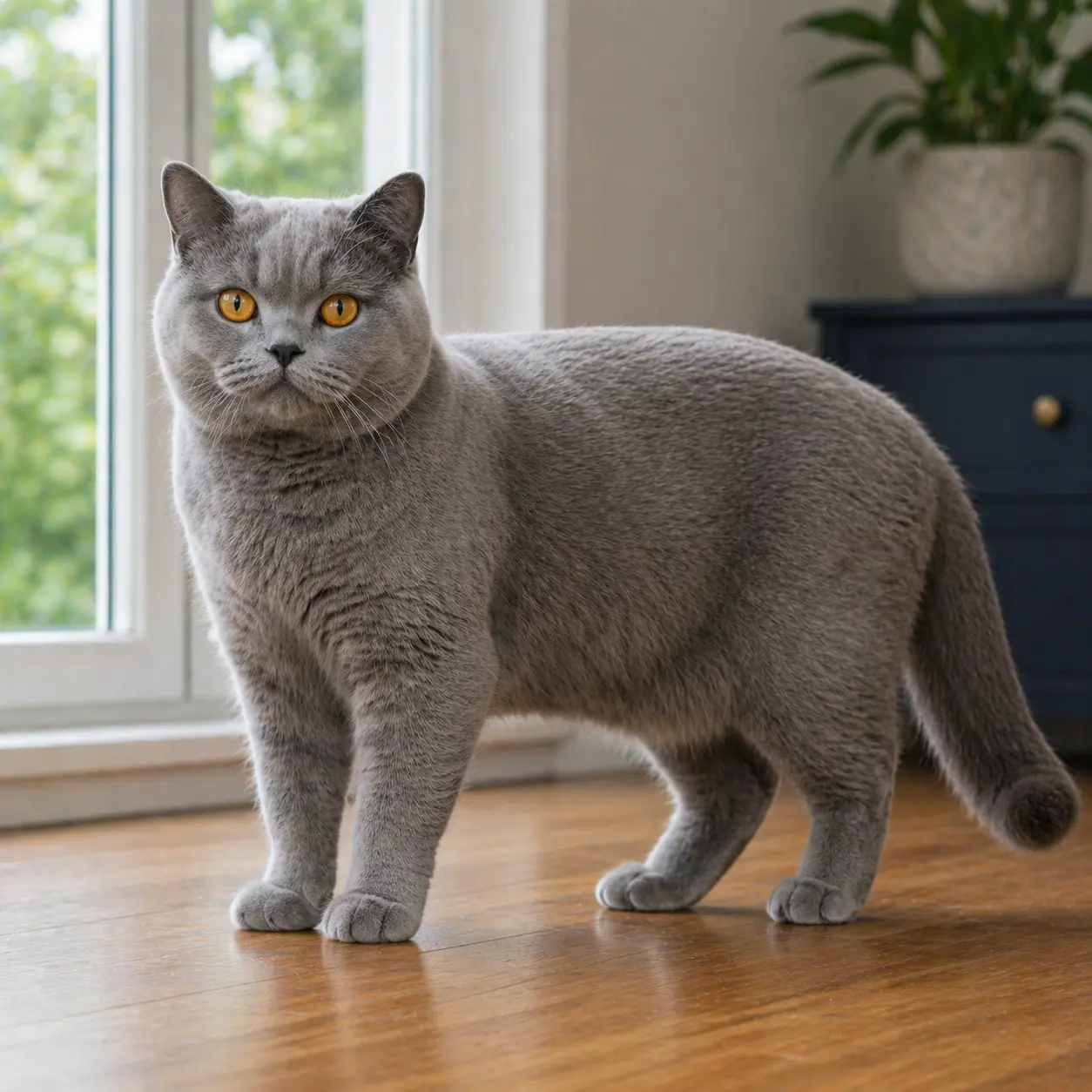 Caption: The British Shorthair's round head and impossibly plush coat give it its iconic teddy-bear appearance.
British Shorthairs are calm, self-possessed, and quietly loyal. They don't demand constant attention, but they'll plant themselves nearby and keep you company. They tolerate being picked up less than most breeds — they prefer four paws on the ground. They are excellent for busy owners, families with children, or households where a cat needs to adapt to varying energy levels without becoming anxious.
| Feature | Details |
|---|---|
| Origin | United Kingdom |
| Size & Weight | Medium to Large (9–18 lbs) |
| Coat | Short, dense, plush; found in nearly every color — most famous in blue-gray (British Blue) |
| Grooming Needs | Low to Moderate — weekly brushing |
| Activity Level | Low to Moderate |
| Good With | Families, singles, busy owners, multi-pet households |
| Health Watch | HCM and obesity — monitor diet carefully as they tend to be sedentary |
| Lifespan | 12–17 years |
7. Bengal
The Bengal was developed in the United States by crossing domestic cats with the Asian leopard cat (Prionailurus bengalensis). The result is a cat that looks genuinely wild. The coat is short and dense, but what sets it apart is the pattern — vivid rosettes (spots that are outlined, like a leopard's) or marble swirls, often with a glittery, light-catching quality called "glitter." The body is long, lean, and muscular. Bengals feel heavier than they look.
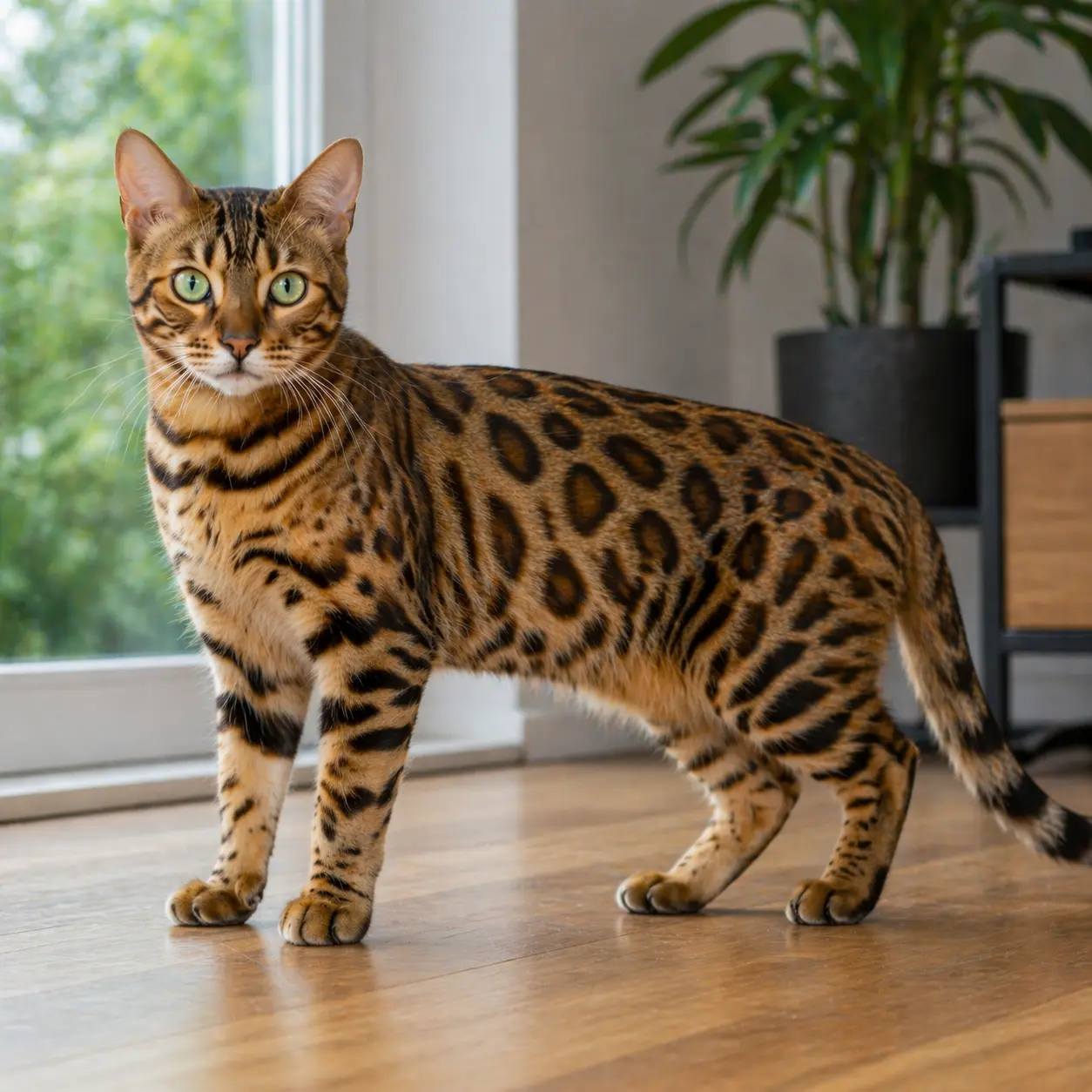 Caption: The Bengal's rosette markings and dense, glittery coat are unlike any other domestic cat breed.
Bengals are energetic. They need daily play. Leave one alone and under-stimulated and you'll come home to a rearranged living room. These cats climb everything, investigate everything, and vocalize freely. They are better suited to owners with experience handling active cats, families who can provide structured playtime, or households with access to outdoor enclosures. They are not a good match for sedentary owners or people who travel frequently.
| Feature | Details |
|---|---|
| Origin | United States |
| Size & Weight | Medium to Large (8–15 lbs) |
| Coat | Short, dense; spotted or marbled in brown tabby, silver, and snow variations — often with a glittery sheen |
| Grooming Needs | Low — short coat needs minimal brushing |
| Activity Level | Very High |
| Good With | Experienced owners, active families, homes with outdoor access |
| Health Watch | Progressive retinal atrophy (PRA-b) — genetic testing available |
| Lifespan | 12–16 years |
8. Abyssinian
The Abyssinian is one of the oldest known cat breeds, with origins debated between Ethiopia and Southeast Asia. It has a lean, athletic build with a slightly arched back and long, slender legs that give it an almost rabbit-like posture when sitting. The coat is short and fine with a distinctive ticked pattern — each individual hair carries alternating bands of color controlled by the agouti gene. This gives the coat a warm, shimmering appearance with no bold stripes or spots.
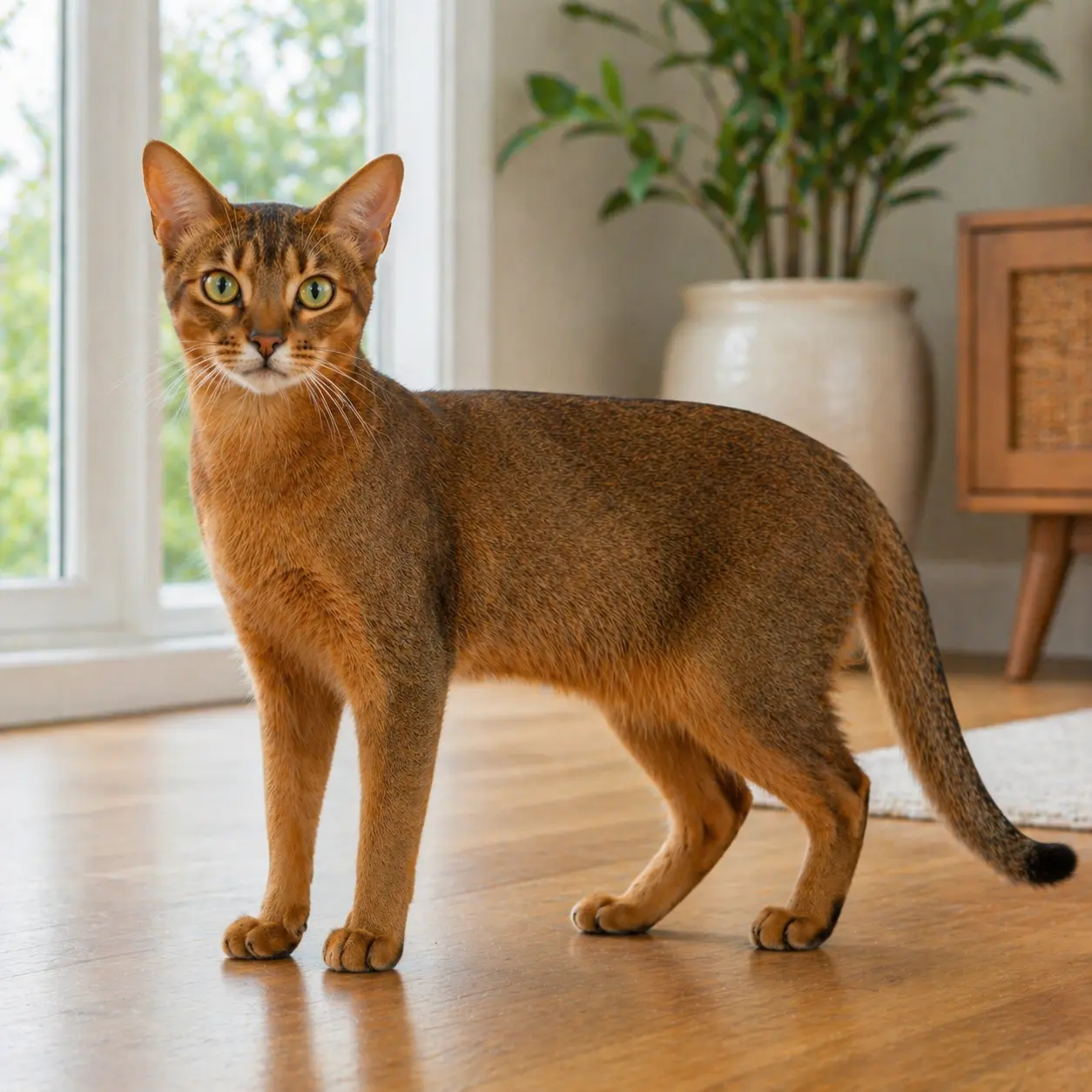 Caption: The Abyssinian's ticked coat creates a luminous, almost glowing effect that no other common breed quite replicates.
Abyssinians are curious to the point of being busy. They explore every corner, investigate every sound, and rarely sit still for long. They form strong bonds with their owners but express affection through presence and play rather than cuddling. They suit owners who spend time at home, enjoy interactive play, and won't mind a cat that supervises everything they do.
| Feature | Details |
|---|---|
| Origin | Ethiopia (Abyssinia) / possibly Southeast Asia |
| Size & Weight | Medium (6–10 lbs) |
| Coat | Short, fine; always ticked — most common in ruddy, sorrel, blue, and fawn |
| Grooming Needs | Low — weekly brushing |
| Activity Level | Very High |
| Good With | Active owners, families with older children, households with other active cats |
| Health Watch | Progressive retinal atrophy and renal amyloidosis — buy from health-screened lines |
| Lifespan | 12–15 years |
9. Russian Blue
The Russian Blue comes from northern Russia, possibly originating in the port city of Archangel. The coat is its defining feature — short, dense, and always a uniform blue-gray, with a distinctive silvery sheen caused by silver-tipped guard hairs. The eyes are a vivid, deep green. The body is lean and elegant, with a long neck and a slightly upturned mouth that makes the cat look perpetually pleased with itself.
 Caption: The Russian Blue's silvery coat and green eyes are its most distinctive and recognizable features.
Russian Blues are gentle and a little reserved with strangers, but deeply loyal to the people they choose. They observe first and engage second. They prefer routine — they notice when furniture moves, when schedules shift, and when someone new enters their space. They suit quieter homes, introverted owners, or anyone who appreciates a cat with emotional depth rather than constant noise.
| Feature | Details |
|---|---|
| Origin | Russia |
| Size & Weight | Medium (7–12 lbs) |
| Coat | Short, dense, plush; always solid blue-gray with silver-tipped guard hairs |
| Grooming Needs | Low — weekly brush |
| Activity Level | Moderate |
| Good With | Singles, quieter households, owners who are home regularly |
| Health Watch | Generally healthy — obesity is the main risk; monitor food portions |
| Lifespan | 15–20 years |
10. Burmese
The Burmese traces its modern lineage to a single cat named Wong Mau, brought to the United States from Burma (now Myanmar) in 1930. It is a compact, surprisingly heavy cat — owners often say picking up a Burmese for the first time is startling, because it weighs more than it looks. The coat is short, satin-like, and lies close to the body. The original Burmese color is a rich, warm sable brown, though the breed now comes in blue, champagne, and platinum.
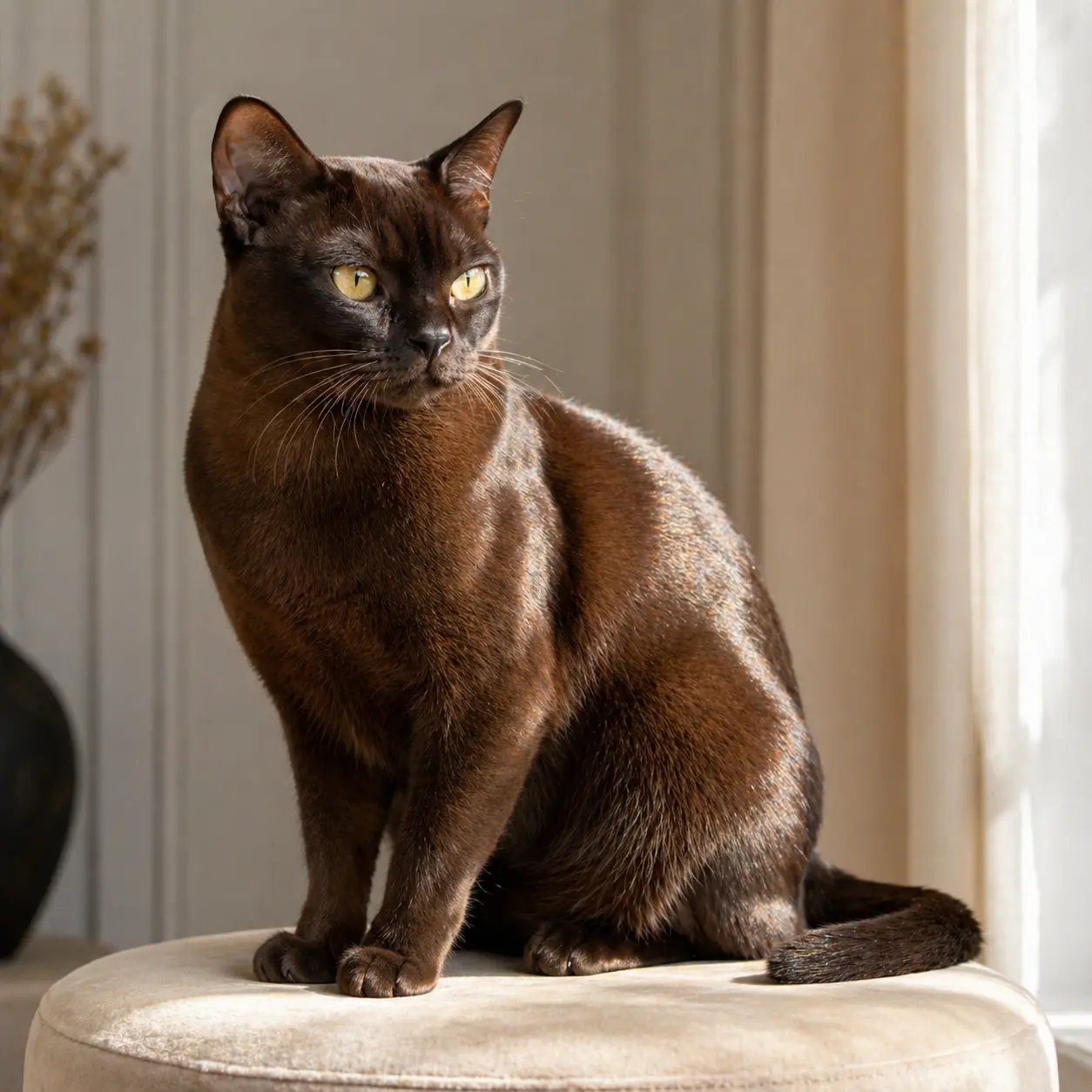 Caption: The Burmese's satin coat and unexpectedly dense, muscular build make it one of the more surprising cats to pick up.
Burmese cats are people-obsessed. They follow their owners everywhere, vocalize regularly, and genuinely need company to thrive. They tolerate being left alone poorly. But for owners who want an intensely connected, warm, interactive companion — a cat that acts like a small, purring shadow — the Burmese delivers that better than almost any other breed.
| Feature | Details |
|---|---|
| Origin | Burma (Myanmar) / refined in the United States |
| Size & Weight | Medium (8–12 lbs) |
| Coat | Short, satin-smooth, close-lying; sable, blue, champagne, or platinum |
| Grooming Needs | Low — minimal brushing needed |
| Activity Level | Moderate to High |
| Good With | Families, multi-pet households, owners who spend significant time at home |
| Health Watch | Hypokalemia (low blood potassium) and cranial deformities in some lines |
| Lifespan | 16–18 years |
11. American Shorthair
The American Shorthair descended from cats brought to North America on European ships in the 1600s. It is a working cat at heart — sturdy, athletic, adaptable. The body is medium to large, well-muscled, and built for endurance. The coat is short and dense. The classic silver tabby — silver base with bold black markings — is the most iconic American Shorthair look, though the breed appears in over 80 color and pattern combinations recognized by the CFA.
 Caption: The silver tabby pattern is the American Shorthair's most iconic look, though the breed comes in over 80 color variations.
American Shorthairs are easygoing without being boring. They enjoy play, tolerate children, adapt to other pets, and don't demand constant attention. They are genuinely low-maintenance in temperament — content, curious, and calm. This is one of the best cat breeds for families or first-time owners who want a healthy, balanced companion without dramatic behavioral needs.
| Feature | Details |
|---|---|
| Origin | United States (descended from European working cats) |
| Size & Weight | Medium to Large (8–15 lbs) |
| Coat | Short, dense; found in 80+ color/pattern combinations — classic silver tabby is most recognized |
| Grooming Needs | Low — weekly brushing |
| Activity Level | Moderate |
| Good With | Families, children, other pets, first-time owners |
| Health Watch | Generally robust — HCM possible; healthy weight management important |
| Lifespan | 15–20 years |
Unique and Specialist Breeds
These breeds look unmistakable. Each one carries a genetic mutation that shapes its appearance in ways that make visual identification almost effortless. Their distinctiveness also makes them conversation starters wherever they go.
12. Scottish Fold
The Scottish Fold gets its name from a dominant cartilage mutation that first appeared in a barn cat named Susie in Scotland in 1961. The mutation causes the ear cartilage to fold forward and downward, giving the cat an almost owl-like appearance. Not every Scottish Fold kitten inherits the fold — those without it are called Scottish Straights. The body is medium and rounded, the face broad, and the eyes large and round. The mutation also affects cartilage throughout the body, which is why responsible breeding practices and health monitoring matter enormously with this breed.
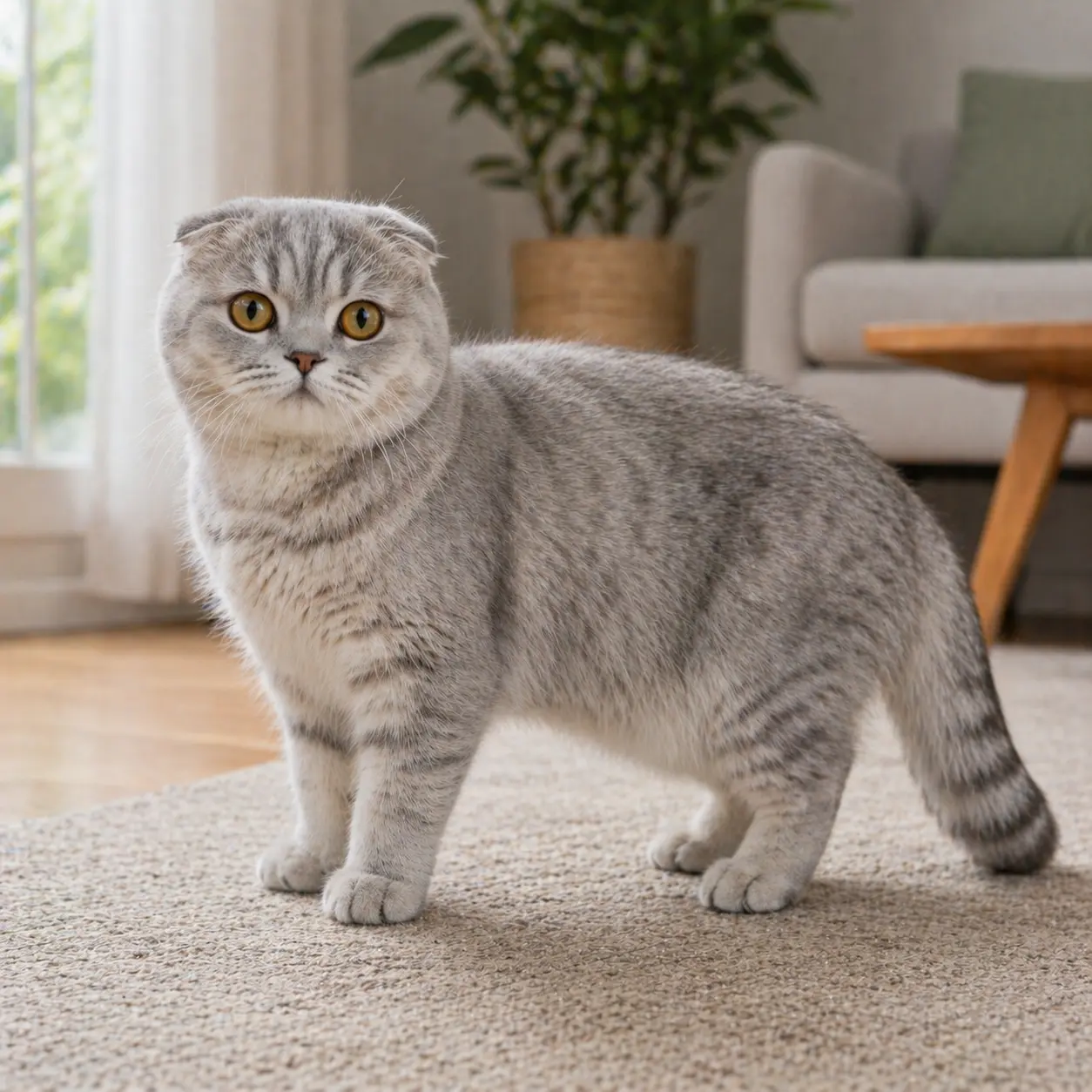 Caption: The Scottish Fold's folded ears are caused by a cartilage mutation — the breed's single most recognizable trait.
Scottish Folds are calm, adaptable, and gently playful. They enjoy being near their owners without demanding constant interaction. They tend to sit in unusual positions — fully stretched out, or balanced on their hind legs — because of how the mutation affects their joints. They suit quieter homes and owners who pay attention to health signals. If you notice a Scottish Fold becoming stiff or reluctant to move, a vet visit is warranted.
| Feature | Details |
|---|---|
| Origin | Scotland |
| Size & Weight | Medium (6–13 lbs) |
| Coat | Short or long; found in most colors and patterns |
| Grooming Needs | Low to Moderate depending on coat length |
| Activity Level | Low to Moderate |
| Good With | Families, singles, quieter households |
| Health Watch | Osteochondrodysplasia — affects joints and cartilage in all fold-eared individuals |
| Lifespan | 11–14 years |
13. Sphynx
The Sphynx appears hairless, but it isn't quite. The skin is covered in a fine, peach-fuzz-like down that you can feel when you touch it. The lack of a visible coat makes every other feature dramatic — the large, bat-like ears, the wrinkled forehead, the lemon-shaped eyes, the barrel chest. The Sphynx originated from a natural genetic mutation that appeared in Toronto, Canada in 1966 and was then developed deliberately through selective breeding. It now ranks among the most recognized and popular cat breeds globally.
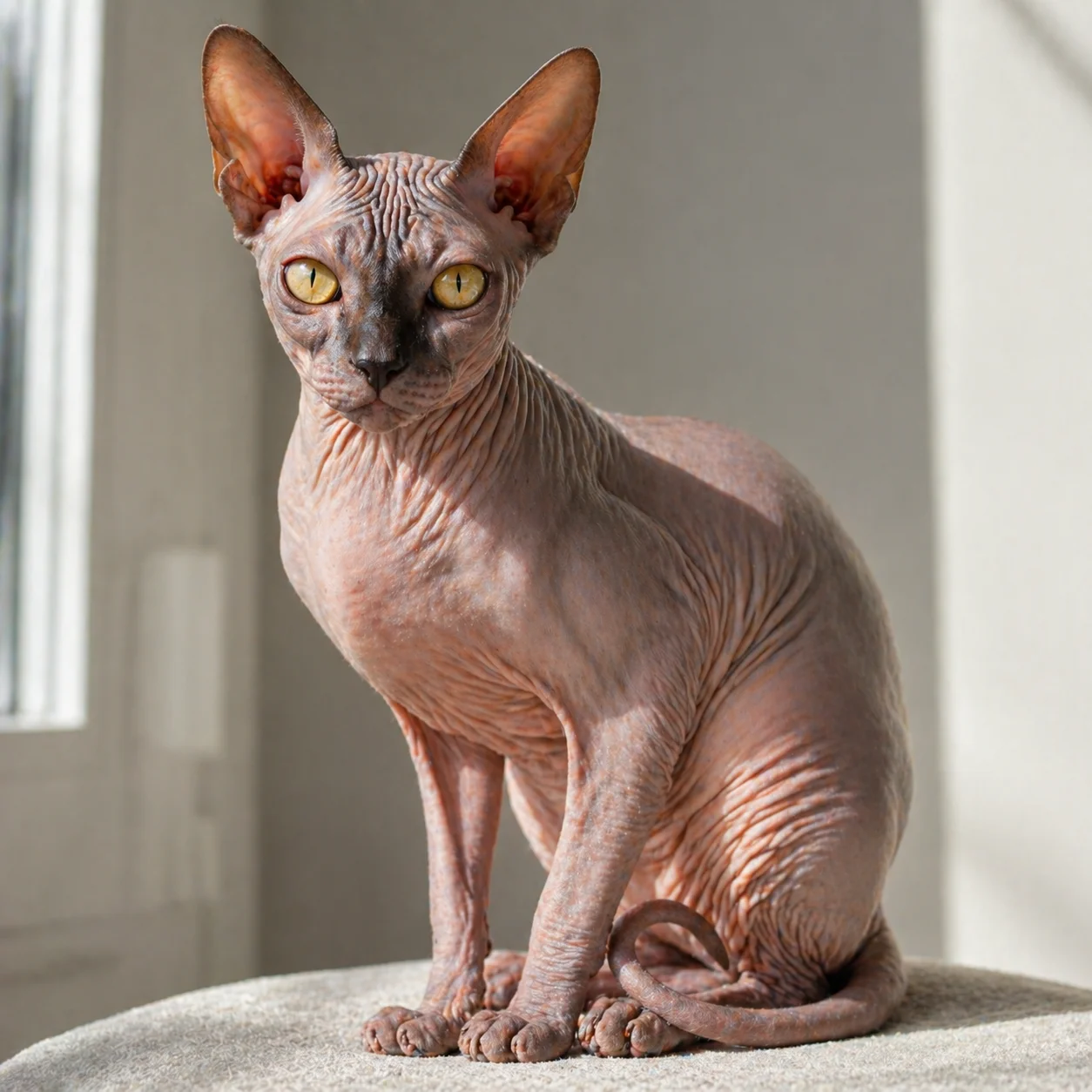 Caption: The Sphynx's hairless appearance is the result of a natural genetic mutation that affects the texture — not the absence — of its coat.
Sphynx cats are warm to the touch and desperate for company. They press against their owners for warmth and attention in equal measure. They are extroverted, funny, and endlessly entertaining. They are also higher maintenance than their appearance suggests — without a coat to absorb body oils, they need weekly baths to stay clean. They do not tolerate cold and need indoor environments with stable temperatures. For owners who want a deeply bonded, almost theatrical companion, the Sphynx rewards that investment fully.
| Feature | Details |
|---|---|
| Origin | Canada (Toronto, 1966) |
| Size & Weight | Medium (6–12 lbs) |
| Coat | Hairless in appearance; covered in fine, warm down — no outer coat |
| Grooming Needs | High — weekly bathing required |
| Activity Level | High |
| Good With | Active owners, families, multi-pet households, people home often |
| Health Watch | HCM is prevalent in the breed — cardiac screening essential |
| Lifespan | 13–15 years |
14. Devon Rex
The Devon Rex appeared from another natural genetic mutation, this time in Devonshire, England in 1959. The coat is soft, wavy, and sparse — it curls in loose waves across the body and is thinner than most cat coats, which means Devon Rex cats can be a better fit for some people with mild cat sensitivities (though no cat is truly hypoallergenic). The ears are enormous relative to the head. The face has strong cheekbones, large eyes, and a short muzzle that gives the cat a mischievous, pixie-like expression.
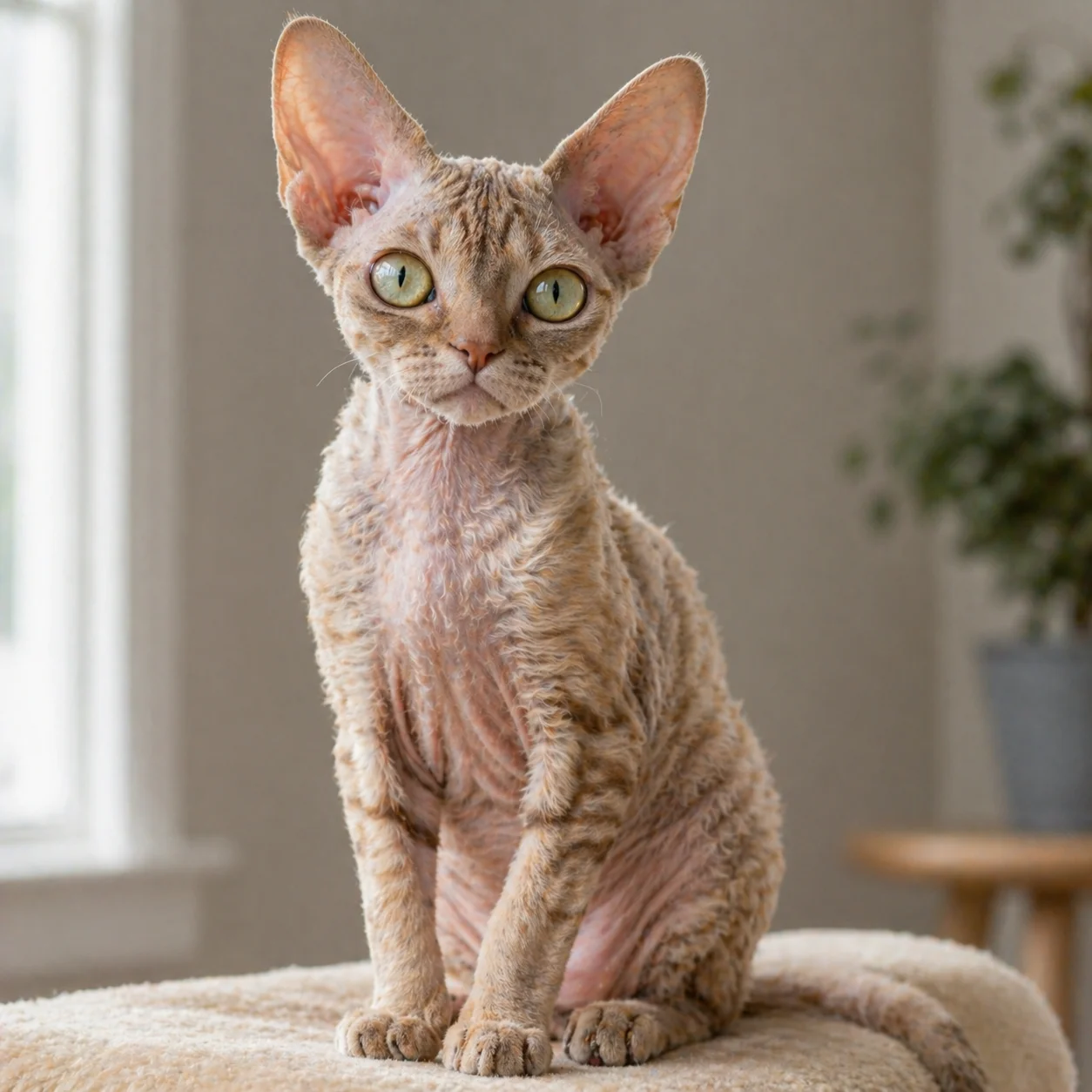 Caption: The Devon Rex's wavy coat and oversized ears are the result of a genetic mutation distinct from the similar-looking Cornish Rex.
Devon Rex cats are social acrobats. They jump to your shoulder, they infiltrate your plate, they insert themselves into everything. Owners describe them as permanently kitten-brained — playful and chaotic well into adulthood. They suit active households, owners with a sense of humor, and families with children who enjoy an energetic, endlessly entertaining cat.
| Feature | Details |
|---|---|
| Origin | England (Devon, 1959) |
| Size & Weight | Small to Medium (5–10 lbs) |
| Coat | Short, wavy, sparse curls; found in most colors and patterns |
| Grooming Needs | Low — handle gently as the fragile coat can break with rough brushing |
| Activity Level | High |
| Good With | Active families, experienced owners, multi-pet households |
| Health Watch | Hereditary myopathy (muscle weakness) and HCM — breed from health-tested lines |
| Lifespan | 9–15 years |
The Most Common Cat of All: The Domestic Shorthair
Here's something worth knowing before you go further: "domestic shorthair" and "domestic longhair" are not breeds. They are descriptions. A domestic shorthair is simply a cat of mixed or unknown ancestry with a short coat. A domestic longhair is the same, but fluffier. Most cats in shelters fall into one of these two categories — and most owned cats in the world are exactly this.
That does not make them less interesting. A domestic shorthair can carry the tabby pattern of an American Shorthair, the eye color of a Russian Blue, the body structure of a British Shorthair, and the temperament of something entirely its own. They are genetic mosaics, shaped by generations of cats mixing freely. The result is extraordinary variety — no two domestic shorthairs are the same.
What's also true is that mixed-breed cats tend to be hardy. The genetic diversity that comes from uncontrolled breeding often produces robust health and long lives. Shelter cats and rescued domestic shorthairs make extraordinary companions. Their personalities are not predictable by breed charts, which means you get to discover who your specific cat is — not who the breed manual says it should be.
If you're curious whether your domestic shorthair carries purebred ancestry — for instance, if the coat pattern or body type looks distinctly breed-specific — our mixed breed cat identification guide walks you through the signs to look for.
Full Breed Comparison Table
| Breed | Size | Coat | Temperament | Grooming | Activity | Good For |
|---|---|---|---|---|---|---|
| Abyssinian | Medium | Short, ticked | Curious, busy | Low | Very High | Active owners |
| American Shorthair | Med–Large | Short, dense | Calm, adaptable | Low | Moderate | Families, beginners |
| Bengal | Med–Large | Short, spotted | Energetic, bold | Low | Very High | Experienced owners |
| British Shorthair | Med–Large | Short, plush | Quiet, loyal | Low–Mod | Low–Mod | Busy owners |
| Burmese | Medium | Short, satin | Affectionate, vocal | Low | Moderate | People home often |
| Devon Rex | Sm–Medium | Wavy, sparse | Playful, chaotic | Low | High | Active families |
| Maine Coon | Large–Giant | Long, shaggy | Sociable, dog-like | High | Mod–High | Families, active homes |
| Norwegian Forest Cat | Large | Long, double | Independent, loyal | High | Mod–High | Experienced owners |
| Persian | Med–Large | Long, silky | Calm, serene | Very High | Low | Seniors, quiet homes |
| Ragdoll | Large | Semi-long, silky | Gentle, floppy | Moderate | Low–Mod | Families, beginners |
| Russian Blue | Medium | Short, dense | Reserved, loyal | Low | Moderate | Singles, quiet homes |
| Scottish Fold | Medium | Short or long | Calm, adaptable | Low–Mod | Low–Mod | Quieter households |
| Siamese | Medium | Short, pointed | Vocal, bonded | Low | High | Engaged owners |
| Sphynx | Medium | Hairless | Extroverted, warm | High (bathing) | High | Active, social owners |
Use this table as a quick reference when you spot a physical trait and want to narrow down possibilities. For a deeper look at how each trait links to specific breeds, see our guide to identifying your cat's breed by physical features. Even for a more detailed and visual guide, take a look at the below infographic which compares 14 breeds, how to differentiate them, special care and a lot more.
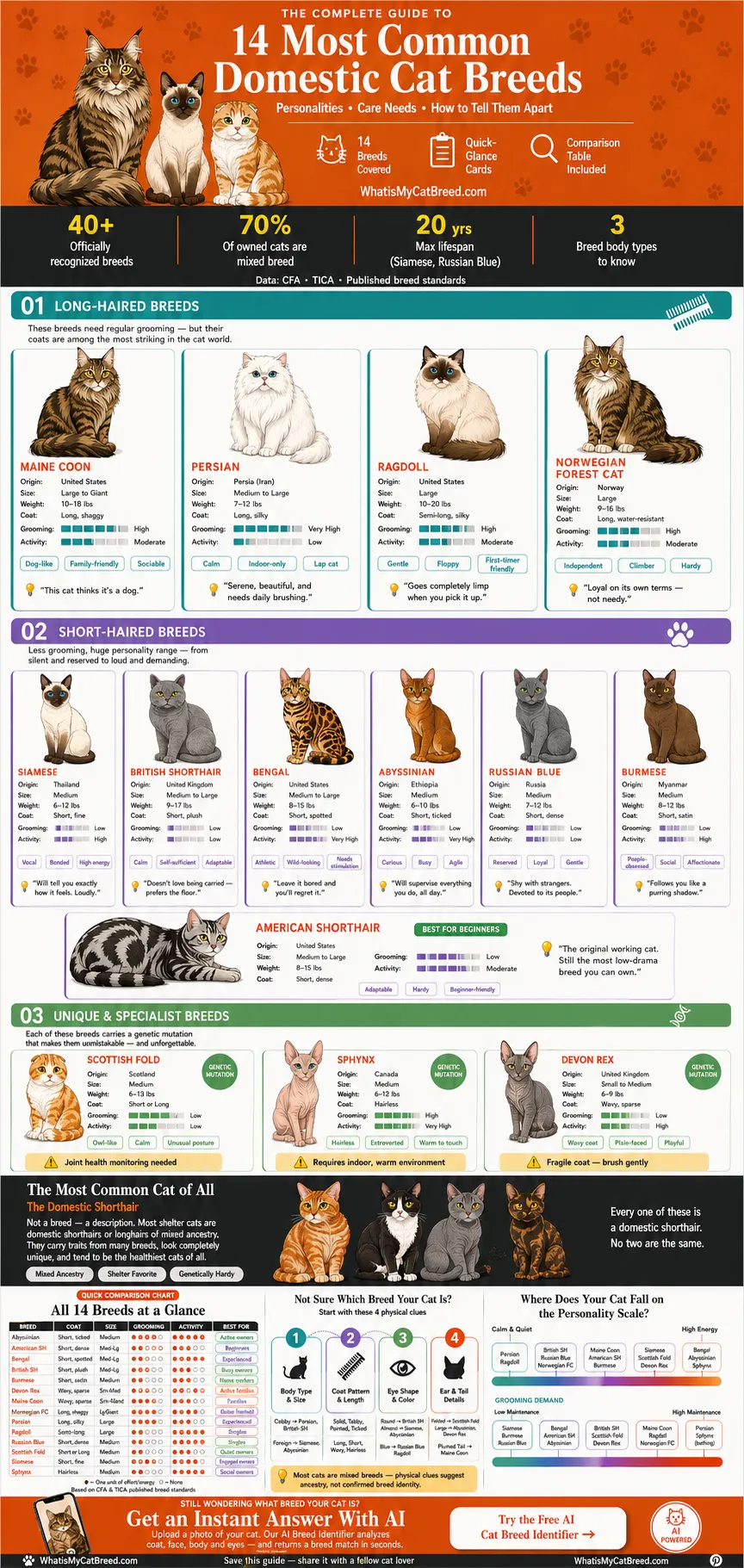
How to Tell Which Breed Your Cat Might Be
The reality is that most cats are mixes. Even if your cat has the spotted coat of a Bengal or the folded ears of a Scottish Fold, that doesn't confirm a breed without documentation or a DNA test. What it does is give you a starting point.
Start with the physical clues. Body type narrows the field quickly — a cobby, round-headed cat points toward British Shorthair or Persian ancestry. A long, lean, angular cat with big ears suggests Siamese or Abyssinian in the background. Coat pattern matters too: pointed coats link to the Siamese family, ticked coats to the Abyssinian, rosettes to the Bengal. Understanding cat breed personality traits can also add a behavioral layer to your identification — behavior isn't conclusive, but it adds meaningful context.
Visual identification alone has limits. A cat can look remarkably like a purebred while being entirely mixed. If you want a definitive answer, DNA testing for cats is the most accurate route available — consumer kits now test against databases of dozens of breeds. And if you're weighing up what a breed designation actually means in practice, our guide to purebred vs mixed breed cats explains the real-world differences. Most of the time, what matters most is the cat in front of you — not the paperwork.
Frequently Asked Questions
What is the most common domestic cat breed?
The most common cat in households worldwide is the domestic shorthair — not a formal breed, but a catch-all description for cats of mixed ancestry with short coats. Among recognized pedigree breeds, the Ragdoll has topped the CFA's popularity rankings in recent years, with the Maine Coon and British Shorthair consistently placing in the top five.
What is the most popular cat breed in the world?
According to CFA registration data, the Ragdoll has held the top spot as the most registered pedigree breed in the United States and several other countries. The Maine Coon, British Shorthair, and Persian are typically the next most popular. Popularity varies by country — the British Shorthair dominates in the UK and parts of Europe, while the Siamese remains historically iconic worldwide.
Are domestic shorthairs a breed?
No. "Domestic shorthair" is a description, not a breed. It refers to any cat of mixed or unknown ancestry that has a short coat. These cats do not have a breed standard and are not registered with organizations like the CFA or TICA. They are the most common cats in shelters and homes worldwide, and they vary enormously in appearance, temperament, and coat type.
What cat breed is best for first-time owners?
The Ragdoll and American Shorthair are two of the most consistently recommended breeds for first-time cat owners. Ragdolls are gentle, low-drama, and tolerant. American Shorthairs are adaptable, healthy, and low-maintenance in temperament. The British Shorthair is another strong choice — calm, quiet, and easy to care for. Any of these breeds rewards a first-time owner without requiring specialized knowledge or experience.
How can I find out what breed my cat is?
Start by observing your cat's physical features — coat type and pattern, body structure, head shape, and eye color. These clues often point toward a breed family even if they don't confirm a specific breed. Try our AI Cat Breed Identifier — upload a photo and get an instant result based on those physical features. For a definitive genetic answer, a feline DNA test is the most reliable option available.