Cat Breed Size Calculator — How Big Will My Cat Get?
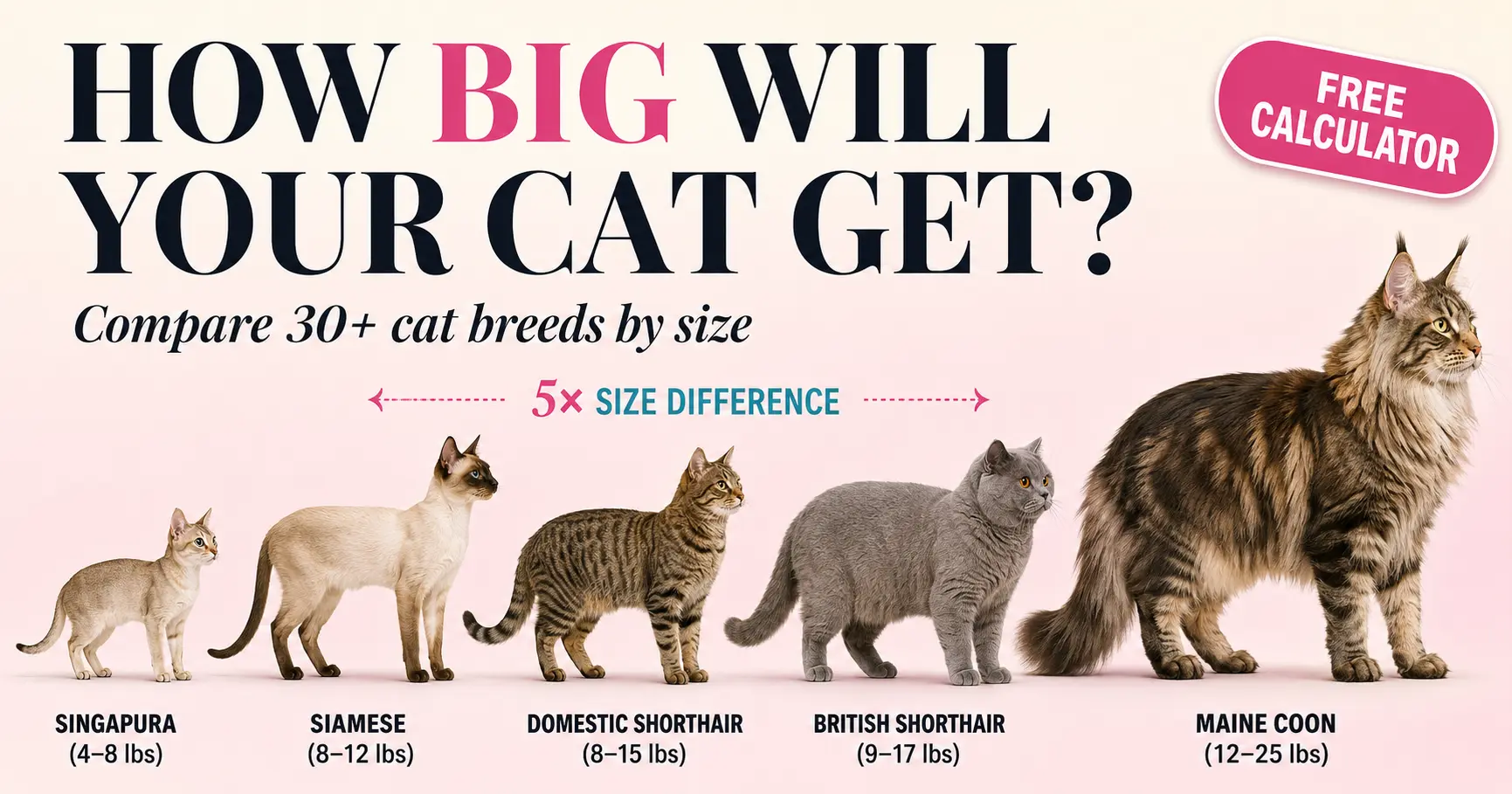
Adult cat size ranges from the diminutive 4-lb Singapura to the 45-inch-long Maine Coon — a fivefold spread within a single species. Breed accounts for the lion's share of that variation. This calculator estimates your cat's adult weight, length, and shoulder height based on breed and sex, and tells you roughly when they'll reach final size.
Cat Breed Size Calculator
Pick the breed and sex to see expected adult size. Add current age and weight for a growth-progress projection.
For mixed breeds, pick the most dominant visible breed or "Domestic Shorthair".
About the data
How to Use the Cat Breed Size Calculator
Under sixty seconds from input to size profile.
- 1
Choose your cat's breed
The dropdown covers 30+ popular breeds with breed-specific size ranges. For mixed-breed cats, pick the dominant breed visible in body type, head shape, or coat. If unsure, our breed identifier or the Domestic Shorthair option both work as fallbacks.
- 2
Select sex
Males average 15-20% heavier than females across most breeds. The gap widens in large breeds — male Maine Coons can outweigh females by 6-8 lbs. Sex is the single most important non-breed predictor.
- 3
Optionally enter current age and weight
Useful for kittens or growing cats. The calculator estimates what percentage of adult size has been reached and projects the remaining months until full growth completes.
- 4
Review the predicted size profile
Results include adult weight range, body length (nose to tail base), shoulder height, body type classification, and the expected age at which growth typically finishes.
The Six Cat Body Types
Cat fanciers and the Cat Fanciers' Association (CFA) classify domestic cats into six body types. Each shapes adult size independently of weight — a "substantial" cat at 10 lbs looks very different from a "foreign" cat at the same weight.
Cobby
Compact, broad-chested, short-legged. Round head, short muzzle. Persian, Exotic Shorthair, British Shorthair, Manx. Heavy-bodied for their length.
Semi-Cobby
Moderately compact, sturdy but not stocky. American Shorthair, Scottish Fold, Burmese. The middle ground of feline body types.
Muscular / Foreign
Athletic, well-muscled, medium-boned. Abyssinian, Russian Blue, Egyptian Mau, Turkish Angora. Built for speed and agility.
Oriental
Slim, long-limbed, fine-boned. Tubular body. Siamese, Oriental Shorthair, Cornish Rex. Lighter than they look because of their length.
Long & Substantial
Large-framed, muscular, often double-coated. Maine Coon, Norwegian Forest Cat, Ragdoll, Siberian. The heavyweights of the cat world.
Semi-Foreign
Athletic but more substantial than pure foreign. Devon Rex, Japanese Bobtail, Tonkinese. Less extreme in proportions.
Read more about how to spot these in our guide to cat body type and breed.
Adult Cat Size Comparison by Breed
Approximate adult ranges based on breed standards from the CFA, TICA (The International Cat Association), and FIFe. Females generally fall in the lower half of the range; males the upper.
| Breed | Weight (lbs) | Length (in) | Body type |
|---|---|---|---|
| Maine Coon | 10–25 | 30–40 | Long & substantial |
| Savannah (F1) | 12–25 | 20–25 (body) | Long & athletic |
| Norwegian Forest | 10–17 | 18–22 (body) | Long & substantial |
| Ragdoll | 10–20 | 17–21 (body) | Long & substantial |
| Siberian | 10–17 | 17–21 (body) | Long & substantial |
| British Shorthair | 9–17 | 22–26 (total) | Cobby |
| Persian | 7–14 | 14–18 (body) | Cobby |
| Bengal | 7–15 | 16–20 (body) | Muscular |
| American Shorthair | 8–15 | 14–18 (body) | Semi-cobby |
| Russian Blue | 7–12 | 15–18 (body) | Muscular / foreign |
| Burmese | 6–12 | 14–18 (body) | Semi-cobby |
| Domestic Shorthair | 6–12 | 15–18 (body) | Variable |
| Abyssinian | 6–10 | 12–16 (body) | Muscular / foreign |
| Scottish Fold | 6–13 | 14–17 (body) | Semi-cobby |
| Sphynx | 6–12 | 14–18 (body) | Muscular / foreign |
| Siamese | 5–12 | 12–16 (body) | Oriental |
| Oriental Shorthair | 5–10 | 12–16 (body) | Oriental |
| Tonkinese | 6–12 | 14–17 (body) | Semi-foreign |
| Devon Rex | 5–9 | 13–16 (body) | Semi-foreign |
| Cornish Rex | 5–9 | 13–16 (body) | Oriental |
| Manx | 8–12 | 13–16 (body, tail-less) | Cobby |
| Japanese Bobtail | 6–10 | 13–16 (body) | Semi-foreign |
| Egyptian Mau | 6–12 | 13–16 (body) | Muscular / foreign |
| Turkish Angora | 5–10 | 13–16 (body) | Muscular / foreign |
| Turkish Van | 10–18 | 14–17 (body) | Long & substantial |
| Birman | 8–14 | 15–18 (body) | Semi-cobby |
| Munchkin | 5–9 | 12–14 (body) | Cobby (short legs) |
| Bombay | 8–11 | 13–16 (body) | Semi-cobby |
| Chartreux | 9–16 | 14–17 (body) | Cobby |
| Singapura | 4–8 | 10–13 (body) | Cobby (smallest) |
Length figures vary in how they're measured. "Total" includes the tail; "body" measures nose to tail base. Maine Coon length records use total-length measurement. See our deeper guide on cat size and weight for measurement methodology.
When Different Cat Breeds Stop Growing
Final adult size is reached at very different ages depending on breed. Small and medium short-haired breeds finish growing roughly by their first birthday. The large slow-maturing breeds continue developing musculature, frame width, and coat density well into adulthood.
What This Calculator Can and Cannot Predict
The calculator gives a probability range based on breed standards. A few important limits to keep in mind:
- Within-breed variation runs 20-30%. Two Maine Coons from the same litter can differ by 5-7 lbs at adulthood.
- Mixed-breed cats are highly variable. The dominant visible breed is a rough guide at best.
- Early nutrition strongly affects final size. Underfed kittens often reach a smaller adult size even with later catch-up feeding.
- The Savannah F1 generation behaves like a wildcat hybrid and is larger than later generations (F2-F5). Pick the F-generation if you know it.
- Polycystic kidney disease, hyperthyroidism, and hepatic shunts can suppress growth — a vet check rules these out.