Cat Age Calculator — Cat Years to Human Years
This cat age calculator converts your cat's chronological age into human-equivalent years. It uses the AAHA-AAFP Feline Life Stage Guidelines — the same framework veterinarians apply when planning preventive care. Enter your cat's age below to see the human-year equivalent, current life stage, and the health priorities matched to that stage.
Cat Age Calculator
Enter your cat's age below. The calculator uses the AAHA-AAFP Feline Life Stage Guidelines.
For a 3-month-old kitten, enter 0 years + 3 months. For a 4-year-old cat, enter 4 years.
View the formula used
Year 2 = +9 more (total 24)
Each year after = +4 human years
Source: AAHA-AAFP Feline Life Stage Guidelines (2010, updated 2021).
How to Use the Cat Age Calculator
The whole process takes under one minute.
- 1
Enter your cat's age in years
Use decimals for kittens — 0.5 means six months, 0.25 means three months. The calculator accepts any value between 0 and 30.
- 2
Pick indoor or outdoor lifestyle
This does not change biological ageing speed, but it adjusts the lifespan projection. Indoor cats live 13-17 years on average; outdoor cats average 3-7 years.
- 3
Read the human-age result
The calculator returns three things: human-equivalent age, current AAHA-AAFP life stage (Kitten, Junior, Adult, Mature, Senior, or Geriatric), and key health concerns for that stage.
- 4
Plan vet visits around the life stage
Cats under 7 years: annual check-ups. Cats 7-10: biannual visits. Cats 10+: biannual visits plus bloodwork screening for kidney disease, hyperthyroidism, and diabetes.
How Cat Years Compare to Human Years
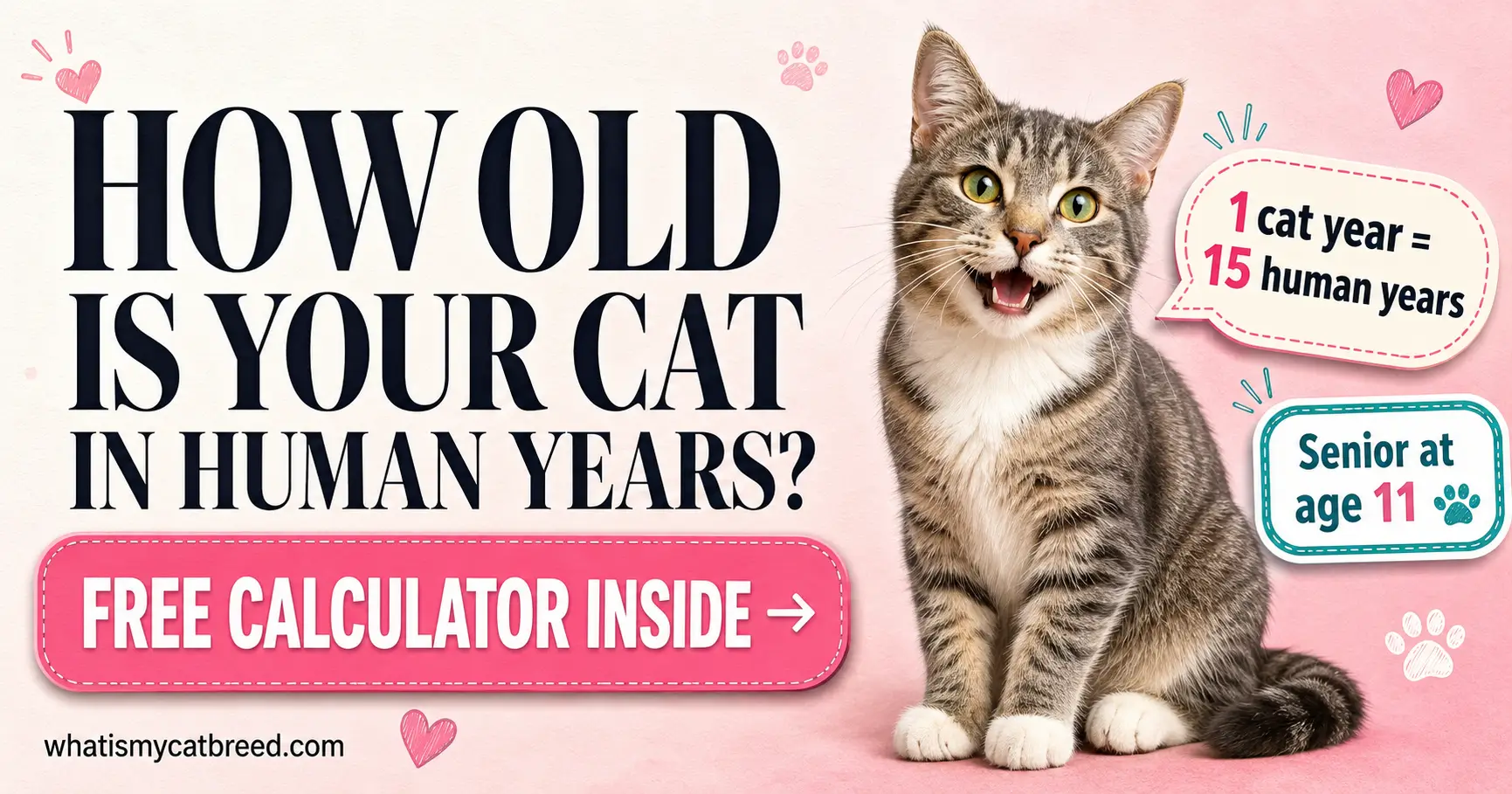
Cats do not age in a straight line. They mature fast at first, then slow down. By the end of year one, a kitten has already gone through changes a human takes 15 years to complete. By age two, the cat matches a 24-year-old human. After that, each cat year roughly equals four human years.
The old "one cat year equals seven human years" rule has no scientific basis. The American Animal Hospital Association (AAHA) and American Association of Feline Practitioners (AAFP) replaced it in 2010 with a stage-based curve. Their joint guidelines, updated in 2021, define six feline life stages tied to physiology, behaviour, and disease risk.
Genetics also affect ageing. A 2014 study in the Journal of Veterinary Internal Medicine found that small, lean breeds — Siamese, Burmese, Russian Blue — outlive larger breeds like Maine Coons by 2-4 years on average. Mixed-breed domestic shorthairs typically reach 15-17 years thanks to hybrid vigour.
For breed-specific lifespan ranges, see our guides on the most common domestic cat breeds and rare cat breeds. The full age-conversion chart from the AAFP Feline Life Stage Guidelines is available online.
Cat Age to Human Age Conversion Chart
The table below shows the AAHA-AAFP conversion at every common age milestone.
| Cat age | Human age | Life stage |
|---|---|---|
| 0–6 months | 0–10 years | Kitten |
| 7–12 months | 12–15 years | Kitten |
| 1 year | 15 years | Junior |
| 2 years | 24 years | Junior |
| 3 years | 28 years | Adult |
| 4 years | 32 years | Adult |
| 5 years | 36 years | Adult |
| 6 years | 40 years | Adult |
| 7 years | 44 years | Mature |
| 8 years | 48 years | Mature |
| 9 years | 52 years | Mature |
| 10 years | 56 years | Mature |
| 11 years | 60 years | Senior |
| 12 years | 64 years | Senior |
| 13 years | 68 years | Senior |
| 14 years | 72 years | Senior |
| 15 years | 76 years | Geriatric |
| 16 years | 80 years | Geriatric |
| 18 years | 88 years | Geriatric |
| 20 years | 96 years | Geriatric |
The Six Feline Life Stages
Kitten
0–1 yearRapid growth, socialisation window (peak 2-7 weeks), permanent teeth erupt by 6 months. Vaccinations: FVRCP and rabies. Spay or neuter typically between 4 and 6 months. A kitten gains roughly 1 lb per month of age until reaching adult weight.
Junior
1–2 yearsSexual maturity reached; physical growth nearly complete. Behaviour stabilises. Transition from kitten food to adult food at around 12 months. First annual vet visit and dental check.
Adult / Prime
3–6 yearsPeak physical condition. Most stable period. Focus on weight management, dental hygiene, and parasite control. Annual veterinary exams plus core vaccine boosters.
Mature
7–10 yearsSubtle ageing begins. Risk of obesity, dental disease, and early kidney changes rises. The AAHA recommends biannual exams from age 7. Baseline bloodwork helps catch hyperthyroidism and chronic kidney disease (CKD) early.
Senior
11–14 yearsEquivalent to 60-72 human years. Higher prevalence of CKD (around 30-40% of cats over 10), hyperthyroidism (10% of cats over 10), diabetes mellitus, osteoarthritis (estimated 90% of cats over 12), and cognitive decline. Twice-yearly vet visits plus annual bloodwork are standard.
Geriatric
15+ yearsCompares to humans 76 and older. Quality-of-life monitoring becomes the priority. Common issues: weight loss, mobility decline, vision and hearing changes, feline cognitive dysfunction syndrome (FCDS — affects roughly 50% of cats over 15). Pain management and hospice planning may apply.
How Long Do Cats Live? The Data
Average feline lifespan depends heavily on lifestyle and breed. The Royal Veterinary College's 2019 VetCompass study analysed 118,016 cats across UK primary-care practice and found a median lifespan of 14.0 years.
- Indoor-only cats: 13–17 years average; many reach 18-20.
- Indoor-outdoor cats: 10–14 years.
- Outdoor-only or feral cats: 3–7 years.
- Burmese & Birman: typically 16–18 years.
- Siamese: 15–20 years; some reach 22+.
- Maine Coon & Ragdoll: 12–15 years.
- Sphynx: 8–14 years (often shorter due to cardiomyopathy risk).
- Persian: 12–17 years, with brachycephaly raising respiratory risk.
The Guinness World Record holder for oldest cat is Creme Puff (1967-2005), who lived 38 years and 3 days in Austin, Texas. Second place goes to Granpa Rex Allen, who reached 34. Both belonged to the same owner, Jake Perry.
When to See a Veterinarian
⚠️ Book a vet visit promptly if you notice any of the following in an ageing cat:
- Increased thirst or urination — early sign of CKD or diabetes
- Unexplained weight loss despite normal appetite — possible hyperthyroidism
- Loss of appetite for more than 24-48 hours — hepatic lipidosis develops fast
- Difficulty jumping or climbing — possible osteoarthritis (affects 90% of cats over 12)
- Disorientation, night-time yowling, or litter-box accidents — signs of feline cognitive dysfunction
- Lumps, persistent vomiting, breathing changes, or hiding behaviour
Cats hide illness well. By the time symptoms show, disease is often advanced. Schedule biannual check-ups from age 7 and annual bloodwork from age 10 to catch problems early.